 Vertex Learn
Living things: plants, animals and fungi
What this lesson covers
- Every living thing is called an organism
- The big groups: plants, animals, fungi and bacteria
- Plants such as grasses, ferns and trees
- Animal groups: fish, amphibians, reptiles, birds, insects and mammals
- Why fungi are not plants, and why we never touch them
- Doing a survey and showing what we found
What is an organism?
- A living thing is called an organism.
- Organisms grow, need food and water, and make more of their own kind.
- A tūī is an organism. So is a pōhutukawa tree.
- A rock is not alive. It does not grow or eat.
Big groups of living things
- There are many kinds of organisms.
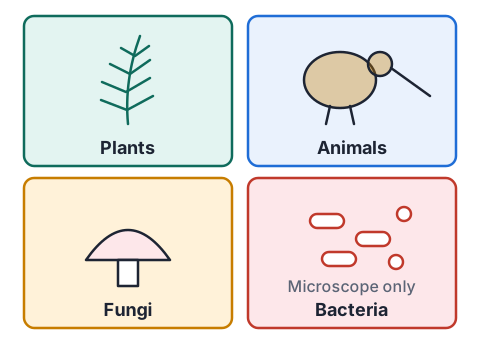
- Four big groups are plants, animals, fungi and bacteria.
- Bacteria are so tiny that you need a microscope to see them.
Plants come in many shapes
- Grasses are thin and grow close to the ground.
- Ferns have long leaves called fronds. A new frond is curled up, and this curl is called a koru.
- Trees are tall, with a hard woody trunk, like a kauri.
- Most plants are green.
Groups of animals
- Animals can be put into groups by what their bodies are like.
| Group | Look for | New Zealand example |
|---|---|---|
| Fish | Fins and scales, lives in water | Snapper |
| Amphibians | Smooth, damp skin | A native frog |
| Reptiles | Dry, scaly skin | Tuatara, gecko |
| Birds | Feathers and a beak | Kiwi, tūī |
| Insects | Six legs | Wētā, bee |
| Mammals | Hair or fur, babies drink milk | Native bat, people |
Try it: which animal group?
Fungi are not plants
- Mushrooms and toadstools are fungi.
- Fungi are not green, and they cannot make food from sunlight like plants do.
- They feed on dead leaves and old wood, and help break them down.
- Many fungi are poisonous. Never touch or eat a mushroom you find outside.
Which group?
- Put each one in a group: a kererū, a wētā, a mushroom and a fern.
- Kererū: feathers and a beak, so a birdlook for feathers
- Wētā: six legs, so an insectcount the legs
- Mushroom: not green, grows on dead wood, so a fungusnot a plant
- Fern: green fronds, so a plantgreen leaves
- Bird, insect, fungus, plant
Try it: plant, animal or fungus?
A survey in the school garden
- Room 4 looked for living things in their school garden for 10 minutes.
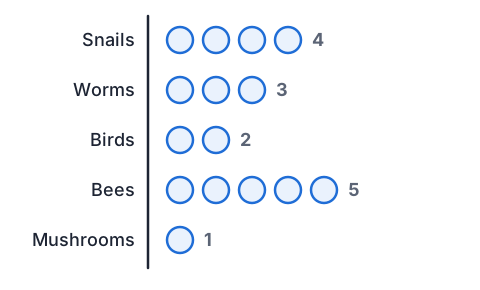
- They made a tally, then a picture graph.
- You can also find out about living things from books, a school journal, or pūrākau (traditional Māori stories) shared by your whānau.
| Living thing | Tally | Total |
|---|---|---|
| Snails | |||| | 4 |
| Worms | ||| | 3 |
| Birds | || | 2 |
| Bees | |||| | | 5 |
| Mushrooms | | | 1 |
Try it: turn the tally into a graph
Drawing what you see
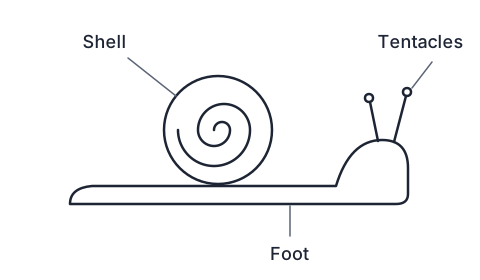
- A science drawing uses clear lines and no colouring in.
- Draw it big, and draw only what you can see.
- Add labels, with a straight line from each word to its part.
Common mistakes
- A mushroom is a plant because it grows in the ground.A mushroom is a fungus; it is not green and cannot make its own food from sunlight.
- A bat is a bird because it flies.A bat has fur and feeds its babies milk, so it is a mammal.
- A frog is a reptile.A frog has smooth, damp skin, so it is an amphibian; reptiles like geckos have dry, scaly skin.
A living things survey
You need: paper, a pencil, a clock or timer, a garden, park or school field
- Go outside with an adult and choose a small patch to look at.
- Look carefully for 10 minutes: on the ground, on plants and in the air.
- Make a tally mark each time you see a living thing.
- Count the tallies and draw a picture graph.
- Look for this: which living thing did you see most? Which group is it in?
Safety: Go with an adult, look but do not touch mushrooms, spiders, bees or wasps, and wash your hands when you come inside.
Your turn
1
Is a rock an organism?
2
A wētā has six legs. Which group is it in?
3
Which group is a mushroom in?
4
In Room 4's survey, which living thing did they see most?
5
A native bat has fur and feeds its babies milk. Which group is it in?
Show answer
1. No, because it is not alive. 2. Insects. 3. Fungi. 4. Bees, 5 of them. 5. Mammals.
Recap
- Every living thing is an organism.
- Plants, animals, fungi and bacteria are big groups of organisms.
- Plants include grasses, ferns and trees.
- Animals include fish, amphibians, reptiles, birds, insects and mammals.
- Mushrooms are fungi, not plants. Never touch them.
- A survey, a tally and a picture graph show what lives near you.
The maths behind it
Report a mistake
How is Year 1 maths going?
See the Year 1 maths guide