 Vertex Learn
Objects and the materials they are made of
What this lesson covers
- An object is a thing; a material is what it is made of
- Wood, metal, plastic, glass, fabric and rock are common materials
- Some objects use one material and some join several together
- Words for how materials look and feel
- Using our senses to find out about a material
- Sorting materials into groups
Objects and materials
- An object is a thing you can see and touch, like a cup or a chair.
- A material is what the object is made of.
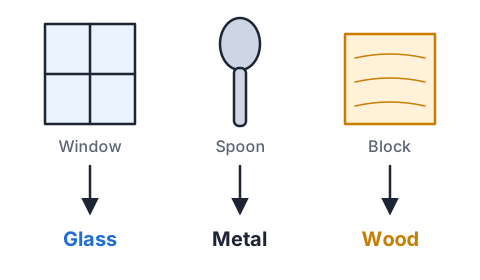
- A spoon can be made of metal. A toy block can be made of wood.
- Wood, metal, plastic, glass, fabric and rock are all materials.
One material or more than one
- Some objects are made of just one material. A glass marble is all glass.
- Other objects join different materials together.
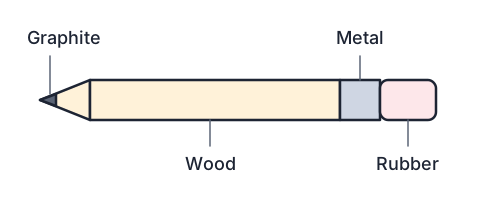
- A pencil has a wood outside and a grey middle called graphite. Some pencils also have a metal band and a rubber end.
- A school bag can have fabric, plastic clips and a metal zip.
Use your senses
- Your senses help you find out about a material.
- Look at it. What colour and shape is it?
- Touch it. Is it rough or smooth? Is it hard or soft?
- Bend it gently. Does it bend, or stay stiff?
- Tap it and listen. Wood makes a dull knock. Metal can ring.
- Never taste a material to test it.
Words for materials
- Scientists use clear words to say what a material is like.
- Something that bends without breaking is called flexible.
| Word | It means | Example |
|---|---|---|
| Smooth | No bumps | Glass |
| Rough | Bumpy | Rock, tree bark |
| Hard | Does not squash when you press it | Metal |
| Soft | Squashes when you press it | Wool, a sponge |
| Flexible | Bends without breaking | Rubber, fabric |
| Stiff | Does not bend | A wooden block |
Try it: bends or stays stiff?
Describing a material
- Mia holds a glass marble. What can she say about the glass?
- Look: it is round and you can see through iteyes
- Touch: it is smooth and hardhands
- Bend: it does not bend at allgentle hands
- Glass is smooth, hard and stiff
Sorting into groups
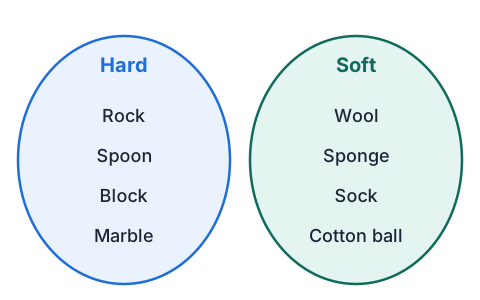
- Room 3 found 8 objects and sorted them by one thing: hard or soft.
- Hard: a rock, a metal spoon, a wooden block and a glass marble.
- Soft: wool, a sponge, a sock and a cotton ball.
- They could sort the same objects again another way, such as flexible or stiff.
Try it: hard or soft?
Common mistakes
- The object and the material are the same thing.The object is the thing, like a chair; the material is what it is made of, like wood.
- A clear plastic cup is made of glass because it looks the same.Some plastic looks like glass, but plastic is lighter and bends a little, while glass is stiff and can break.
- Every object is made of only one material.Many objects join materials, like a pencil made of wood and graphite.
A material hunt at home
You need: a metal spoon, a sock, a wooden peg or block, a plastic lid, a stone from the garden
- Put the five objects on a table.
- Feel each one. Say if it is smooth or rough, and hard or soft.
- Try to bend each one gently with your hands.
- Make two piles: the ones that bend, and the ones that stay stiff.
- Look for this: the sock bends, but the spoon, the peg and the stone stay stiff.
Safety: Ask an adult to help pick the objects, and leave out anything sharp, made of glass, or small enough to fit in your mouth.
Your turn
1
What material is a window made of?
2
A jersey is soft and flexible. Is it made of fabric or rock?
3
Which is harder: a metal spoon or a wool sock?
4
A pencil is made of wood and graphite. Is that one material or more than one?
5
A stone and a jersey. Which one bends?
Show answer
1. Glass. 2. Fabric. 3. The metal spoon. 4. More than one material. 5. The jersey bends; the stone stays stiff.
Recap
- An object is a thing. A material is what it is made of.
- Wood, metal, plastic, glass, fabric and rock are materials.
- Some objects use one material; some join several.
- We look, touch, bend and listen to find out what a material is like.
- We can sort materials into groups, like hard and soft.
The maths behind it
Report a mistake
How is Year 1 maths going?
See the Year 1 maths guide