 Vertex Learn
Breathing, moving and sensing
What this lesson covers
- Muscles move your body by pulling
- A muscle gets shorter to pull, then relaxes
- Breathing in: muscles lift your ribs out and air comes in
- Breathing out: the muscles relax, your ribs move in and air goes out
- Your sense organs pick up light, sound, smells, touch and heat, and your brain works out what they mean
- Testing what each sense organ can pick up
Muscles pull
- Muscles are the parts of your body that make it move.
- A muscle can only pull. To pull, it gets shorter and fatter. This is called contracting.
- When a muscle stops pulling, it relaxes and gets longer again.
- Muscles are joined to bones, so when a muscle pulls, a bone moves.
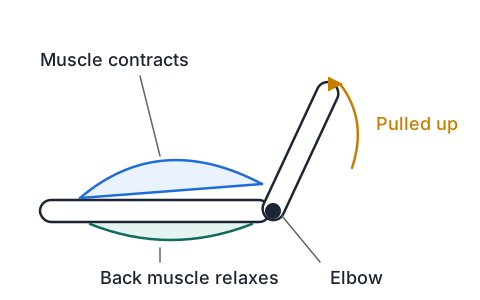
Bend your arm
- Hold your left hand on the front of your right upper arm. Slowly bend your right elbow, then straighten it. What do the muscles do?
- Bending: the front muscle gets shorter and harderit contracts
- It pulls the lower arm upa muscle pulls a bone
- Straightening: the front muscle relaxes, and a muscle at the back pulls insteadmuscles cannot push
- One muscle pulls to bend the arm; another pulls to straighten it
How you breathe
- Your lungs are inside your chest, behind your ribs.
- To breathe in, muscles contract and lift your ribs up and out. Your chest gets bigger, and air rushes in through your nose or mouth.
- To breathe out, the muscles relax. Your ribs drop back in, your chest gets smaller, and air is pushed out.
- Put your hands on your ribs and take a deep breath. Feel them move out, then in.
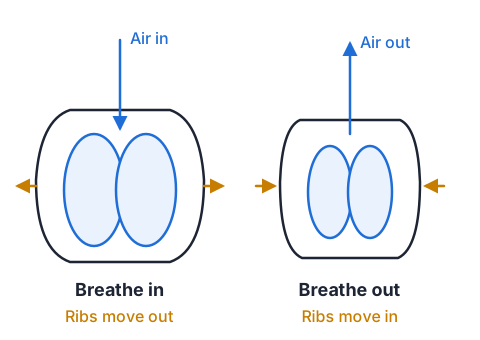
Try it: breathing in or out?
Your senses
- Your senses tell your brain what is around you.
- Each sense organ picks up something different and sends a message to your brain.
- Your brain works out what the message means: bright, loud, smelly, hot or soft.
| Sense organ | Sense | It picks up |
|---|---|---|
| Eyes | Sight | Light and colour |
| Ears | Hearing | Sound |
| Nose | Smell | Strong and faint smells |
| Tongue | Taste | Sweet, salty, sour and bitter |
| Skin | Touch | Light and hard touch, hot and cold |
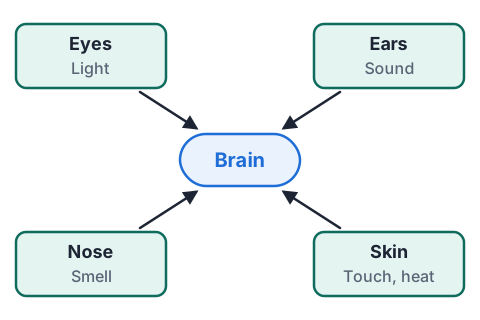
Try it: which sense organ?
Strong and faint smells
- Room 9 put 1 drop of vanilla on one cotton ball and 5 drops on another. Ten children each sniffed both from an arm's length away.
| Cotton ball | Children who smelled it |
|---|---|
| 1 drop | 2 of 10 |
| 5 drops | 9 of 10 |
- 1 drop: 2 of 10 children smelled ita faint smell
- 5 drops: 9 of 10 children smelled ita strong smell
- A stronger smell is easier for the nose to pick up, but people's noses differ
Try it: who smelled the vanilla?
Touch, hot and cold
- Your skin can feel a light touch, like a feather, and a hard press, like a push.
- It can also feel hot and cold.
- Your fingertips and lips feel touch better than your back does.
Common mistakes
- Muscles push bones to move them.Muscles can only pull; to move a bone back, another muscle pulls the other way.
- When I breathe in, the air goes into my stomach.Air goes down into your lungs; your tummy moves because the muscles under your lungs move.
- My eyes do all the seeing by themselves.Your eyes pick up light, but your brain works out what you are looking at.
The three bowls test
You need: 3 bowls, cold tap water, warm tap water, a clock or timer
- Fill one bowl with cold tap water, one with warm tap water, and the middle bowl with a mix of the two.
- Put one hand in the cold bowl and the other hand in the warm bowl.
- Keep them there while you count slowly to 60.
- Now put both hands into the middle bowl together.
- Look for this: the same water feels warm to one hand and cool to the other, because your skin compares it with what it felt before.
Safety: Ask an adult to run the warm water and test it with their own hand first, so it is warm and not hot enough to scald.
Your turn
1
When a muscle contracts, does it get shorter or longer?
2
When you breathe in, do your ribs move in or out?
3
Which sense organ picks up a smell?
4
Which part of your body works out what your senses pick up?
5
In Room 9's test, how many children smelled the 5-drop cotton ball?
Show answer
1. Shorter, and fatter. 2. Out. 3. The nose. 4. The brain. 5. 9 of 10 children.
Recap
- Muscles pull on bones to move them; they contract to pull and relax to stop.
- Breathing in, muscles lift your ribs out and air comes into your lungs.
- Breathing out, the muscles relax, your ribs move in and air goes out.
- Eyes, ears, nose, tongue and skin pick up what is around you.
- Your brain works out what your senses are telling it.
The maths behind it
Report a mistake
How is Year 2 maths going?
See the Year 2 maths guide