 Vertex Learn
Life cycles: from egg or seed to adult
What this lesson covers
- Each kind of living thing has its own life cycle
- Animals are born or hatch, grow up and have young
- Plants grow from seeds, grow up and make new seeds
- Young look like their parents, but not exactly the same
- Every living thing dies in the end
- Comparing life cycles and drawing them with arrows
What is a life cycle?
- A life cycle is the set of stages a living thing goes through, from the start of its life until it has young of its own.
- The young grow up and have young too, so the cycle goes round again.
- Every living thing dies in the end, but its young carry the cycle on.
A monarch butterfly
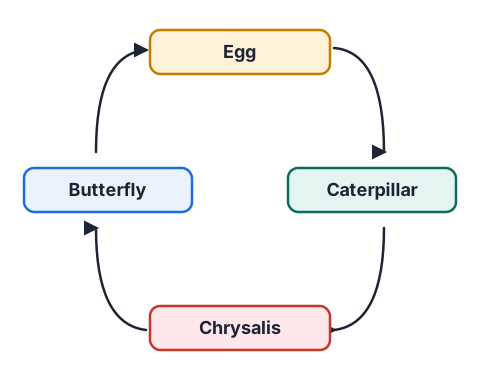
- A monarch butterfly lays tiny eggs on a swan plant.
- Each egg hatches into a caterpillar, which eats swan plant leaves and grows fast.
- The caterpillar makes a hard case called a chrysalis and changes inside it.
- An adult butterfly comes out, and later lays eggs of its own.
A frog
- Frogs in garden ponds lay eggs covered in jelly, called spawn.
- The eggs hatch into tadpoles, which swim and have tails.
- Tadpoles grow legs and lose their tails, and become frogs.
Born or hatched
- Some animals hatch from eggs, like chickens, kiwi and fish.
- Other animals are born, like humans, dogs and sheep.
- A baby grows into a child, then an adult, who can have babies of their own.
Try it: hatched or born?
A broad bean plant
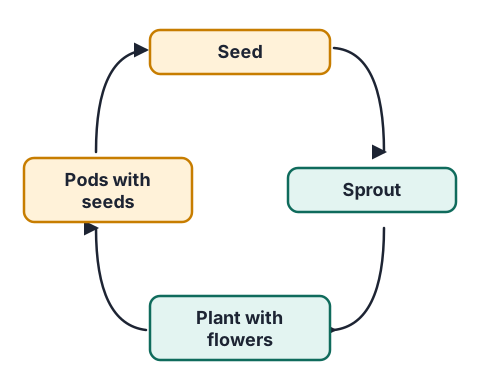
- A plant starts as a seed.
- With water and warmth, the seed sprouts a root, then a shoot.
- The young plant grows leaves, then flowers.
- The flowers turn into pods with new seeds inside.
- A kōwhai tree makes seeds in pods too, and new kōwhai trees grow from them.
Butterfly and chicken
- How are the life cycles of a monarch butterfly and a chicken the same, and how are they different?
| Stage | Monarch butterfly | Chicken |
|---|---|---|
| Start | Egg | Egg |
| Young | Caterpillar, looks nothing like the adult | Chick, looks like a small hen |
| Changing | Chrysalis | Grows bigger and gets feathers |
| Adult | Butterfly | Hen or rooster |
- Same: both start as eggs and grow into adults that lay eggscompare starts and ends
- Different: the caterpillar changes its whole shape; the chick just growscompare the young
- Both are life cycles, but a butterfly changes shape and a chicken does not
Try it: butterfly, chicken or both?
Like their parents, but not the same
- The young of a plant or animal are called its offspring.
- Offspring look like their parents. A lamb looks like a sheep, not a dog.
- But they are not exactly the same. Puppies from one litter can have different colours.
Room 6's broad beans
- Room 6 planted broad bean seeds in pots and wrote down what they saw.
| Day | What we saw |
|---|---|
| Day 1 | Planted the seeds |
| Day 10 | A shoot came up through the soil |
| Day 21 | The plant had 4 leaves |
| Day 60 | White and black flowers |
| Day 80 | Green pods with seeds inside |
- Seed, then shoot, then leaves, then flowers, then podsthe order of stages
- The new seeds in the pods can start the cycle again
Common mistakes
- A caterpillar is a different animal from a butterfly.A caterpillar is a young butterfly; it changes shape inside the chrysalis.
- Babies look exactly the same as their parents.Offspring look like their parents, but each one is a little different.
- Plants do not have a life cycle because they do not move.Plants grow from seeds, grow up, make new seeds and die, so they have a life cycle too.
Grow a bean in a jar
You need: a clear jar, paper towels, 2 or 3 dried beans, water
- Line the inside of the jar with damp paper towels.
- Push the beans between the paper towel and the glass so you can see them.
- Keep the paper towel damp, and look at the beans every day for 2 weeks.
- Draw the beans every 2 days, with labels.
- Look for this: a root grows first and points down, then a shoot grows up.
Safety: Ask an adult to handle the glass jar, and never eat the dried beans, because some raw beans are poisonous until they are cooked.
Your turn
1
Put these in order: butterfly, egg, chrysalis, caterpillar.
2
Does a kiwi chick hatch from an egg, or is it born?
3
What grows first from a bean seed: a root or a shoot?
4
Is a lamb exactly the same as its mother?
5
In Room 6's beans, on which day did the shoot first come up?
Show answer
1. Egg, caterpillar, chrysalis, butterfly. 2. It hatches from an egg. 3. A root. 4. No, it looks like her but is not exactly the same. 5. Day 10.
Recap
- A life cycle is the stages of life, from the start to having young.
- Animals are born or hatch from eggs, grow up and have young.
- Plants grow from seeds, grow up, flower and make new seeds.
- Young look like their parents, but each one is a little different.
- All living things die in the end, and their young carry on the cycle.
- Arrows in a loop show a life cycle.
The maths behind it
Report a mistake
How is Year 2 maths going?
See the Year 2 maths guide