 Vertex Learn
Food chains: who eats what, starting with a plant
What this lesson covers
- Plants make their own food from sunlight, water and carbon dioxide
- Every food chain starts with a plant
- Food passes along a chain when one living thing eats another
- The arrows in a food chain point to the eater
- Living things in a food chain depend on each other
- A change to one living thing changes the others too
Plants make their own food
- Animals have to eat. Plants do not.
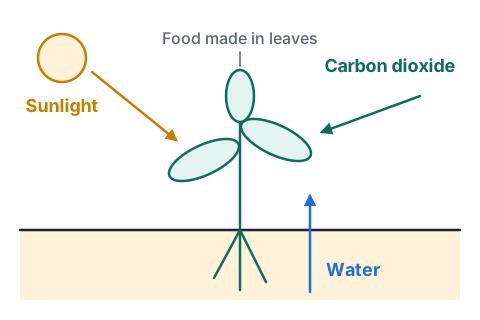
- Plants make their own food.
- They use sunlight, water from the soil, and a gas from the air called carbon dioxide.
- The food is made in the leaves.
What a food chain shows
- A food chain shows who eats what.
- It always starts with a plant, because plants make food.
- Here is one: grass → rabbit → hawk.
- The food, and the energy in it, passes along the chain from one living thing to the next.
Which way the arrows go
- The arrow means 'is eaten by'.
- It points to the eater.
- In leaf → caterpillar → bird, the caterpillar eats the leaf, and the bird eats the caterpillar.
Example: a food chain in the bush
- In the New Zealand bush, tree wētā come out at night to eat leaves.
- Ruru, also called moreporks, catch and eat wētā.
- Write the food chain.
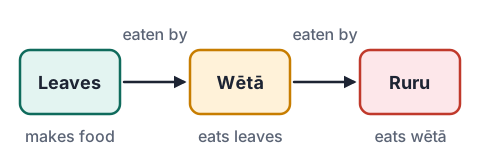
- Start with the plant: leaves
- Leaves are eaten by wētā: leaves → wētā
- Wētā are eaten by ruru
- leaves → wētā → ruru
Example: a food chain in the sea
- Kina are spiky sea animals that eat kelp, a big seaweed. Big snapper eat kina.
- Put these in a food chain: snapper, kelp, kina.
- Kelp is the plant, so it goes firstit makes its own food
- Kina eat kelp: kelp → kina
- kelp → kina → snapper
Try it: where in the chain?
Living things need each other
- In a food chain, each living thing needs the one before it for food.
- So if one changes, the others change too.
- If the rabbits got sick and died, the hawks would have less food.
- If the hawks were gone, there would be more rabbits, and they would eat more grass.
Try it: change a forest food web
Example: what if the snapper go?
- People catch lots of snapper in one bay. Use the chain kelp → kina → snapper.
- What happens to the kelp?
- Fewer snapper eat kina
- So more kina are left alive
- More kina eat more kelp
- The kelp gets eaten away, so there is less of it
Common mistakes
- In grass → rabbit, the arrow means the grass eats the rabbit.The arrow points to the eater: the grass is eaten by the rabbit.
- A food chain can start with any animal.Every food chain starts with a plant, because only plants make their own food.
- Plants get their food from the soil.Plants make their own food from sunlight, water and carbon dioxide; the soil gives them water.
Make a hanging food chain
You need: 4 pieces of card, coloured pencils, a long piece of string or wool, sticky tape, scissors
- Go into the garden or a park with an adult. Find a plant and look for animals near it, such as a snail, a slater or a bird.
- Draw the plant on one card and one animal on each of the other cards.
- Tape the cards onto the string in order, with the plant at the top.
- Draw an arrow on each card pointing down to the next one, the eater.
- Check your chain: does it start with a plant, and does every arrow point to the eater?
Safety: Do not touch or pick up wild animals, and wash your hands after being in the garden.
Your turn
1
What three things does a plant use to make its food?
2
Put these in a food chain: hawk, grass, rabbit.
3
In leaf → caterpillar → thrush, what eats the caterpillar?
4
What is always at the start of a food chain?
5
In grass → rabbit → hawk, the rabbits get sick and die. What happens to the hawks?
Show answer
1. Sunlight, water and carbon dioxide. 2. grass → rabbit → hawk. 3. The thrush. 4. A plant. 5. The hawks have less food, so there will be fewer hawks.
Recap
- Plants make food from sunlight, water and carbon dioxide.
- A food chain shows who eats what, and it starts with a plant.
- The arrow means 'is eaten by' and points to the eater.
- Food and its energy pass along the chain.
- Living things in a chain need each other, so a change to one changes the rest.
Report a mistake
How is Year 3 maths going?
See the Year 3 maths guide