 Vertex Learn
Materials: bendy, stretchy, hard, snappy and soaking
What this lesson covers
- Flexible materials bend and twist easily, most of all when they are thin
- Elastic materials stretch and then spring back to their first shape
- Rigid materials are hard to bend, and brittle ones snap or shatter
- Absorbent materials soak up water; waterproof ones keep it out
- Measuring how far a material stretches
- Choosing the right material for a job
What is a property?
- A material is what a thing is made of.
- Wood, plastic, glass, wool and paper are all materials.
- A property is what a material is like.
- Does it bend? Does it stretch? Does it snap? Does it soak up water?
- We find out by testing it.
Flexible: it bends
- A flexible material bends or twists without breaking.
- Paper, cloth, tinfoil and a plastic straw are flexible.
- Thin things bend more easily than thick things.
- One sheet of paper bends easily. A thick pile of paper does not.
Elastic: it stretches and springs back
- An elastic material stretches when you pull it.
- When you let go, it goes back to its first shape.
- A rubber band, a hair tie and a balloon are elastic.
- Play dough stretches too, but it stays stretched. So play dough is not elastic.
Rigid and brittle
- A rigid material is hard to bend, stretch or break.
- A wooden table leg and a metal spoon are rigid.
- A brittle material does not bend. It snaps or shatters when you bend it or hit it.
- A dry cracker, an eggshell and a glass cup are brittle.
- Rigid and brittle are not the same. A metal spoon is rigid, but it does not shatter when you drop it.
Try it: which property fits best?
Soaks it up or keeps it out
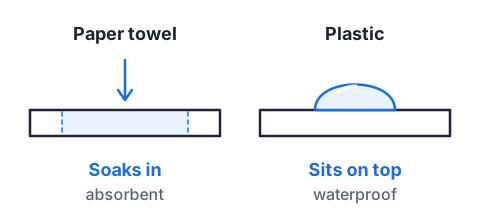
- An absorbent material soaks up water. A paper towel, a sponge and a cotton sock are absorbent.
- A waterproof material keeps water out. A plastic bag, a raincoat and a gumboot are waterproof.
- To test, put a drop of water on it.
- If the drop sinks in, the material is absorbent. If the drop sits on top, it is waterproof.
Try it: absorbent or waterproof?
Example: how far does it stretch?
- Room 5 hung the same bag of marbles on three things. They measured each one before and with the bag.
- How far did each one stretch?
| Thing | Before | With the bag |
|---|---|---|
| Rubber band | 8 cm | 12 cm |
| Hair tie | 6 cm | 9 cm |
| String | 10 cm | 10 cm |
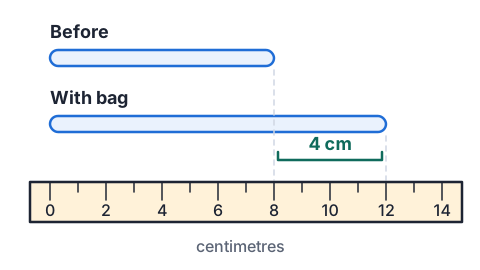
- Rubber band: 12 cm − 8 cm = 4 cmnew length take away first length
- Hair tie: 9 cm − 6 cm = 3 cm
- String: 10 cm − 10 cm = 0 cmstring does not stretch
- The rubber band stretched the most, 4 cm
- With the bag off, the band went back to 8 cm, so it is elastic
Example: the best material for a raincoat
- A raincoat must keep rain out, and it must bend when you move your arms.
- Which is best: paper towel, wool or plastic?
- Paper towel is absorbent, so the rain would soak in
- Wool is flexible, but it soaks up water
- Plastic is flexible and waterproof
Common mistakes
- Play dough is elastic because it stretches.Elastic things go back to their shape when you let go; play dough stays stretched, so it is not elastic.
- Hard things are always brittle.Brittle things snap or shatter. A metal spoon is hard and rigid, but it does not shatter.
- The band reached 12 cm on the ruler, so it stretched 12 cm.The stretch is the new length take away the first length: 12 cm take away 8 cm is 4 cm.
The drip test
You need: a paper towel, a piece of plastic bag, an old cotton sock, a piece of tinfoil, a cup of water, a teaspoon, a tray
- Lay the four materials flat on the tray.
- Guess which ones will soak up water. Say your guess out loud.
- Put one teaspoon of water on each material.
- Count slowly to 20, then lift each one and look underneath.
- Look for where the water went. On absorbent materials it soaks in and spreads. On waterproof ones it sits on top in a round drop.
Safety: Ask an adult to help, and wipe up any spilled water straight away so nobody slips on the wet floor.
Your turn
A hair tie is 6 cm long. When it is stretched it is 10 cm long. How far did it stretch?
You bend a dry cracker and it snaps. Is it flexible or brittle?
Which is best for a bath mat: plastic, a towel or glass?
A balloon is blown up, then let down. It goes back to small. Is it elastic?
Why is a gumboot made of rubber and not cloth?
Show answer
1. 4 cm, because 10 − 6 = 4. 2. Brittle, because it snaps when you bend it. 3. A towel, because it is absorbent and soaks up the drips. 4. Yes, it is elastic, because it goes back to its shape. 5. Rubber is waterproof and bends when you walk; cloth soaks up water.
Recap
- Flexible materials bend; thin ones bend most easily.
- Elastic materials stretch and spring back.
- Rigid materials are hard to bend; brittle ones snap or shatter.
- Absorbent materials soak up water; waterproof ones keep it out.
- To find a stretch, take the first length away from the new length.
- Pick a material for a job by its properties.
The maths behind it
Report a mistake
How is Year 3 maths going?
See the Year 3 maths guide