 Vertex Learn
Light: where it comes from, what it does, and shadows
What this lesson covers
- Light comes from a light source and travels out from it
- Light can bounce off, bend, or be soaked up when it hits things
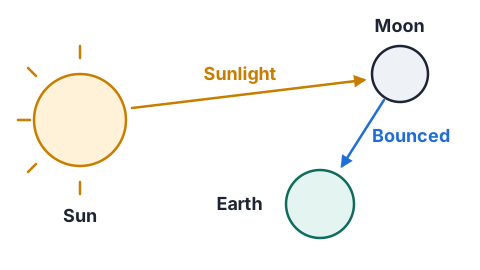
- The Sun makes light; the Moon only bounces back sunlight
- Things look smaller when they are further away
- Transparent, translucent and opaque materials, and where colour comes from
- How moving the light changes a shadow's length and direction
Where light comes from
- A light source makes its own light.
- The Sun, a torch, a lamp and a fire are light sources.
- Light goes out from the source in straight lines.
- We see a thing when light from it goes into our eyes.
The Moon is not a light source
- The Moon does not make any light.
- Sunlight hits the Moon and bounces off it.
- That bounced light reaches our eyes, so the Moon looks bright.
- A bike reflector works the same way. It only shines when a light hits it.
When light hits something
- Light can bounce off a thing. This is called reflection. A mirror reflects light very well.
- Light can bend when it goes into water or glass. This is called refraction. A straw in a glass of water looks broken.
- Light can be soaked up. This is called absorption. A black T-shirt soaks up lots of light, so it gets hot in the sun.
See-through or not?
- Transparent things let most light through. You can see clearly through them, like a clean window.
- Translucent things let some light through. Things look blurry, like through baking paper.
- Opaque things let no light through, like wood, card or your hand.
- Opaque things bounce back some light and soak up the rest.
- The light they bounce back gives them their colour. A red apple bounces back red light.
| Group | Light through | Examples |
|---|---|---|
| Transparent | Most | Window glass, clear plastic, water |
| Translucent | Some | Baking paper, tissue paper, frosted glass |
| Opaque | None | Wood, cardboard, a book, your hand |
Try it: why things have colours
Example: sorting with a torch
- Room 8 shone a torch at four things, one at a time, and looked at the wall behind.
- Sort each thing into a group.
| Thing | On the wall |
|---|---|
| Clear drink bottle | Bright light |
| Baking paper | A dim glow |
| Wooden ruler | A dark shadow |
| Plastic sandwich bag | Bright light |
- Bright light means most light got throughtransparent
- A dim glow means some light got throughtranslucent
- A dark shadow means no light got throughopaque
- Bottle and sandwich bag: transparent. Baking paper: translucent. Ruler: opaque
Try it: how much light gets through?
Shadows
- A shadow forms when an opaque thing blocks the light.
- The shadow is on the side away from the light.
- When the light is low, the shadow is long.
- When the light is high, the shadow is short.
- Move the light to the left and the shadow moves to the right.
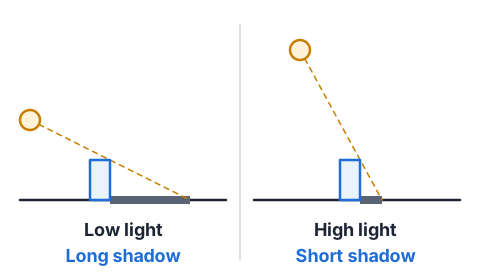
Example: a fence post's shadow through the day
- The Sun moves across the sky in the day. What happens to the shadow of a fence post?
- Morning: the Sun is low in the east, so the shadow is long and points west
- Midday: the Sun is high in the sky, so the shadow is short
- Evening: the Sun is low in the west, so the shadow is long and points east
- The shadow is long, then short, then long, and always points away from the Sun
Far away looks small
- Things look smaller when they are further away.
- A plane high in the sky looks tiny, but it is really huge.
- Hold up your thumb. It can hide a whole car at the end of the street.
- The car has not shrunk. It just takes up less of what you can see.
Common mistakes
- The Moon makes its own light, like the Sun.The Moon only bounces back light from the Sun; the Sun is the light source.
- Translucent means you can see clearly through it.Translucent lets only some light through, so things look blurry; transparent is the one you see clearly through.
- A shadow is longest when the light is high above.A high light makes a short shadow; a low light makes a long one.
Make a shadow grow and shrink
You need: a torch, a small toy, a wall or a big sheet of paper, a table, a room you can make dark
- Stand the toy on the table, close to the wall.
- Make the room dark. Hold the torch low, near the table top, and shine it at the toy. Look at the shadow on the wall.
- Now hold the torch high, above the toy, and shine it down. Look at the shadow again.
- Move the torch to the left side of the toy, then to the right side.
- Look for this: a low torch makes a long shadow, a high torch makes a short one, and the shadow is always on the side away from the torch.
Safety: Never shine the torch into anyone's eyes, and ask an adult to stay with you so nobody trips in the dark room.
Your turn
Is a torch a light source?
Is baking paper transparent, translucent or opaque?
Why can we see the Moon at night?
A torch moves from high above a toy to low down. Does the shadow get longer or shorter?
A cup looks blue. Which colour of light does it bounce back?
A boat far out at sea looks tiny. Is it really tiny?
Show answer
1. Yes, it makes its own light. 2. Translucent, because it lets some light through. 3. The Moon bounces sunlight back to Earth. 4. Longer, because a low light makes a long shadow. 5. Blue light. 6. No. It looks small because it is far away.
Recap
- A light source makes its own light. The Sun is one; the Moon is not.
- Light can bounce off (reflect), bend (refract) or be soaked up (absorb).
- Transparent lets most light through, translucent some, opaque none.
- An opaque thing's colour is the light it bounces back.
- Low light makes long shadows; high light makes short ones.
- Far-away things look smaller than they are.
The maths behind it
Report a mistake
How is Year 3 maths going?
See the Year 3 maths guide