 Vertex Learn
Pushes and pulls: what makes things move, stop and turn
What this lesson covers
- A push or a pull happens between two things
- A still object only starts to move when it is pushed or pulled
- Pushes and pulls can start, stop, speed up, slow down or turn a moving thing
- A bigger push or pull makes a bigger change
- Pushes and pulls can change a thing's shape
- Shape, rough or smooth surfaces, air and water all change how things move
Pushes and pulls
- A push moves a thing away from you. A pull moves it towards you.
- Kicking a ball is a push. Opening a drawer is a pull.
- A push or a pull always happens between two things: the one doing it and the one it acts on.
- Scientists call a push or a pull a force.
Still things stay still
- A ball sitting on the grass will not move by itself.
- It starts to move only when something pushes or pulls it.
- That could be a foot, a hand, the wind or a dog's nose.
What a push or pull can do
- A push or a pull can start a thing moving.
- It can stop a moving thing, like a goalkeeper catching a ball.
- It can make a thing go faster or slower.
- It can make a thing change direction, like a bat hitting a ball.
- It can change a thing's shape, like squashing a ball of play dough.
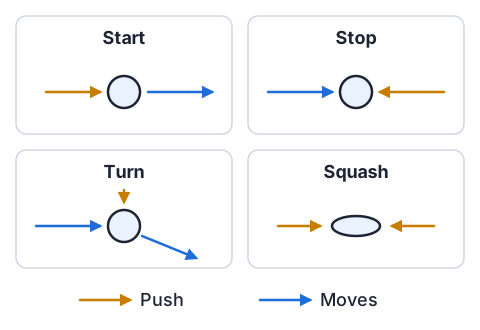
Try it: what did the push or pull do?
Bigger push, bigger change
- A gentle push makes a ball roll slowly, and only a little way.
- A hard push makes it roll fast and far.
- A bigger push or pull makes a bigger change in how a thing moves.
Pushes can change shape
- Squash play dough and it stays flat.
- Squeeze a sponge and it springs back when you let go.
- Push hard on a brick and nothing seems to change.
- What happens depends on what the thing is made of.
Rough, smooth, air and water
- A toy car rolls a long way on a smooth floor. On carpet it slows down and stops quickly.
- Rough surfaces rub more on things moving over them. This rubbing is called friction.
- Air and water push back on things that move through them.
- A thing's shape matters too. A boat with a pointed front moves through water more easily than a flat box.
Example: one car, three surfaces
- Room 3 let the same toy car roll down the same ramp onto three surfaces. They did each surface three times, and the results were close each time.
- Which surface let the car roll furthest, and why?
| Surface | How far it rolled |
|---|---|
| Wood floor | 210 cm |
| Concrete path | 145 cm |
| Carpet | 60 cm |
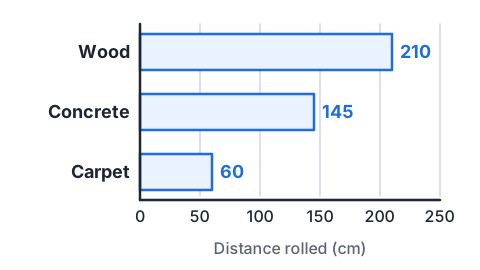
- Same car, same ramp, only the surface changeda fair test
- Wood floor 210 cm is the longest; carpet 60 cm is the shortest
- The smooth wood floor let the car roll furthest. Rough carpet rubbed it most, so it stopped soonest
- The three tries were close, so the pattern is real
Try it: far or short roll?
Example: flat paper or a paper ball?
- Two sheets of the same paper are dropped from the same height. One is flat. One is scrunched into a ball.
- Which lands first?
- Both are the same paper, so only the shape is different
- The flat sheet has to push lots of air out of the way, so it floats down slowly
- The ball pushes only a little air, so it falls fast
- The paper ball lands first, because of its shape
Common mistakes
- A rolling ball stops because it runs out of push.It stops because the ground and the air rub against it; on a smoother surface it rolls further.
- We can change the car and the surface at the same time to test the surface.Change only one thing at a time, or you cannot tell which change made the difference.
- A soft push and a hard push do the same thing.A harder push makes a bigger change, so the ball goes faster and further.
Roll test on different floors
You need: a toy car, a big hardcover book or a flat board, a pile of 3 books, a tape measure, a towel
- Lean the big book on the pile of books to make a ramp on a hard floor.
- Hold the car at the top of the ramp and let it go. Do not push it.
- Measure how far it rolled from the bottom of the ramp. Do it three times.
- Lay the towel flat at the bottom of the ramp and do the same three times.
- Look for this: the car rolls further on the smooth floor than on the rough towel, every time.
Safety: Set up the ramp where nobody is walking, and put the books away afterwards so nobody trips over them.
Your turn
You open a door by pulling the handle towards you. Is that a push or a pull?
A ball is sitting still on the floor. What will make it start to move?
Ana kicks a ball gently, then kicks it hard. Which kick sends it further?
Where would a marble roll furthest: on sand, on grass, or on a kitchen floor?
You squeeze a sponge and let go. What happens to its shape?
Show answer
1. A pull, because the door comes towards you. 2. A push or a pull. 3. The hard kick, because a bigger push makes a bigger change. 4. The kitchen floor, because it is the smoothest. 5. It springs back to its first shape.
Forces and Motion: Basics
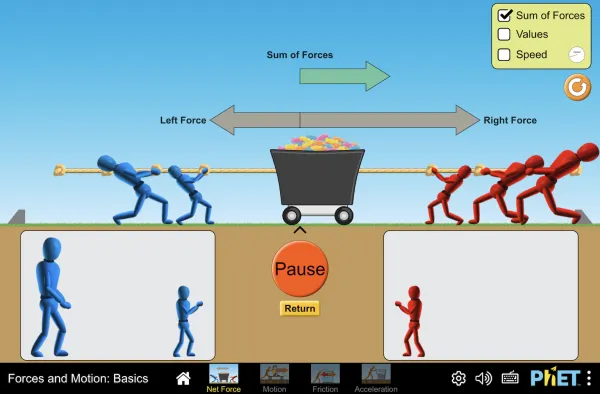
Full screen · PhET Interactive Simulations, University of Colorado Boulder, CC BY 4.0
Recap
- A push or a pull is a force between two things.
- Still things only start moving when they are pushed or pulled.
- Pushes and pulls can start, stop, speed up, slow down or turn things, and change their shape.
- A bigger push makes a bigger change.
- Rough surfaces, air and water slow things down; shape matters too.
- In a test, change only one thing at a time.
The maths behind it
Report a mistake
How is Year 3 maths going?
See the Year 3 maths guide