 Vertex Learn
Flowers, fruits and seeds, and how seeds travel
What this lesson covers
- Some living things have many young at a time; others have only a few
- Some plants can grow a new plant from a piece of themselves
- Flowers are where pollination and fertilisation happen, so seeds can form
- After fertilisation a fruit grows from the flower and holds the seeds
- Seeds store food, need water to sprout, and have parts that help them spread
- Sorting seeds by how they are spread
Lots of young, or just a few
- Some living things have lots of young. A mouse can have a litter of many babies, several times a year.
- The wētāpunga, our giant wētā, lays lots of eggs.
- Others have only a few young and look after them for a long time.
- People usually have one baby at a time. A kiwi lays just one or two very big eggs.
New plants from a piece
- Some plants can make a new plant without seeds.
- Plant a piece of potato that has an 'eye' (a bud), and a new potato plant grows from it.
- Put a cut stem of mint in a glass of water, and it grows roots.
- A plant grown from a piece is the same as the parent plant.
Pollination and fertilisation
- Flowers are the parts of a plant made for reproduction.
- Pollination is when pollen moves from an anther to a stigma. Bees, birds, wind and other animals carry it.
- Tūī and korimako (bellbirds) carry pollen between harakeke (flax) and kōwhai flowers while they drink nectar.
- Fertilisation comes next. Inside the flower, the pollen joins with an egg cell in the ovary. Now a seed can form.
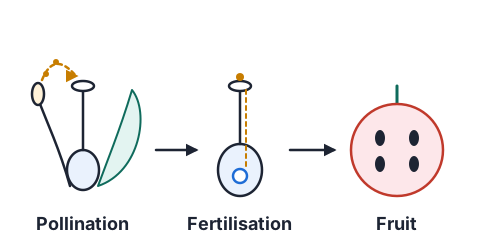
From flower to fruit
- After fertilisation, the petals fall off and the ovary grows into a fruit.
- The fruit holds and protects the seeds.
- In science, a fruit is any part that grows from a flower and holds seeds. So tomatoes, capsicums and pumpkins are fruits too.
Try it: pollination, fertilisation or fruit?
What is inside a seed
- A seed has a tough coat, a tiny baby plant, and a store of food.
- A dry seed waits. When it gets water, it swells up and germinates.
- The stored food feeds the young plant until its leaves can make food from sunlight.
Spreading seeds
- Young plants need their own light, water and space, so seeds must get away from the parent plant. Spreading seeds is called dispersal.
- Wings or fluff: the wind carries them, like dandelion and thistle seeds.
- Hooks: they catch on fur, feathers or socks, like bidibids.
- Fleshy fruit: animals eat it and drop the seeds far away in their droppings. Kererū spread the big seeds of taraire and tawa.
- Pods that burst: gorse pods dry out, pop open and flick their seeds away.
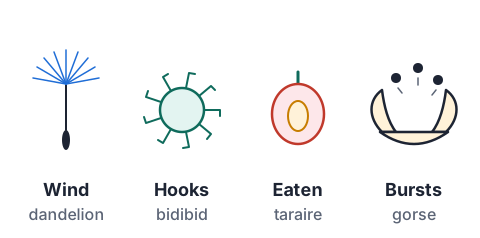
Example: how does each seed travel?
- Look at the structure of each seed or fruit, then decide how it is spread.
| Seed or fruit | Structure | Spread by |
|---|---|---|
| Maple seed | A flat wing | Wind |
| Bidibid | Tiny hooks | Animals' fur |
| Blackberry | Juicy flesh | Animals eating it |
| Coconut | Light, air-filled husk | Floating on water |
- A wing or fluff catches the airwind
- Hooks grab onto furanimals carry it
- Sweet flesh is foodanimals eat it
- Maple: wind. Bidibid: fur. Blackberry: eaten. Coconut: water
Try it: how does each seed travel?
Common mistakes
- Pollination and fertilisation are the same thing.Pollination moves pollen to the stigma; fertilisation happens after, when pollen joins an egg cell in the ovary.
- Fruits are only sweet things like apples and oranges.Any part grown from a flower that holds seeds is a fruit, so tomatoes and pumpkins count.
- A seed needs soil to start growing.A seed needs water to germinate; its stored food feeds it at first, so it can sprout on a wet paper towel.
Sprout seeds without soil
You need: 8 dried beans or chickpeas from the pantry, paper towels, 2 clear jars, water, a ruler, a pen and paper
- Fold a paper towel into each jar so it lines the side. Wet the towel in the first jar. Leave the second one dry.
- Push 4 beans between the towel and the glass in each jar, so you can see them.
- Keep the first towel damp. Put both jars on a windowsill.
- Each day for 5 days, look at the beans and measure any roots. Write it down.
- Look for this: only the wet beans germinate. They grow roots and shoots with no soil, using the food stored inside the seed.
Safety: Raw dried beans can make you sick, so do not eat them, and wash your hands after handling them.
Your turn
1
Which usually has more young at a time: a mouse or a kiwi?
2
How can you grow a new potato plant without a seed?
3
What is it called when pollen moves from an anther to a stigma?
4
Which part of a flower grows into the fruit?
5
A seed is covered in tiny hooks. How is it spread?
6
What does a seed need first, to germinate?
Show answer
1. A mouse. 2. Plant a piece of potato that has an eye. 3. Pollination. 4. The ovary. 5. By catching on animals' fur or feathers. 6. Water.
Recap
- Some living things have many young; others have a few and care for them.
- Some plants can grow from a piece, like a potato eye or a stem cutting.
- Pollination moves pollen to the stigma; fertilisation in the ovary starts a seed.
- The ovary grows into a fruit that holds the seeds.
- Seeds store food and need water to germinate.
- Wings, hooks, fleshy fruit and bursting pods help seeds spread.
Report a mistake
How is Year 4 maths going?
See the Year 4 maths guide