 Vertex Learn
Skeletons, shells and stems: how living things are held up
What this lesson covers
- Vertebrates have a backbone; invertebrates do not
- Most animals are small invertebrates, and water holds up some sea animals
- Skeletons and muscles work together to protect organs and to move
- The human skeleton: skull, ribcage, spine, pelvis, and arms and legs built on one pattern
- Exoskeletons, shells, and soft bodies with no hard skeleton
- How trunks and stems hold plants up
Backbone or no backbone
- A vertebrate is an animal with a backbone, also called a spine. The backbone is a chain of small bones called vertebrae.
- Fish, frogs, reptiles, birds and mammals are vertebrates.
- An invertebrate is an animal with no backbone. Insects, spiders, worms, snails and jellyfish are invertebrates.
- Most kinds of animals on Earth are invertebrates, and most of them are small.
Try it: backbone or not?
Held up by water
- Some sea invertebrates have soft bodies that the water holds up.
- A jellyfish floats open and wide in the sea.
- Washed up on the beach, with no water around it, it slumps into a flat blob.
Skeletons and muscles work together
- A vertebrate's skeleton is inside its body. It is an internal skeleton.
- It holds the body up, protects soft organs, and gives muscles something to pull on.
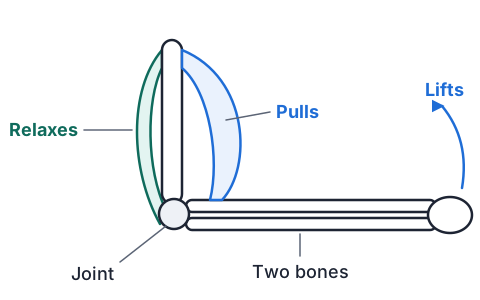
- Muscles are joined to bones. A muscle can only pull, by getting shorter.
- So muscles work in pairs. To bend your arm, the front muscle pulls while the back one relaxes. To straighten it, they swap.
Your skeleton
- Your skull protects your brain.
- Your ribcage protects your heart and lungs.
- Your spine holds you upright and protects the spinal cord, the main nerve running down your back.
- Your pelvis holds up your body and joins your legs to it.
Example: arms and legs share a pattern
- Compare the bones of your arm and your leg, from the top down. What pattern do they share?
| Part | Arm | Leg |
|---|---|---|
| Top | Upper arm: 1 bone | Thigh: 1 bone |
| Middle | Forearm: 2 bones | Lower leg: 2 bones |
| Joint | Wrist: small bones | Ankle: small bones |
| End | Hand: 5 fingers | Foot: 5 toes |
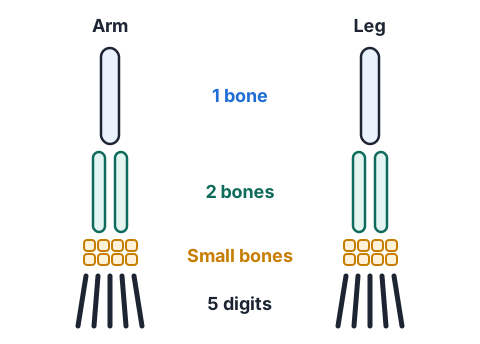
- Arm: 1 bone, then 2 bones, then small bones, then 5 fingers
- Leg: 1 bone, then 2 bones, then small bones, then 5 toes
- Both follow the same pattern: 1 bone, 2 bones, small bones, then 5 digits
Skeletons on the outside, or none
- Some invertebrates have a hard skeleton on the outside, called an exoskeleton. Wētā, beetles and crabs have one.
- An exoskeleton protects the animal like armour, and its muscles pull on it from the inside.
- An exoskeleton cannot grow. A growing wētā sheds its old one and grows a bigger one. This is called moulting.
- Snails and pāua grow a shell that gets bigger as they do.
- Slugs, worms and jellyfish have no hard skeleton at all.
Example: sort by skeleton
- Sort these animals by whether they have a backbone, and what kind of support they have.
| Animal | Backbone? | Support |
|---|---|---|
| Kererū | Yes | Internal skeleton |
| Tuna (eel) | Yes | Internal skeleton |
| Wētā | No | Exoskeleton |
| Pāua | No | Shell |
| Slug | No | No hard skeleton |
| Jellyfish | No | Held up by water |
- Backbone means vertebrate: kererū and tuna
- No backbone means invertebrate: wētā, pāua, slug, jellyfish
- Vertebrates have internal skeletons; invertebrates have exoskeletons, shells, or no hard skeleton
Try it: what holds it up?
How plants stand up
- Plants have no bones, but they still need support.
- Woody plants have stiff wood in their trunks and branches, so they can grow very tall, like kauri and tōtara.
- Non-woody plants have soft, green stems. They stay small or lean on other plants.
- Water inside a soft stem pushes outwards and keeps it firm. Without enough water, the stem droops.
Common mistakes
- Insects and spiders have backbones.Insects and spiders are invertebrates with no backbone; their support is an exoskeleton on the outside.
- Muscles push bones to move them.Muscles can only pull, so they work in pairs: one pulls to bend a joint and the other pulls to straighten it.
- A wētā's skeleton grows with it, like ours.An exoskeleton cannot grow, so a wētā moults: it sheds the old one and grows a bigger one.
The floppy stem test
You need: 2 sticks of celery with leaves, 2 glasses, water, a ruler
- Put one celery stick in a glass of water. Put the other in an empty glass.
- Leave them both for one day.
- Hold each stick flat by its bottom end, over the table. Measure how far the leafy end droops down.
- Now put the floppy stick in water too, and test it again after a few hours.
- Look for this: the stick with water stays firm and straight, and the dry one droops. Water inside a soft stem is what holds it up.
Safety: Ask an adult before taking celery from the kitchen, and put the glasses where they will not get knocked over.
Your turn
1
A tuatara has a backbone. Is it a vertebrate or an invertebrate?
2
Which part of your skeleton protects your brain?
3
How many bones are in your forearm?
4
What kind of skeleton does a crab have?
5
Why does a jellyfish slump on the beach?
6
Why can a kauri grow much taller than a daisy?
Show answer
1. A vertebrate. 2. The skull. 3. 2 bones. 4. An exoskeleton. 5. There is no water to hold its soft body up. 6. Its trunk is made of stiff wood, which can hold up a tall plant.
Recap
- Vertebrates have a backbone; invertebrates do not, and most animals are invertebrates.
- Internal skeletons hold up, protect and, with muscles, move the body.
- Muscles only pull, so they work in pairs.
- Arms and legs share one pattern: 1 bone, 2 bones, small bones, 5 digits.
- Some invertebrates have exoskeletons or shells; some have no hard skeleton.
- Wood holds up tall plants; water keeps soft stems firm.
Report a mistake
How is Year 4 maths going?
See the Year 4 maths guide