 Vertex Learn
Digestion, part 2: absorbing nutrients and getting rid of waste
What this lesson covers
- How nutrients pass from the small intestine into the blood
- What the body uses nutrients for
- The helpful bacteria that live in the gut
- How the large intestine takes water back into the body
- How waste is stored in the rectum and leaves through the anus
Where part 1 finished
- In part 1, teeth, saliva, the stomach and enzymes broke food down. By the end of the small intestine, much of it has become nutrients: tiny pieces such as sugars and the building blocks of proteins and fats.
- Absorb means to soak up or take in. Absorption is the next big job.
- Nutrients are only useful once they are absorbed into your blood, because blood carries them to every part of your body.
Into the blood: the small intestine
- Most nutrients are absorbed in the small intestine.
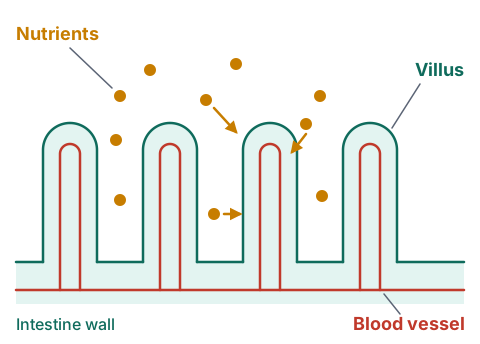
- Its inside wall is covered in millions of tiny finger-shaped bumps called villi (say "vil-eye"). One of them is called a villus.
- The villi give the wall a huge surface, so lots of nutrients can be absorbed at once.
- Each villus has a very thin wall with tiny blood vessels just underneath. Nutrients pass through the thin wall into the blood, and the blood carries them away.
Example: why a bumpy surface soaks up more
- Room 5 cut two strips the same size: one from a smooth cotton cloth and one from a looped bath towel. They dipped each in water, let it drip for 10 seconds, then squeezed it into a measuring cylinder.
- What do the results show, and how does this link to villi?
| Strip | Water held (mL) |
|---|---|
| Smooth cloth | 8 |
| Looped towel | 21 |
- Same size strips, same dipping and drippinga fair test
- The looped towel held 21 mL, the smooth cloth 8 mLmore than double
- The loops give the towel much more surface to hold waterthe reason
- A bumpy surface soaks up more, just as villi let the small intestine absorb more nutrients
What your body does with nutrients
- Blood carries nutrients to all your cells. A cell is one of the tiny living units your body is made of.
- Your body uses nutrients to stay alive, to move, to keep warm, and to grow and repair itself.
| Nutrient | Found in | Used for |
|---|---|---|
| Sugars and starch | Bread, rice, kūmara, fruit | Energy to move, think and keep warm |
| Proteins | Meat, fish, eggs, beans, milk | Growing and repairing muscles and skin |
| Fats | Butter, nuts, avocado | Stored energy and keeping warm |
| Vitamins and minerals | Fruit, vegetables, milk | Keeping bones, blood and skin healthy |
Try it: which nutrient?
Helpful bacteria in your gut
- Bacteria are microorganisms: living things too small to see without a microscope.
- Huge numbers of bacteria live in your digestive system, most of them in the large intestine. Many of them are helpful.
- They break down some parts of food that your own enzymes cannot, such as some of the fibre in vegetables, fruit and wholegrain bread.
- Helpful bacteria also make some vitamins and help keep harmful germs from taking over. Eating plenty of fibre feeds them.
The large intestine takes back water
- What cannot be absorbed in the small intestine moves on into the large intestine. This leftover material is mostly water, fibre and bacteria.
- The large intestine is wider than the small intestine but much shorter.
- Its main job is to absorb water back into the body, so the leftovers slowly become firmer.
- If too little water is taken back, the result is runny poo, called diarrhoea. If the waste moves too slowly and too much water is taken back, it becomes hard, called constipation. Drinking water and eating fibre help keep things moving.
Storing waste and getting rid of it
- The solid waste left at the end is called faeces, or poo.
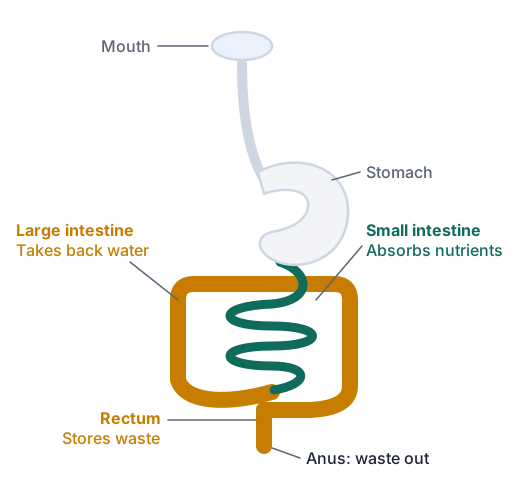
- It is stored in the rectum, the last short section of the large intestine, until you go to the toilet.
- Getting rid of waste from the body is called excretion. Faeces leave the body through the anus, a ring of muscle at the end of the tube that you can control.
Example: following an apple
- Ella eats an apple. Describe what happens to it in each part of her digestive system, from the mouth to the anus.
| Part | What happens to the apple |
|---|---|
| Mouth | Chewed into small pieces and wetted with saliva |
| Oesophagus | Squeezed down to the stomach |
| Stomach | Churned with acid into a soupy mush |
| Small intestine | Enzymes finish breaking it down; sugars are absorbed into the blood |
| Large intestine | Bacteria break down some fibre; water is taken back |
| Rectum and anus | Leftover fibre and waste are stored, then leave the body |
- Sugars from the apple end up in Ella's bloodabsorbed in the small intestine
- Most of the skin's fibre is not absorbedher enzymes cannot break it down
- The apple's sugars feed Ella's body; its leftover fibre and water go on to the large intestine, and the waste leaves through the anus
Try it: where does it happen?
Common mistakes
- Food goes straight from the stomach into the blood.Most nutrients are absorbed through the villi of the small intestine, after the food has been fully broken down.
- All the bacteria in your gut are harmful germs.Many gut bacteria are helpful: they break down some fibre, make some vitamins and help keep harmful germs out.
- The large intestine is longer than the small intestine.The large intestine is wider but much shorter; the small intestine is the longest part.
- The large intestine absorbs most of the nutrients.The small intestine absorbs most nutrients; the large intestine's main job is taking back water.
Which cloth soaks up more?
You need: a face cloth (looped towel), a smooth tea towel, scissors, a bowl of water, a measuring jug, a timer
- With an adult, cut or fold the face cloth and the tea towel so you have two pieces the same size.
- Dip the face cloth piece in the bowl until it is soaked, lift it out and let it drip for 10 seconds.
- Squeeze it over the measuring jug and read how many millilitres came out. Empty the jug.
- Do the same with the tea towel piece.
- Look for this: the looped face cloth usually holds more water, because its loops give it more surface, just as villi give the small intestine more surface to absorb nutrients.
Safety: Ask an adult before cutting any cloth and use only scissors, and mop up spilt water straight away so nobody slips.
Your turn
In which part of the digestive system are most nutrients absorbed?
What is the job of the villi?
What is the main job of the large intestine?
Give one way that helpful bacteria in your gut help you.
Where is waste stored before it leaves the body?
Show answer
1. The small intestine. 2. They give the small intestine a huge surface, so nutrients can pass quickly into the blood. 3. To absorb water back into the body. 4. They break down some fibre that your enzymes cannot (they also make some vitamins and help keep harmful germs out). 5. In the rectum, until it leaves through the anus.
Recap
- Nutrients are absorbed through the villi of the small intestine into the blood.
- The blood carries nutrients to cells, which use them to stay alive, move and grow.
- Helpful gut bacteria break down some fibre, make some vitamins and help keep harmful germs out.
- The large intestine absorbs water from what is left.
- Waste is stored in the rectum and leaves the body through the anus.
Report a mistake
How is Year 5 maths going?
See the Year 5 maths guide