 Vertex Learn
Digestion, part 1: from your mouth to your small intestine
What this lesson covers
- What digestion is, and the difference between mechanical and chemical digestion
- How teeth and saliva start digestion in the mouth
- Enzymes, the chemicals your body makes to break food down
- How food travels down the oesophagus to the stomach
- How churning and acid in the stomach help break food down
- How the small intestine finishes turning food into nutrients
- Making a model of the digestive system that shows what each part does
What is digestion?
- Nutrients are the useful substances in food that your body needs, such as sugars, proteins, fats and vitamins.
- Most food is made of pieces far too big to get into your blood. Digestion is the process of breaking food down into pieces small enough for your body to take in.
- Mechanical digestion breaks food into smaller lumps by force, like chewing or squeezing. The food is still the same stuff, just in smaller bits.
- Chemical digestion uses chemicals to change food into different, much smaller substances. For example, starch in bread is changed into sugar.
The digestive system
- An organ is a part of the body with a special job, like the heart or the stomach.
- The digestive system is the group of organs that food passes through, joined together as one long tube from your mouth to your bottom.
- In this lesson you follow food through the first four parts: the mouth, the oesophagus, the stomach and the small intestine.
- Part 2 follows what happens next, in the large intestine and the rectum.
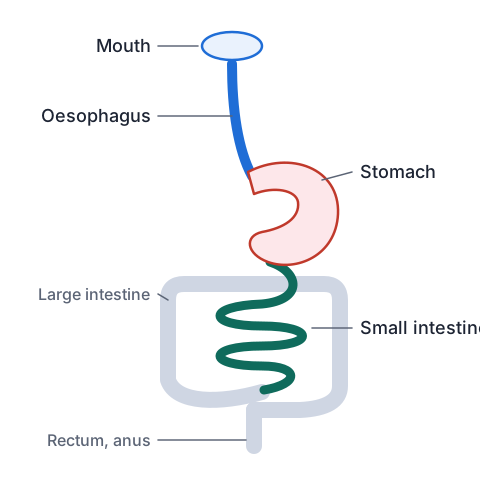
Try it: follow food through the gut
The mouth: teeth and saliva
- Digestion starts the moment you take a bite.
- Your teeth do mechanical digestion. Incisors at the front cut, canines grip and tear, and molars at the back grind food into a mush.
- Saliva (spit) wets the food so it is easy to swallow. It also contains a chemical that starts chemical digestion, changing starch into sugar.
- Your tongue mixes the food with saliva and rolls it into a soft ball, ready to swallow.
| Teeth | Where | Job |
|---|---|---|
| Incisors | Front | Cut and bite |
| Canines | Beside the incisors, pointed | Grip and tear |
| Molars | Back, wide and flat | Crush and grind |
Enzymes: the body's chemical scissors
- A molecule is a tiny particle of a substance, far too small to see.
- Many food molecules are long chains, like a string of beads. Starch is a long chain of sugar molecules.
- Digestive enzymes are chemicals made by your body that cut these chains into small pieces, like scissors snipping a string of beads.
- Each kind of enzyme works on one kind of food. One works on starch, another on proteins, and another on fats.
- Enzymes are not alive. They are chemicals, and they are not used up, so the same enzyme can cut chain after chain.
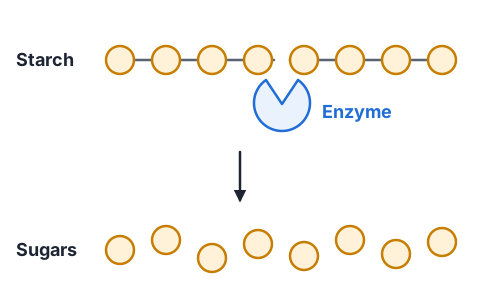
Example: why chewed bread tastes sweet
- Aroha chews a piece of plain white bread for a whole minute without swallowing. It starts to taste a little sweet.
- Explain why, using the words starch, enzyme and sugar.
- Bread is mostly starchstarch does not taste sweet
- Saliva contains an enzyme that cuts starchchemical digestion in the mouth
- Starch is cut into sugar, which tastes sweetthe product of the enzyme
- The enzyme in Aroha's saliva changed some of the starch into sugar
Swallowing: the oesophagus
- The oesophagus (say "ee-soff-a-gus") is the tube that carries food from your throat to your stomach.
- Food does not just fall down it. Rings of muscle in its wall squeeze one after another, pushing the food along in a wave.
- That is why you can still swallow when you are lying down, or even upside down.
- When you swallow, a small flap covers your windpipe so food goes down the oesophagus and not into your lungs.
The stomach
- The stomach is a stretchy, muscly bag. It can hold a whole meal.
- Its muscles churn the food, squeezing and mixing it. This is mechanical digestion.
- The stomach also makes a strong acid. The acid kills many germs in the food and helps an enzyme break down proteins, from foods like meat, eggs and beans.
- After a few hours of churning, the food has become a thick, soupy liquid, and it is squirted a little at a time into the small intestine.
Try it: mechanical or chemical?
The small intestine
- The small intestine is a long, narrow tube, folded and coiled up to fit inside your belly.
- It is called small because it is thin, not because it is short. It is the longest part of the digestive system.
- Here more enzymes are added to the food. Together they finish breaking down starch, proteins and fats.
- By the end of this stage the food has been turned into nutrients that are small enough for your body to take in. Part 2 shows how they get into your blood.
Example: a model digestive system
- Room 15 built a model to show how the parts link to their jobs. A model is a simple copy of something that helps explain how it works.
- What does each part of the model show, and what can the model not show?
| Model part | Real part | What it shows |
|---|---|---|
| Crackers broken by a rolling pin | Teeth in the mouth | Mechanical digestion makes food smaller |
| Water poured on the crumbs | Saliva | Food is wetted so it can move |
| A zip-lock bag squeezed by hand | Stomach | Churning mixes food into a mush |
| An old stocking the mush is pushed through | Small intestine | A long tube the food moves along |
- Each model part does the same kind of job as the real partthis is what makes it a good model
- There are no enzymes or acid in the modela limit of the model
- The model shows mechanical digestion well, but it cannot show chemical digestion
Common mistakes
- Digestion starts in the stomach.Digestion starts in the mouth, where teeth break food up and saliva starts changing starch into sugar.
- Food falls down the oesophagus because of gravity.Muscles in the oesophagus squeeze food along in waves, which is why you can swallow lying down.
- Enzymes are tiny living things, like germs.Enzymes are chemicals made by your body; they are not alive and are not used up.
- The small intestine is short, because it is called small.It is called small because it is narrow; it is actually the longest part of the digestive system.
Squeeze a model stomach
You need: 2 zip-lock bags, 4 plain crackers, a measuring cup, water, a timer
- Put 2 crackers in each bag and pour half a cup of water into each one.
- Squeeze out the air and seal both bags tightly.
- Leave one bag still on the bench. Squeeze and squash the other bag in your hands for 2 minutes.
- Lay the two bags side by side and compare them.
- Look for this: the squeezed bag has turned into a smooth mush, while the still bag has soggy lumps, which shows how churning helps the stomach break food up.
Safety: Ask an adult before using food from the kitchen, check the seals are closed so the bags cannot burst over the bench, and do not eat the mixture afterwards.
Your turn
1
Which teeth grind food at the back of your mouth?
2
Is chewing mechanical digestion or chemical digestion?
3
What does the enzyme in saliva change starch into?
4
What is the name of the tube that carries food from your mouth to your stomach?
5
Give two jobs of the acid in your stomach.
Show answer
1. Molars. 2. Mechanical digestion, because it only breaks food into smaller pieces. 3. Sugar. 4. The oesophagus. 5. It kills many germs in the food, and it helps an enzyme break down proteins.
Recap
- Digestion breaks food into nutrients small enough for your body to take in.
- Mechanical digestion breaks food into smaller lumps; chemical digestion uses enzymes to change it into smaller substances.
- In the mouth, teeth cut and grind, and saliva starts changing starch into sugar.
- Muscles in the oesophagus push food down to the stomach.
- The stomach churns food and adds acid, which kills germs and helps break down proteins.
- In the small intestine more enzymes finish breaking food down into nutrients.
Report a mistake
How is Year 5 maths going?
See the Year 5 maths guide