 Vertex Learn
Simple circuits: loops, switches and circuit diagrams
What this lesson covers
- The three parts every simple circuit needs
- Closed circuits and open circuits
- How a switch turns a circuit on and off
- Why charge moves through metal but not plastic
- The standard symbols for circuit parts
- Drawing and reading circuit diagrams
What a simple circuit needs
- Electric charge is the tiny moving "stuff" of electricity. It can flow through some materials, such as metals.
- A circuit is a path that charge can travel all the way round.
- A simple circuit has three parts: a power source, such as a cell or battery, that pushes the charge; wires that carry it; and a load, such as a lamp, buzzer or motor, that uses the energy.
- The parts must join up in a loop that goes from one end of the battery, through the load, and back to the other end.
Closed and open circuits
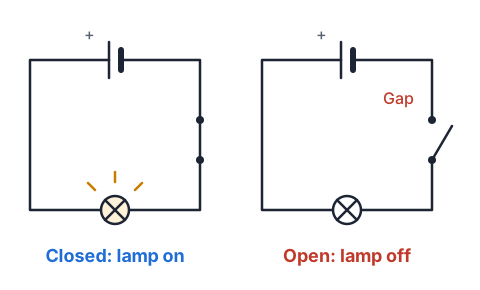
- A closed circuit is a complete loop with no gaps. Charge flows all the way round, so the lamp lights.
- An open circuit has a gap somewhere. Charge stops flowing everywhere in the loop, not just at the gap, so the lamp goes out.
- A gap can be a loose wire, a broken lamp, a flat battery, or a switch that is off.
What a switch does
- A switch is a part that opens or closes a gap in a circuit, so you can control whether charge flows.
- When a switch is on, its metal parts touch and close the circuit. When it is off, they pull apart and open the circuit.
- The light switch on your wall works the same way. Never open one up: the mains electricity in a house can kill.
Try it: open and close the switch
Conductors and insulators
- Charge travels through the metal wires and through the metal parts inside each component, such as the thin wire inside a lamp.
- A conductor is a material that lets charge flow through it easily. Most metals are good conductors.
- An insulator is a material that does not let charge flow, such as plastic, rubber, wood and glass.
- A wire has a copper conductor inside and a plastic insulator outside, so the charge stays in the wire and does not reach your fingers.
| Material | Conductor or insulator? |
|---|---|
| Copper | Conductor |
| Aluminium foil | Conductor |
| Steel paper clip | Conductor |
| Plastic | Insulator |
| Rubber | Insulator |
| Dry wood | Insulator |
Circuit symbols
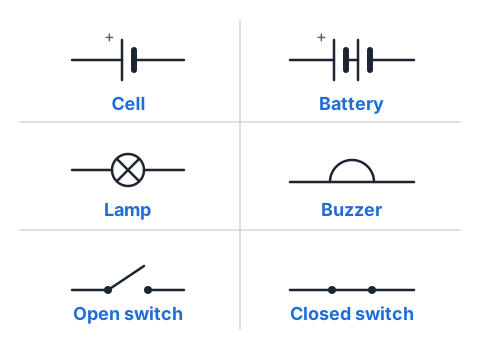
- A circuit diagram is a simple drawing of a circuit that uses standard symbols instead of pictures.
- The symbols are the same all over the world, so anyone can read your diagram and build the same circuit.
- A cell is drawn as a long thin line beside a short thick line; the long line is the positive (+) end. A battery is two or more cells joined together.
- Wires are drawn as straight lines with square corners, even if the real wires are curly.
Drawing a torch as a circuit diagram
- A torch has two cells, a switch and a lamp. Draw its circuit diagram.
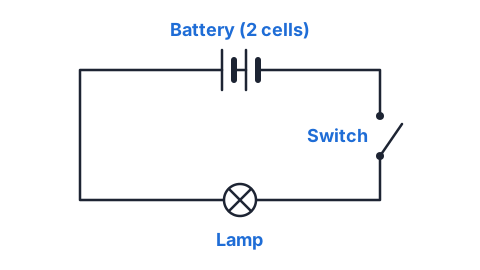
- Draw the battery: two cells side by side, long line to short line each timetwo cells
- Draw the switch symbol in the loopit opens and closes the gap
- Draw the lamp symbol: a circle with a crossthe load
- Join them with straight wires and square corners into one loop
Testing what closes a circuit
- Room 5 built a circuit with a gap in it and put different objects across the gap. Which objects closed the circuit?
| Object across the gap | Lamp | Circuit |
|---|---|---|
| Steel paper clip | Lit | Closed |
| Plastic ruler | Off | Open |
| Aluminium foil strip | Lit | Closed |
| Rubber eraser | Off | Open |
| Pencil lead (graphite) | Lit, dimly | Closed |
| Wooden pop stick | Off | Open |
- The clip and the foil are metal, and both lit the lampmetals conduct
- Plastic, rubber and wood left the lamp offinsulators
- Pencil lead lit it dimly: graphite conducts, but not as well as metala surprise
- The paper clip, the foil and the pencil lead closed the circuit
Try it: conductor or insulator?
Common mistakes
- One wire from the battery to the lamp is enough to light it.The lamp needs two wires so charge can go out from the battery and come back; it must be a complete loop.
- When a switch is off, the circuit is closed.Off means the switch has opened a gap, so the circuit is open and no charge flows.
- The charge gets used up in the lamp, so less comes back to the battery.The charge flows all the way round and back; it is energy that the lamp uses, not the charge.
- In a diagram, a lamp is drawn as a little picture of a light bulb.A lamp is drawn as a circle with a cross inside it, the standard symbol.
Find the circuit inside a torch
You need: a torch that takes AA or AAA batteries, paper, a pencil
- With an adult, open the torch, take the batteries out and lay all the parts on a table.
- Trace the path with your finger: from one end of the batteries, through the spring and metal strips, to the switch, the lamp and back to the other end.
- Put the batteries back the right way and switch on. Then slide a small piece of paper between the batteries and switch on again.
- Take the paper out and draw the torch's circuit diagram with the standard symbols.
- Look for this: the torch only lights when the loop is complete; the paper is an insulator that opens the circuit.
Safety: Use only a torch with AA or AAA batteries, never one with coin or button cells, which can badly burn a small child who swallows one; ask an adult to help.
Your turn
A lamp will not light because one wire has come loose. Is the circuit open or closed?
Which of these would close the gap in a circuit: a plastic straw, a steel spoon, or a wooden pop stick?
What are the three parts every simple circuit needs?
In a circuit diagram, what does a circle with a cross inside it show?
Why do wires have a plastic coating?
Show answer
1. Open: there is a gap, so no charge flows. 2. The steel spoon, because steel is a metal and a conductor. 3. A power source (a cell or battery), wires, and a load such as a lamp. 4. A lamp. 5. Plastic is an insulator, so it keeps the charge in the wire and away from your fingers.
Circuit Construction Kit: DC
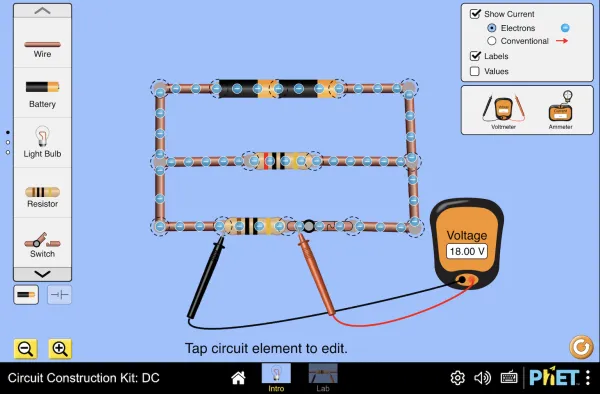
Full screen · PhET Interactive Simulations, University of Colorado Boulder, CC BY 4.0
Recap
- A simple circuit is a complete loop of a power source, wires and a load.
- A closed circuit has no gaps and charge flows; an open circuit has a gap and charge stops.
- A switch opens or closes a gap to turn the circuit off or on.
- Charge flows through conductors such as metals, not through insulators such as plastic.
- Circuit diagrams use standard symbols and straight wires with square corners.
Report a mistake
How is Year 6 maths going?
See the Year 6 maths guide