 Vertex Learn
Chemical change: new substances and the signs to look for
What this lesson covers
- What makes a change chemical: a new substance is made
- Reactants go in, products come out
- Four clues that a chemical change has happened
- Why most chemical changes are hard to undo
- Chemical changes in living things and in machines
- How people use chemical changes every day
A change that makes something new
- A substance is one kind of matter, such as water, salt, sugar or iron.
- In a chemical change, the tiny particles in the starting materials swap partners and join up in a new way, so a new substance is made.
- The new substance has different properties. Properties are things you can notice or measure, such as colour, smell, hardness, or whether it burns.
- Cooking an egg is a chemical change: the clear, runny part turns white and firm, and it never turns clear again.
- Melting ice is not a chemical change. The water is still water, so we call it a physical change.
Reactants and products
- Scientists call a chemical change a chemical reaction.
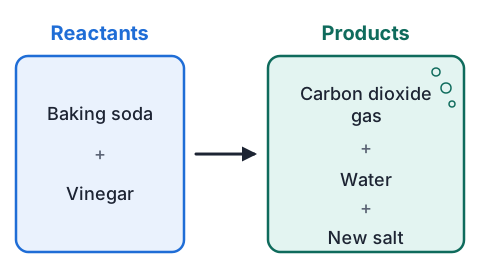
- The substances you start with are the reactants. The new substances the reaction makes are the products.
- We write a reaction with an arrow that means "turns into": reactants → products.
- When you bake a cake, the batter is the reactants and the soft, spongy cake is the product.
- When baking soda meets vinegar, one of the products is carbon dioxide, a gas that makes the fizz.
Four clues to look for
- You cannot see particles, so you look for clues that a new substance has been made.
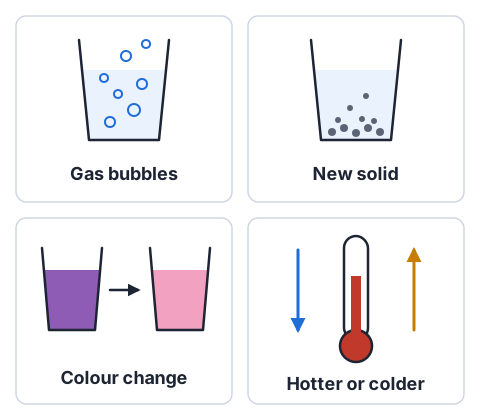
- A precipitate is a new solid that suddenly appears in a liquid, often as cloudy specks or lumps.
- A clue is good evidence, not proof. Boiling water also bubbles, but no new substance is made, so check more than one clue when you can.
| Clue | What you notice | Example |
|---|---|---|
| Gas | Bubbles or fizzing | Baking soda in vinegar |
| A new solid (precipitate) | Cloudy specks or lumps form | Vinegar stirred into milk makes white lumps |
| Colour change | A new colour that stays | A cut apple turning brown |
| Temperature change | The mixture gets hotter or colder | A hand warmer heating up; baking soda and vinegar cooling down |
Try it: which clue?
Recording observations in a table
- Room 9 tested four mixtures. For each one they wrote what they saw before and after, under the same headings, and took the temperature at the start and after 2 minutes. Which mixtures had a chemical change?
| Mixture | Bubbles? | New solid? | Colour change? | Temperature (°C) |
|---|---|---|---|---|
| A: baking soda + vinegar | Yes, lots | No | No | 19 then 15 |
| B: milk + vinegar | No | Yes, white lumps | No | 18 then 18 |
| C: salt + water | No | No, salt disappears | No | 18 then 18 |
| D: purple cabbage juice + lemon juice | No | No | Yes, purple to pink | 18 then 18 |
- A: bubbles of gas, and it got 4 °C coldertwo clues
- B: a new solid appeareda precipitate
- C: no clues, and the salt comes back if the water dries upphysical change
- D: a new colour that stayscolour change
- A, B and D are chemical changes; C is a physical change
Try it: chemical or physical?
Most chemical changes are hard to undo
- You cannot turn a baked cake back into flour, eggs and sugar, or turn burnt toast back into bread.
- Corrosion is a slow chemical change where a metal is eaten away by air and water. Rust on an old gate is corrosion of iron, and the rust does not turn back into shiny iron by itself.
- A few reactions can be run backwards in special conditions. When a rechargeable battery powers a torch, a chemical change happens inside it, and plugging it into a charger pushes that change back the other way.
In living things and in machines
- Chemical reactions happen inside living things all the time.
- Digestion is the way your body breaks food into smaller, new substances that can pass into your blood. Your stomach and gut use special chemicals to do this.
- Plants make their own sugar from water and carbon dioxide using the energy in sunlight, which is another chemical change.
- Chemical reactions also happen in non-living things. Combustion means burning: a fuel reacts with oxygen from the air and gives out heat and light. A car engine burns petrol this way to make the car move.
How people use chemical changes
- People use chemical changes on purpose, every day.
| Use | The chemical change | Example |
|---|---|---|
| Cooking | Heat changes the substances in food, making new tastes, smells and textures | A hāngī, a roast, a fried egg |
| Combustion | Fuel burns with oxygen to release heat | A wood burner warming a house in winter |
| Manufacturing | Raw materials react to make new materials | Cement setting hard in concrete; making plastics and steel |
| Keeping safe | Gas made very quickly fills a bag | A car airbag opening in a crash |
Explaining a chemical change: why bread rises
- Bread dough is made with flour, water, sugar and yeast. Left in a warm place for an hour, it swells to about twice its size. Explain why, using the idea of a chemical change.
- Yeast is a tiny living thing that feeds on the sugar in the doughreactant: sugar
- Its chemical change makes carbon dioxide gasa product
- The gas makes bubbles that get trapped in the stretchy doughclue: gas
- The yeast makes a gas by a chemical change, and the trapped bubbles make the dough rise
Common mistakes
- Ice melting is a chemical change because it looks different.Melting is a physical change: the water is still water, and it freezes back into ice.
- Any bubbles mean a chemical change.Bubbles are only a clue; boiling water bubbles too, but no new substance is made.
- The products are the things you mix together at the start.The things you start with are the reactants; the products are the new substances made at the end.
- Salt dissolving in water makes a new substance, because the salt disappears.The salt is still there, spread through the water, and you get it back when the water dries up, so it is a physical change.
Hunt for chemical change clues
You need: baking soda, vinegar, milk, sugar, 3 clear cups, a teaspoon, paper and a pencil
- Draw a table with the headings: cup, bubbles, new solid, colour change, feels warmer or colder.
- Cup 1: put in a teaspoon of baking soda, then add 3 teaspoons of vinegar. Hold the outside of the cup and write down what you see and feel.
- Cup 2: pour in a quarter of a cup of milk, stir in 3 teaspoons of vinegar, and leave it for 5 minutes. Write down what you see.
- Cup 3: stir a teaspoon of sugar into a quarter of a cup of water and write down what you see.
- Look for the clues: cup 1 fizzes and feels a little colder, cup 2 grows white lumps, so both made new substances; the sugar in cup 3 just dissolves, with no clues.
Safety: Ask an adult to help. Vinegar stings if it gets in your eyes, so keep your face back from the fizzing cup, and do not drink any of the mixtures.
Your turn
Is melting butter for a cake a chemical change or a physical change?
A steel nail left outside turns orange and flaky. What clue is this, and what kind of change is it?
In the reaction wood + oxygen → ash + smoke + carbon dioxide, what are the reactants?
Why can a cake never be turned back into batter?
Name a chemical change that happens inside your own body.
Show answer
1. A physical change: it is still butter, and it goes solid again when it cools. 2. A colour change, with a new flaky solid; it is a chemical change called rusting, a kind of corrosion. 3. Wood and oxygen, the substances before the arrow. 4. Baking made new substances, and they cannot be turned back into the ingredients. 5. Digestion, which breaks food into new, smaller substances.
Recap
- A chemical change makes a new substance with different properties.
- In a chemical reaction, reactants turn into products.
- Clues are gas bubbles, a new solid, a colour change, and getting hotter or colder.
- Most chemical changes are hard to undo, though a rechargeable battery can be run backwards.
- Chemical changes happen in living things, like digestion, and in machines, like engines.
- People use chemical changes for cooking, burning fuel and making new materials.
The maths behind it
Report a mistake
How is Year 6 maths going?
See the Year 6 maths guide