 Vertex Learn
Pushes and pulls: starting, stopping and turning
What this lesson covers
- A force is a push or a pull
- Forces can start something moving or stop it
- Forces can make things faster, slower, or change direction
- Ways things move: rolling, sliding, gliding, bouncing, spinning and falling
- Testing big and small pushes, and recording what happens
A force is a push or a pull
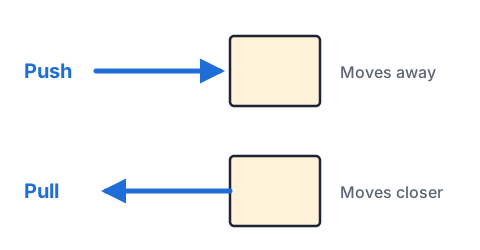
- A force is a push or a pull.
- A push moves something away from you, like shutting a door.
- A pull moves something towards you, like opening a drawer.
- You cannot see a force, but you can see what it does. Arrows show which way a force acts.
Try it: push or pull?
Starting and stopping
- A ball on the grass stays still until a force moves it.
- A kick is a push that starts the ball moving.
- A goalkeeper's hands push back on the ball and stop it.
Faster, slower, or a new direction
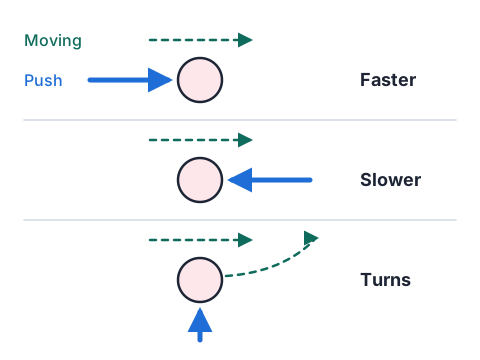
- A force can change how something is already moving.
- A push in the same direction makes it go faster.
- A push the opposite way makes it go slower.
- A push from the side makes it change direction.
Ways things move
- Things can move in different ways.
| Way of moving | Example |
|---|---|
| Rolling | A ball going down a hill |
| Sliding | A book pushed across a table |
| Gliding | A paper plane, a toroa (albatross) over the sea |
| Bouncing | A netball dropped on the court |
| Spinning | A spinning top |
| Falling | An apple dropping from a tree |
Try it: how does it move?
What did the force do?
- Say what each force does: a kick sends a still ball forward; a hand catches a ball; a bat hits a ball back the way it came; a push from behind on a swing.
- Kick: the ball starts movingstart
- Catch: the ball stopsstop
- Bat: the ball changes directionturn
- Push on a swing: it goes fasterspeed up
- Start, stop, change direction, go faster
Big push, small push
- Room 5 predicted that a bigger push would send a toy car further. They pushed it three times and counted the floor tiles it rolled over.
- They wrote down what they saw: faster, slower, stopped or turned.
| Push | Floor tiles rolled | What we saw |
|---|---|---|
| Small | 3 | Rolled slowly, stopped soon |
| Medium | 6 | Rolled faster |
| Big | 10 | Rolled fastest, turned a little at the end |
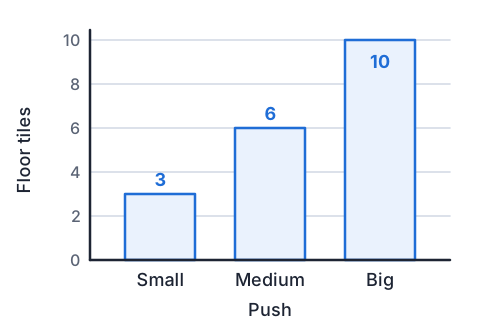
- Small push: 3 tilesshortest
- Big push: 10 tilesfurthest
- A bigger push made the car go faster and further, so the prediction was right
Try it: tiles rolled for each push
Common mistakes
- When I push a heavy box and it does not move, there is no force.You are still pushing; your push is just not big enough to start the box moving.
- A rolling ball stops because it gets tired.The ground and the air rub on the ball, and that rubbing is a force that slows it down.
- A push and a pull are the same thing.A push moves something away from you; a pull moves it towards you.
Toy car push test
You need: a toy car, a strip of tape or a book for a start line, a clear floor, paper and a pencil
- Put the car on the start line.
- Give it a small push and count how many hand spans it rolls. Write it down.
- Give it a big push from the same line and count again.
- Roll the car again, and gently tap it from the side as it goes past.
- Look for this: the big push sends it further, and the side tap makes it turn.
Safety: Do this on a clear floor with an adult nearby, away from stairs, and pick the car up after so nobody trips or slips on it.
Your turn
1
Opening a drawer: is that a push or a pull?
2
You push a swing gently, then much harder. What happens with the harder push?
3
A ball rolls towards you and you put your foot on it. What does your push do?
4
How does a paper plane move through the air?
5
In Room 5's test, how far did the car go after the big push?
Show answer
1. A pull. 2. The swing goes faster and higher. 3. It stops the ball. 4. It glides. 5. 10 floor tiles.
Forces and Motion: Basics
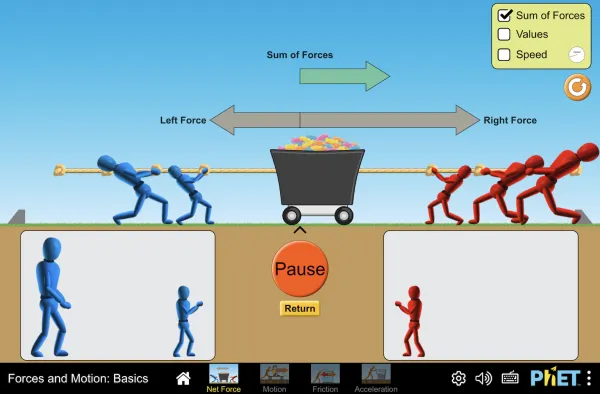
Full screen · PhET Interactive Simulations, University of Colorado Boulder, CC BY 4.0
Recap
- A force is a push or a pull.
- Forces can start or stop movement.
- Forces can make things faster, slower, or turn.
- Things roll, slide, glide, bounce, spin and fall.
- A bigger push makes a bigger change, which we can test and record in a table.
The maths behind it
Report a mistake
How is Year 2 maths going?
See the Year 2 maths guide