 Vertex Learn
Sound: vibrations, loudness and high and low
What this lesson covers
- Every sound comes from something vibrating
- Sound travels through air, water and solid materials
- Bigger vibrations make louder sounds
- Frequency: fast vibrations make high sounds, slow ones make low sounds
- Soft, thick materials make sound quieter and less clear
- Testing sounds and comparing what different people hear
Sounds come from vibrations
- Every sound comes from something vibrating, which means moving back and forth very fast.
- Pluck a rubber band and it looks blurry while it vibrates.
- Sound can also make other things vibrate. A very loud truck can make a window rattle.
Rice on a drum
- Room 8 put a few grains of rice on a drum and tapped the side of the drum.
| What they did | The rice | The sound |
|---|---|---|
| Nothing | Stayed still | None |
| Gentle tap | Hopped a little | Quiet |
| Hard hit | Jumped high | Loud |
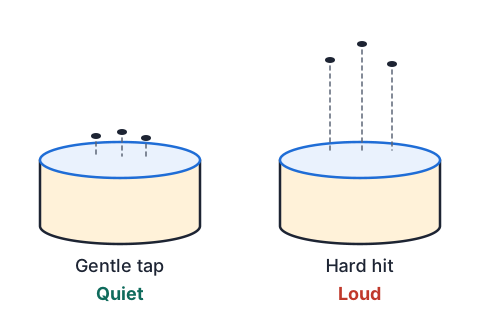
- The rice moved only when there was a soundthe drum skin was vibrating
- Bigger jumps came with the louder soundbigger vibrations
- Sounds are made by vibrations, and big vibrations make loud sounds
Big vibrations, loud sounds
- Volume is how loud or quiet a sound is.
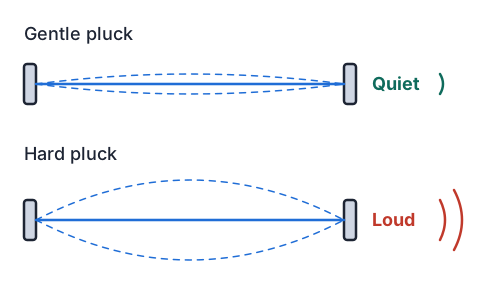
- A big vibration makes a loud sound. A small vibration makes a quiet sound.
- Pluck a guitar string hard and it swings a long way, so the sound is loud. Pluck it gently and it swings a little, so the sound is quiet.
Try it: loud or quiet?
High and low sounds
- Pitch is how high or low a sound is.
- Frequency is how fast something vibrates.
- Fast vibrations, a high frequency, make a high sound, like a whistle.
- Slow vibrations, a low frequency, make a low sound, like a big drum.
- A short, tight rubber band makes a higher sound than a long, loose one.
Try it: high or low?
Sound travels through materials
- Sound moves from the thing that vibrates to your ears.
- It can travel through air, through water, and through solid materials like wood and metal.
- Put your ear on a table and gently tap the far end. The tap sounds clearer through the wood than through the air.
Materials change the sound
- Soft, thick materials like pillows and curtains soak up sound, so it is quieter and muffled.
- Hard, smooth materials like tiles bounce sound around, which is why a bathroom sounds echoey.
- Tap a bowl when it is empty and again when it is full of water. The sounds are different.
- Traditional Māori instruments use vibrating air too: the kōauau is a small flute, and the pūtātara is a shell trumpet.
Does everyone hear the same?
- Room 8 tapped one end of a table. Three children listened at the other end, first with an ear on the table, then with their head up in the air. They also put a hand flat on the table.
| Child | Ear on table | Ear in the air | Felt it in their hand? |
|---|---|---|---|
| Aroha | Clear | Quiet | Yes |
| Ben | Clear | Very quiet | Yes |
| Sione | Clear | Quiet | No |
- All three heard the tap more clearly through the tablesame for everyone
- How quiet it was in the air, and whether they felt it, was a little differentpeople differ
- Sound travels well through wood, but each person hears and feels it a bit differently
Common mistakes
- A whistle is high because it is loud.High or low is pitch, from how fast it vibrates; loud or quiet is volume, from how big the vibrations are.
- Sound can only travel through air.Sound also travels through water and solids, often more clearly than through air.
- Putting a pillow over a speaker makes it louder.Soft, thick materials soak up sound, so the sound gets quieter and muffled.
Make a rubber band guitar
You need: an empty tissue box or small plastic tub, 3 rubber bands of different thickness
- Stretch the three rubber bands around the box so they cross the opening.
- Pluck each band gently and listen.
- Pluck one band hard, then gently, and compare the sounds.
- Press one band down near the end with a finger to make the part you pluck shorter, then pluck it again.
- Look for this: harder plucks are louder, thin or shorter bands sound higher, and thick bands sound lower.
Safety: Ask an adult to help stretch the bands, and keep them away from faces, because a band that slips off can flick into an eye.
Your turn
What has to happen to make any sound?
You pluck a string harder. What happens to the sound?
Which has a higher frequency: a whistle or a big drum?
Which makes a voice from the next room harder to hear: an open door or a thick, closed curtain?
In Room 8's test, was the tap clearer with an ear on the table or in the air?
Show answer
1. Something must vibrate. 2. It gets louder, because the string swings further. 3. The whistle. 4. The thick, closed curtain, because soft, thick materials soak up sound. 5. With an ear on the table.
Recap
- Every sound comes from something vibrating.
- Sound travels through air, water and solids.
- Bigger vibrations make louder sounds.
- Fast vibrations, a high frequency, make high sounds; slow ones make low sounds.
- Soft, thick materials make sound quieter and less clear; hard ones bounce it.
- Different people can hear and feel the same sound a little differently.
Report a mistake
How is Year 2 maths going?
See the Year 2 maths guide