 Vertex Learn
Day, night and shadows: modelling the Sun and Earth
What this lesson covers
- Shadows change length and direction as the Sun moves across the sky
- The half of Earth facing the Sun has daytime
- The half facing away from the Sun has night-time
- Earth's spin causes day and night and the Sun's path across the sky
- Earth's orbit around the Sun makes a year
- Using a torch and a ball to model the Sun and Earth
Shadows through the day
- A shadow forms where something blocks the sunlight.
- A shadow always points away from the Sun.
- In the morning the Sun is low in the eastern sky, so shadows are long and point towards the west side.
- At midday the Sun is at its highest, in the north, so shadows are at their shortest and point south.
- In the afternoon the Sun is low in the western sky, so shadows are long again and point towards the east side.
Example: a shadow stick record
- Room 6 stood a 1 m stick in the school field and marked its shadow three times in one day.
- Describe how the shadow changed, and explain why.
| Time | Shadow length | Shadow points |
|---|---|---|
| 9 am | 70 cm | South-west |
| 12 pm | 30 cm | South |
| 3 pm | 65 cm | South-east |
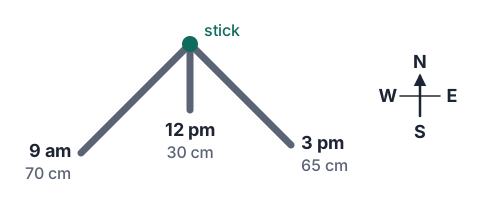
- Length: 70 cm, then 30 cm, then 65 cmshortest at midday
- Direction: south-west, then south, then south-eastswinging from west to east
- The Sun was highest at midday, so the shadow was shortest then
- As the Sun moved from east to west, the shadow got shorter then longer, and swung from west to east
Try it: what time of day?
Day and night
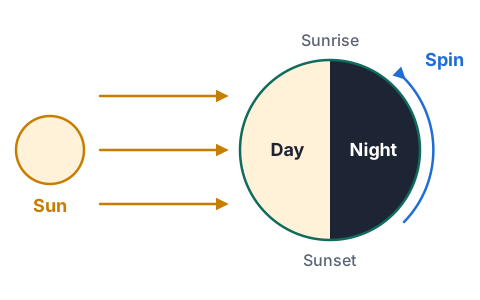
- The Sun can only light up the half of Earth that faces it.
- The half facing the Sun has daytime.
- The half facing away is in Earth's own shadow, so it has night-time.
- As Earth spins, each place turns into the sunlight (sunrise), across it (day), and out of it again (sunset).
Example: day here, night there
- It is 1 pm on a sunny day in Auckland. London is on the other side of the Earth.
- Is it day or night in London?
- At 1 pm, New Zealand faces the Sunit is daytime here
- The other side of Earth faces away from the Sun
- It is night-time in London
The spin explains the Sun's path
- Earth turns towards the east.
- Each morning our part of Earth turns to face the Sun, so the Sun appears in the east.
- All day we keep turning, so the Sun seems to cross the sky.
- In the evening we turn away, so the Sun disappears in the west.
Spinning and orbiting together
- Earth does two things at once.
- It spins once about every 24 hours. That gives day and night.
- It orbits the Sun once about every 365 and a quarter days. That gives a year.
- Through the year, the Sun's path across the sky shifts a little: higher in summer and lower in winter. So when you record the Sun, use the same times and the same spot each time.
Try it: the Sun through the year
Example: a torch-and-ball model
- Room 6 used a torch as the Sun and a ball with a sticker on New Zealand as the Earth.
- How does the model show day, night and a year?
- Torch held still, shining on the ballthe Sun
- Ball turned slowly, so the sticker moved into the light: sunrise
- Sticker facing the torch: midday. Sticker turned into the dark: sunset, then night
- One full turn of the ball models one day
- Then the ball was carried slowly in a big circle around the torch, still turning: one circle models one year
Common mistakes
- Night happens because the Sun goes around to the other side of Earth.The Sun does not go around Earth; Earth spins, so our side turns away from the Sun.
- Day and night happen because Earth goes around the Sun.Day and night come from Earth's spin every 24 hours; one trip around the Sun takes a whole year.
- Shadows are longest at midday, when the Sun is strongest.At midday the Sun is highest in the sky, so shadows are shortest.
Model day and night
You need: a torch, a ball or an orange, a small sticker or a piece of tape, a pen, a room you can make dark
- Put the sticker on the ball where New Zealand would be.
- Make the room dark. Ask an adult to hold the torch still and shine it at the ball from about one metre away.
- Hold the ball at the top and bottom, and turn it slowly so the sticker moves from the dark side into the light.
- Say 'sunrise' when the sticker enters the light, 'midday' when it faces the torch, and 'sunset' when it leaves the light.
- Look for this: the half facing the torch is always lit and the other half is always dark, so one turn gives one day and one night.
Safety: Do not shine the torch into anyone's eyes, and clear the floor first so nobody trips in the dark room.
Your turn
At midday, is your shadow long or short?
In the morning in New Zealand, which way do shadows point: towards the east side or the west side?
Which half of Earth has daytime?
What causes day and night?
It is midday in New Zealand. Is it day or night on the opposite side of Earth?
In the torch-and-ball model, what does one full turn of the ball stand for?
Show answer
1. Short, because the Sun is high. 2. Towards the west side, away from the morning Sun in the east. 3. The half facing the Sun. 4. Earth spinning on its axis. 5. Night. 6. One day.
Recap
- Shadows point away from the Sun: long in the morning and afternoon, shortest at midday.
- The half of Earth facing the Sun has day; the other half has night.
- Earth's spin turns us into and out of the sunlight, giving day, night and the Sun's path across the sky.
- Earth's orbit around the Sun takes a year.
- A torch and a ball can model day, night and a year.
The maths behind it
Report a mistake
How is Year 4 maths going?
See the Year 4 maths guide