Units, tools and estimating
What this lesson covers
- Different measurement tools and scales use different-sized units; the unit must be recorded with the measurement amount.
Seven what?
- "How long is the desk?" "Seven."
- Seven what? Seven centimetres? Seven metres?
- A number on its own is not a measurement.
| if you say | you mean something about |
|---|---|
| 7 mm | the thickness of a pencil |
| 7 cm | a matchbox |
| 7 m | a classroom wall |
| 7 km | a long walk (over an hour) |
The unit is part of the answer
- Always write the unit next to the number.
- Not because a teacher says so.
- Because without it you have not said anything.
| written down | is this a measurement? |
|---|---|
| 7 | no, seven of what? |
| 7 cm | yes |
| 7 kg | yes, but of something quite different |
Different jobs, different tools
- Length gets a ruler. Mass gets scales.
- Capacity gets a jug. Temperature gets a thermometer.
- And each tool comes with its own units.
| to measure | use | units |
|---|---|---|
| length | ruler or tape measure | mm · cm · m |
| mass | scales | g · kg |
| capacity | measuring jug | mL · L |
| temperature | thermometer | degrees Celsius |
Read the scale before you read the number
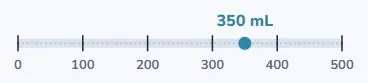
- Look at what one little mark is worth first.
- On one ruler a mark is 1 mm. On a jug it might be 50 mL.
- Same-looking gap. Completely different amount.
Carry your own measuring tools
- Your hand span is about 15 cm. Always with you.
- One big stride is about half a metre.
- Learn a few of these and you can estimate anywhere.
| this thing | is about |
|---|---|
| your hand span | about 15 cm |
| one big stride | about half a metre |
| a bag of sugar | 1 kg |
| a milk bottle | 2 L |
Benchmarks catch mistakes
- Someone measures the door and writes 8 cm.
- Your hand is 15 cm. The door is not half a hand.
- You do not need the right answer to spot a wrong one.
| someone says | check it against | verdict |
|---|---|---|
| the door is 8 cm | your hand span, 15 cm | far too small |
| the door is 2 m | a bit taller than a grown-up | sounds right |
| the door is 2 km | a twenty minute walk | nonsense |
Mixed units are place value again
- 1 m and 23 cm. Two units, one length.
- 100 cm make a metre, like 10 tens make a hundred.
- Same idea you already know, wearing different clothes.
| written as | means | all in one unit |
|---|---|---|
| 1 m 23 cm | 1 metre and 23 centimetres | 123 cm |
| 2 L 500 mL | 2 litres and 500 millilitres | 2,500 mL |
| 10 kg 3 g | 10 kilograms and 3 grams | 10,003 g |
Temperature has units too
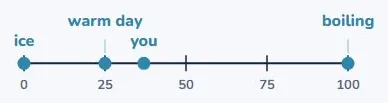
- We measure it in degrees Celsius.
- Water freezes at 0 and boils at 100.
- A warm day here is about 25 degrees.
Your turn
- Would you measure a pencil in mm, m or km?
- Is a bag of apples 2 g, 2 kg or 2 L?
- How many cm in 3 m and 40 cm?
| question | pick one |
|---|---|
| a pencil | mm · m · km |
| a bag of apples | 2 g · 2 kg · 2 L |
| 3 m 40 cm | ? cm |
Show answer
Millimetres, or centimetres; a pencil in metres would be a broom handle. 2 kg; grams would be two paperclips and litres is the wrong kind of measurement altogether, since apples are a mass not a capacity. 340 cm: three lots of 100, plus the 40. Watch for anyone answering the third in metres; the question named the unit it wants.
Units and estimating
- A number with no unit is not a measurement.
- Check what one mark on the scale is worth.
- Know a few benchmarks and you can check anything.
| idea | what to remember |
|---|---|
| the unit | part of the answer, not an extra |
| the tool | ruler, scales, jug, thermometer |
| the scale | find out what one mark is worth first |
| your hand span | about 15 cm, always with you |
| 1 m 23 cm | the same as 123 cm |
| temperature | degrees Celsius: 0 ice, 100 boiling |
Is your child on track?
Take the free placement test