Flips, slides, turns and grid maps
What this lesson covers
- A reflection is when a shape is flipped over a line, creating a mirror image.
- A translation is when a shape is slid from one place to another without being turned.
- A rotation is when a shape is turned around a fixed point.
- An alphanumeric grid reference is a system that divides a map into labelled rows (letters) and columns (numbers), so that each square can be identified by combining a letter and a number (e.g. A1, B2).
Three ways to move a shape
- You can flip it over a line.
- You can slide it somewhere else.
- Or you can turn it around a point.
| everyday word | proper word | what happens |
|---|---|---|
| flip | reflection | mirrored over a line |
| slide | translation | moved, still facing the same way |
| turn | rotation | turned about a fixed point |
The shape itself never changes
- Same side lengths. Same angles. Same size.
- Only where it is, or which way it faces.
- If your answer is bigger or squashed, something went wrong.
| does this change? | |
|---|---|
| the side lengths | never |
| the angles | never |
| where it is | yes |
| which way it faces | for a flip or a turn |
A flip is a mirror
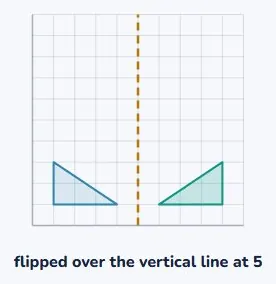
- Put a mirror line down the middle.
- Every corner hops to the other side, the same distance.
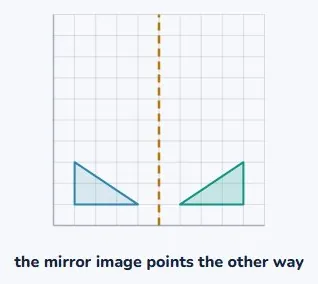
- The triangle is now facing the other way.
Look at which way it points
- The long leg pointed right. Now it points left.
- That is how you know it was flipped and not slid.
- A flip turns the shape back to front.
A slide keeps it facing the same way
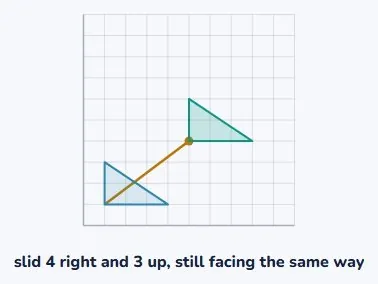
- Move every corner the same distance, the same direction.
- Here: 4 squares right and 3 up.
- It still points exactly the way it did before.
So a flip and a slide are different
- Both moved the triangle. Only one turned it around.
- Check which way the long side points.
- Same way: a slide. Other way: a flip.
| after a... | the shape faces |
|---|---|
| slide | exactly the same way |
| flip | back to front |
| turn | a different way round |
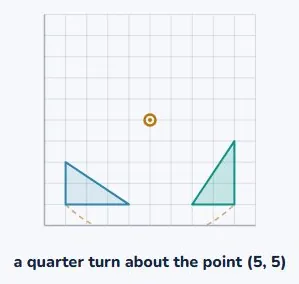
A turn goes around a fixed point
- Pick a point and pin the shape there.
- Turn it a quarter turn (90 degrees).
- The pin stays still. Everything else swings round.
Saying where something is
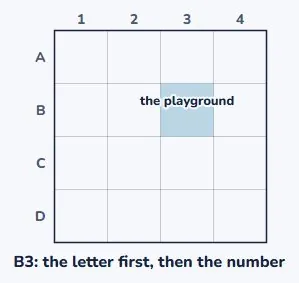
- One direction is labelled with letters, the other with numbers.
- Every square then has its own name.
- Letter first, then number. Always.
Why the order matters
- B3 and 3B would be different squares.
- Everyone has agreed: the letter comes first.
- A rule only helps if we all use the same one.
| reference | means |
|---|---|
| A1 | the letter A, then the number 1 |
| B3 | the letter B, then the number 3 |
| D2 | the letter D, then the number 2 |
Your turn
- A shape is slid 3 right. Does it face a new way?
- What is a flip properly called?
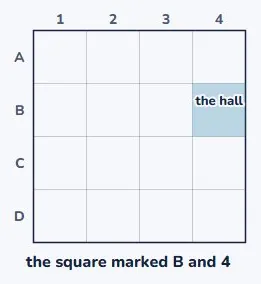
- The hall is in the square marked B and 4. Write its reference.
Show answer
No, a slide never changes which way a shape faces; that is exactly what separates it from a flip. A reflection. B4: the letter is always written first. Anyone who answers 4B has found the right square and written it the wrong way round, which on a real map means somebody else reads it as a different square entirely.
Moving shapes, and finding places
- Flip, slide and turn never change the shape itself.
- Which way it points tells you which one happened.
- On a grid map, the letter always comes first.
| idea | what to remember |
|---|---|
| a flip | a reflection (mirrored over a line) |
| a slide | a translation (same way up) |
| a turn | a rotation (around a fixed point) |
| all three | same size, same angles, every time |
| telling them apart | look at which way it points |
| a grid reference | letter first, then number |
Is your child on track?
Take the free placement test