 Vertex Learn
Habitats: where living things find what they need
What this lesson covers
- A habitat gives living things water, food, air and shelter
- Most habitats are home to many kinds of living things
- Living things in one habitat often share the same resources
- Living things in a habitat affect each other, such as hunter and hunted
- Jane Goodall's long, patient observing changed what we know about chimpanzees
- Gathering information about a habitat and showing it in maps and pictographs
What a habitat is
- A habitat is the place where a living thing lives.
- A good habitat gives it what it needs: water, food, air and shelter.
- Shelter means a safe place to hide, rest and raise young.
- A rock pool, a rotting log, a pond and a school garden are all habitats.
Lots of living things together
- Most habitats have many kinds of living things in them.
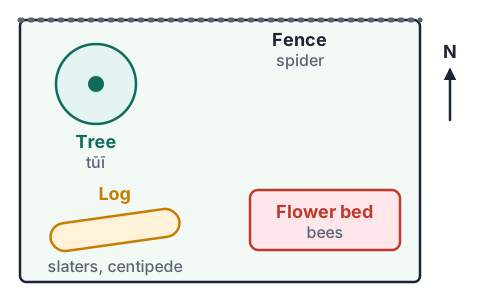
- A garden might hold tūī in the trees, bees on the flowers, worms in the soil and slaters under the pots.
- Plants, insects, birds and fungi can all share one small patch.
Sharing resources
- Resources are the things living things use, such as food, water and shelter.
- Living things in one habitat often use the same resources.
- Birds and insects drink from the same puddle or stream. Many small animals shelter under the same log.
- Kawakawa leaves are food for the kawakawa looper caterpillar. That is why kawakawa leaves are often full of holes.
Try it: food, water or shelter?
Living things affect each other
- Living things in a habitat interact. That means they affect one another.
- A spider catches flies in its web. The spider gets food, and the flies are eaten.
- Bees drink nectar from flowers and carry pollen, which helps the plants make seeds.
- Two birds may chase each other away from the same feeding tree.
Example: life under a log
- Room 4 gently rolled over a log in the school garden, counted what was under it, then rolled it back.
- What does the log give these animals, and how do they interact?
| Living thing | How many | What it uses the log for |
|---|---|---|
| Slaters | 12 | Damp shelter, and rotting wood to eat |
| Earthworms | 6 | Damp, dark soil |
| Spiders | 2 | Shelter, and small insects to catch |
| Centipede | 1 | Shelter, and slaters to hunt |
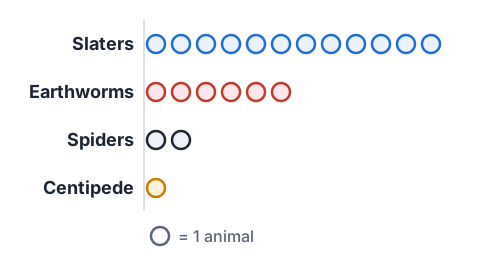
- Under the log it is damp and darkshelter
- Rotting wood is food for the slatersfood
- The centipede hunts slaters; the spiders catch insectsthey interact
- The log gives shelter, damp and food, and the animals under it are hunters and hunted
Try it: life under the log
Example: predict how a tree wētā uses a tree
- A tree wētā lives in a hole in a tree trunk. It comes out at night.
- Predict how it uses the tree.
- By day the hole is dark and safe from birdsshelter
- At night it climbs out onto the branches to chew leavesfood
- The tree gives the wētā shelter by day and food by night
Jane Goodall and the chimpanzees
- The English scientist Jane Goodall began studying wild chimpanzees in Gombe, Tanzania, in 1960.
- She sat quietly near them for months, until they got used to her, and wrote down everything she saw.
- She saw a chimpanzee strip the leaves off a twig and poke it into a termite mound to fish out termites. People had thought only humans made tools.
- She also found that chimpanzees hunt and eat meat, and that each one has its own personality and family bonds.
Finding out and showing it
- Observe for yourself: sit still, look closely, count, and write or draw what you see.
- Read and listen too: books, school journal articles and stories such as pūrākau can tell you what other people have noticed over a long time.
- Show what you found with a map, a drawing, a table or a pictograph.
Common mistakes
- A habitat is just an animal's nest or burrow.A habitat is the whole place it lives, including where it finds food, water and shelter.
- Each animal in a habitat has its own food and water that nothing else uses.Living things in one habitat often share the same resources, such as one stream or one log.
- After looking under a log, you can leave it turned over.Roll it back gently the way it was, because it is the animals' shelter.
Survey a patch of garden
You need: 4 sticks or pegs, a piece of string about 4 m long, a notebook and pencil, a magnifying glass, if you have one
- Mark out a square of garden about 1 m on each side with the sticks and string.
- Sit still beside it for 10 minutes. Make a tally of every living thing you see in or above the square.
- With an adult, gently lift one stone or pot inside the square, count what is under it, then put it back exactly as it was.
- Draw a pictograph of your counts, with one symbol for each animal.
- Look for this: which living things share your square, and what each one seems to be using it for.
Safety: Lift stones only with an adult and keep your fingers out of holes, because a spider or wasp could bite or sting; wash your hands afterwards.
Your turn
What four things does a good habitat give a living thing?
A slater lives under a damp log and eats rotting wood. What does the log give it?
A fantail and a spider both catch flies in the same garden. What resource do they share?
In Room 4's survey, how many more slaters than earthworms were there?
What did Jane Goodall see a chimpanzee use a twig for?
Why should you roll a log back after looking underneath it?
Show answer
1. Water, food, air and shelter. 2. Shelter and food. 3. Flies, which are food for both. 4. 6 more, because 12 − 6 = 6. 5. To fish termites out of a termite mound. 6. It is the shelter of the animals that live there.
Recap
- A habitat gives living things water, food, air and shelter.
- Most habitats hold many kinds of living things, and they share resources.
- Living things in a habitat affect each other, as hunters, hunted, helpers or rivals.
- Jane Goodall's patient observing showed chimpanzees make tools and hunt.
- Gather information by observing and reading, and show it with maps and pictographs.
The maths behind it
Report a mistake
How is Year 4 maths going?
See the Year 4 maths guide