 Vertex Learn
Fungi, bacteria, species and scientific names
What this lesson covers
- Fungi: mushrooms, moulds and yeasts, and why they are a group of their own
- Bacteria that help us, bacteria that do nothing to us, and bacteria that make us sick
- What scientists mean by a species
- How two-part scientific names work
- Extinct species such as the moa, and what they tell us about how life has changed
- Lucy Moore and her work describing New Zealand's plants
Fungi: not plants, not animals
- Fungi (say "fun-guy" or "fun-ghee") are a group of living things that includes mushrooms, moulds and yeasts.
- Fungi cannot make their own food from sunlight like plants. They grow into their food, such as dead leaves, rotting logs or bread, and soak it up.
- They cannot move around and hunt like animals either, so they are a separate group.
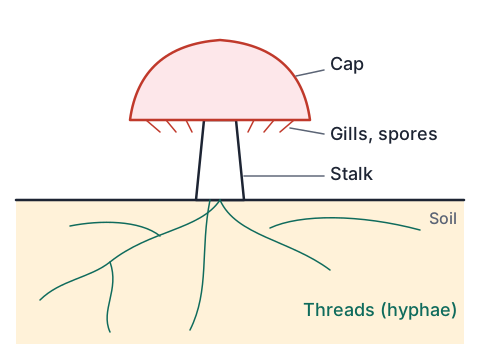
- Most of a fungus is a web of very thin threads called hyphae, hidden in the soil or the food. A mushroom is only the part that pops up to spread tiny seeds called spores.
- Many fungi are poisonous. Never touch or eat a mushroom you find outside.
| Kind of fungus | What it looks like | Where you find it |
|---|---|---|
| Mushroom | A cap on a stalk | Lawns, forest floors, rotting logs |
| Mould | Fuzzy patches of white, green, blue or black | Old bread, fruit, damp walls |
| Yeast | Too small to see; a beige powder when dried | Bread dough, where it makes the dough rise |
Try it: plant, animal or fungus?
Bacteria: helpful, harmless and harmful
- Bacteria are microorganisms. Each one is a single tiny cell, so you need a microscope to see it. A cell is the smallest living part of an organism.
- Some bacteria are helpful. Bacteria turn milk into yoghurt, and bacteria in your gut help you digest food.
- Many bacteria are neutral, which means they do us no good and no harm. Huge numbers live on your skin without you noticing.
- Some bacteria are harmful. They can cause illnesses such as food poisoning. Washing your hands and keeping food cold helps stop them spreading.
Try it: helpful, neutral or harmful?
Example: mould in a sealed bag
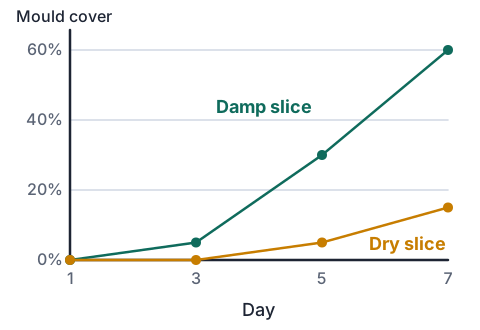
- Room 12 sealed one damp slice and one dry slice of bread in separate plastic bags. Each day they looked through the bags and estimated how much of each slice was covered in mould.
- The bags were closed systems: nothing could get in or out. What do the results show?
| Day | 1 | 3 | 5 | 7 |
|---|---|---|---|---|
| Damp slice | 0% | 5% | 30% | 60% |
| Dry slice | 0% | 0% | 5% | 15% |
- Nothing could get into the sealed bagsso the mould spores were already on the bread
- Damp slice reached 60%, dry slice only 15%compare day 7
- Mould grew on both slices, and much faster on the damp one, so mould grows best with water
What is a species?
- A species is one kind of living thing. Members of a species can mate with each other and have young, and those young can grow up and have young of their own.
- All dogs are one species, so a poodle and a labrador can have puppies that grow up and have puppies.
- A horse and a donkey can have a baby called a mule, but mules almost never have young of their own. So horses and donkeys are two different species.
Scientific names
- The same organism can have many common names in different places and languages. To avoid mix-ups, every known species also has a scientific name that is the same everywhere in the world.
- A scientific name has two parts. The first part is the genus, a small group of very close relatives. The second part names the species in that genus.
- The genus starts with a capital letter and the species part is all lower case. The name is printed in italics, or underlined when handwritten.
| Common name | Scientific name |
|---|---|
| Human | Homo sapiens |
| Kauri | Agathis australis |
| Pōhutukawa | Metrosideros excelsa |
| North Island brown kiwi | Apteryx mantelli |
Example: reading kiwi names
- Three New Zealand birds are named Apteryx mantelli (North Island brown kiwi), Apteryx haastii (great spotted kiwi) and Apteryx owenii (little spotted kiwi).
- What do these names tell you about how the three birds are related?
- First word: Apteryx in all threethey share a genus
- Second word: mantelli, haastii, oweniithree different species
- They are three different species of kiwi that are close relatives in the same genus
Species that have died out
- A species is extinct when no living members are left anywhere.
- Scientists classify extinct species too, using bones, feathers, eggshells and fossils.
- Moa were giant flightless birds that lived only in New Zealand. They were hunted to extinction, and none have been alive for about 500 years.
- Extinct species show that the living things on Earth have changed over time: some groups have disappeared and new ones have appeared.
| Moa fact | Detail |
|---|---|
| Number of species | 9 |
| Died out | About 500 years ago |
| Bird group | Ratites, the same group as kiwi, emus and ostriches |
| Closest living relatives | Tinamous, flying birds of South America |
Lucy Moore, plant scientist
- A botanist is a scientist who studies plants.
- Lucy Moore was a New Zealand botanist, born in Warkworth in 1906.
- She studied seaweeds, weeds and tussock grasslands, and then led the huge job of finishing the first volume of Flora of New Zealand, a book that describes the country's native plants so people can identify them.
- She also co-wrote the second volume with Elizabeth Edgar. Botanists still use these books to name and classify New Zealand plants.
| Year | What happened |
|---|---|
| 1906 | Born in Warkworth |
| 1938 | Started work at the Botany Division of the DSIR in Wellington |
| 1961 | Flora of New Zealand, volume one, published |
| 1970 | Volume two, written with Elizabeth Edgar, published |
| 1987 | Died, aged 80 |
Common mistakes
- Mushrooms are plants because they grow out of the ground.Mushrooms are fungi: they cannot make food from sunlight, so they feed by growing into and soaking up their food.
- All bacteria are germs that make you sick.Only some bacteria are harmful; many are harmless, and some, like those in yoghurt and your gut, are helpful.
- The human scientific name is written homo Sapiens.The genus has the capital and the species part is lower case: Homo sapiens, in italics.
- Any two animals that can have a baby together are the same species.Their young must also be able to have young; a horse and a donkey make a mule, which almost never can.
Grow mould in a sealed bag
You need: 2 slices of bread, 2 zip-lock bags, sticky tape, a few drops of water, a marker pen, paper and a pencil
- Sprinkle a few drops of water on one slice of bread. Leave the other slice dry.
- Put each slice in its own bag, seal it, tape the seal shut, and label the bags "damp" and "dry".
- Leave both bags side by side in a warm, dark cupboard.
- Each day for a week, look at the bags without opening them and write down how much of each slice is covered in mould.
- Look for fuzzy white patches first, then green, blue or black ones, and for mould growing faster on the damp slice.
Safety: Mould spores can make people sick, so never open the bags; at the end an adult should put them in the rubbish still sealed.
Your turn
Is yeast a plant, an animal or a fungus?
The bacteria that turn milk into yoghurt: are they helpful, neutral or harmful to us?
In the scientific name Homo sapiens, which word is the genus, and which word starts with a capital letter?
A horse and a donkey have a mule, and the mule cannot have young. Are horses and donkeys the same species?
Are Apteryx mantelli and Apteryx owenii close relatives? How can you tell?
Show answer
1. A fungus. 2. Helpful. 3. Homo is the genus, and it is the word with the capital letter; sapiens is all lower case. 4. No. The young of one species must be able to have young of their own, and mules cannot. 5. Yes, because they share the same genus name, Apteryx.
Recap
- Fungi, such as mushrooms, moulds and yeasts, are neither plants nor animals. Never touch wild mushrooms.
- Bacteria are tiny single cells; some are helpful, many are neutral and some are harmful.
- A species is a group whose members can breed together and have young that can also breed.
- Every species has a two-part scientific name: Genus species, such as Homo sapiens.
- Classification includes extinct species like the moa, which shows life on Earth has changed.
- Lucy Moore helped describe and name New Zealand's plants in Flora of New Zealand.
Report a mistake
How is Year 5 maths going?
See the Year 5 maths guide