 Vertex Learn
Sorting living things: plants, animals and keys
What this lesson covers
- Why scientists sort living things into groups
- How a classification key works, and how to make one
- The main groups of plants: flowering plants, cone-bearing plants, ferns and mosses
- Why algae are a separate group from plants
- Vertebrates and invertebrates, and the main groups of each
- Microorganisms, which are too small to see without a microscope
Why sort living things?
- An organism is any living thing: a plant, an animal, a mushroom or a germ.
- Classification means sorting organisms into groups by the features they share, such as having feathers or making seeds.
- Small groups fit inside bigger groups, like books on shelves inside sections of a library.
- Organisms in the same group are usually related to each other, the way cousins share the same grandparents. Over a very long time, groups of living things have changed and split into new groups.
- Sorting this way helps scientists all over the world talk about the same organism and spot new ones.
Groups of plants
- Plants are sorted by their structures, which means their body parts, such as flowers, cones, roots and leaves.
- They are not sorted by where they live. Seagrass grows under the sea in New Zealand estuaries, but it has flowers, so it belongs with the flowering plants.
| Group | Key features | New Zealand examples |
|---|---|---|
| Flowering plants | Have flowers; seeds form inside a fruit | Kōwhai, pōhutukawa, grasses, seagrass |
| Cone-bearing plants | No flowers; seeds grow in cones | Kauri, pine trees |
| Ferns | No flowers or seeds; fronds with spores underneath | Ponga (silver fern), kiokio |
| Mosses | Tiny, soft, no true roots; spores, no seeds | Moss on damp rocks and logs |
Try it: which plant group?
Algae are a group of their own
- Algae (say "al-gee") are living things that make their own food from sunlight, like plants do.
- Seaweeds such as kelp are algae, and so is the green slime that grows in a pond.
- Algae do not have true roots, stems or leaves. A seaweed holds onto a rock with a holdfast, but it does not take in water through it like a root does.
- Because their structures are so different, scientists put algae in a separate group from plants.
Vertebrates and invertebrates
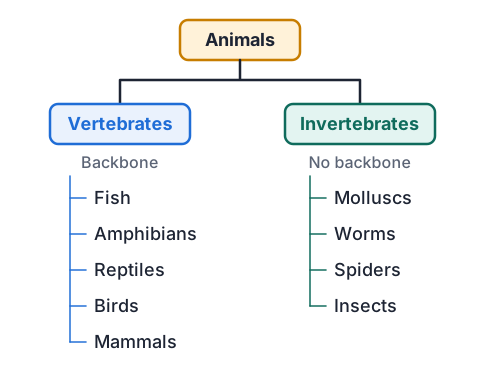
- Animals are first sorted into two big groups by one feature: a backbone.
- A vertebrate is an animal with a backbone. Fish, amphibians, reptiles, birds and mammals are vertebrates.
- An invertebrate is an animal without a backbone. Molluscs, worms, spiders and insects are invertebrates.
| Group | Backbone? | New Zealand example |
|---|---|---|
| Fish | Yes | Snapper |
| Amphibians | Yes | Archey's frog |
| Reptiles | Yes | Tuatara, geckos |
| Birds | Yes | Kiwi, tūī |
| Mammals | Yes | Long-tailed bat, people |
| Molluscs | No | Pāua, garden snail |
| Worms | No | Earthworm |
| Spiders | No | Kātipo |
| Insects | No | Wētā, monarch butterfly |
Try it: backbone or not?
Microorganisms
- A microorganism is a living thing so small that you need a microscope to see it. "Micro" means very small.
- A microscope is a tool with lenses that makes tiny things look many times bigger.
- Bacteria are microorganisms, and so are some algae and yeasts.
- A single drop of pond water can hold hundreds of microorganisms that you cannot see with your eyes alone.
Classification keys
- A classification key is a tool for finding out what an organism is.
- It is a list of questions about features you can see, each with two answers, such as "Does it have flowers? Yes or no."
- Each answer sends you to the next question, until you reach the organism's name.
- Good questions are about features anyone can check, such as legs, shells or flowers. Questions about colour or size can trick you, because these can change.
Example: using a key on four plants
- Tama finds four plants on a bush walk: a kōwhai, a kauri, a ponga and a patch of moss.
- Use the key in the figure to name a plant that has no flowers, no cones and large fronds.
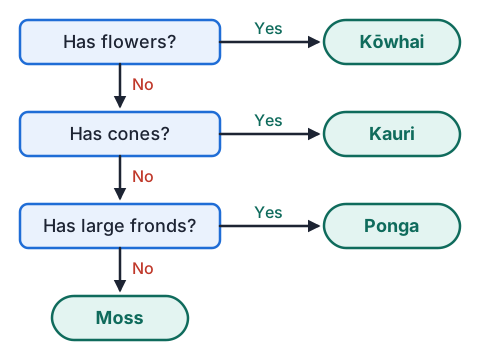
- Has flowers? Nogo to the next question
- Has cones? Nogo to the next question
- Has large fronds? Yesfollow the yes arrow
- The plant is a ponga
Example: designing a key for four animals
- Make a key that separates a kiwi, a tuatara, a wētā and a pāua.
- 1. Has a backbone? Yes: go to 2. No: go to 3.split vertebrates from invertebrates
- 2. Has feathers? Yes: kiwi. No: tuatara.a bird and a reptile
- 3. Has a shell? Yes: pāua. No: wētā.a mollusc and an insect
- Three questions name all four animals
Common mistakes
- Seaweed is a plant because it is green and lives in water.Seaweed is an alga: it has no true roots, stems or leaves, so it is in a separate group from plants.
- Plants that live in water all go in the same group.Plants are grouped by their structures, not where they live; seagrass has flowers, so it is a flowering plant.
- A spider is an insect.Spiders have eight legs and two body parts; insects have six legs and three body parts, so they are different groups.
- A key question can be "Is it big?"Use features anyone can check the same way, such as "Does it have a shell?", because big means different things to different people.
Make a key for leaves from your garden
You need: 6 different leaves from a garden or park, a sheet of paper, a pencil, a family member to test your key
- With an adult, collect six leaves that look different from each other.
- Lay them out and find one feature that splits them into two groups, such as "Is the edge smooth or jagged?"
- Keep splitting each group with a new yes or no question until every leaf is on its own.
- Write your questions down as a key, then hand one leaf to a family member and ask them to name it using only your key.
- If they get it wrong, look for the question that confused them and make it clearer.
Safety: Have an adult check each plant before you pick from it, because some garden plants are poisonous or prickly, and wash your hands afterwards.
Your turn
A kauri makes seeds in cones and has no flowers. Which plant group is it in?
A tuatara has a backbone. Is it a vertebrate or an invertebrate?
Why is kelp not classified as a plant?
An animal has eight legs, two body parts and no backbone. Is it an insect or a spider?
Which of these can only be seen with a microscope: a bacterium, a moss or an ant?
Show answer
1. Cone-bearing plants. 2. A vertebrate (it is a reptile). 3. It has no true roots, stems or leaves, so it is an alga, not a plant. 4. A spider, because insects have six legs and three body parts. 5. A bacterium, because it is a microorganism.
Recap
- Classification sorts organisms into groups by shared features; related organisms end up together.
- Plants are grouped by structure: flowering plants, cone-bearing plants, ferns and mosses.
- Algae have no true roots, stems or leaves, so they are not plants.
- Vertebrates (fish, amphibians, reptiles, birds, mammals) have a backbone; invertebrates (molluscs, worms, spiders, insects) do not.
- Microorganisms can only be seen with a microscope.
- A classification key uses yes or no questions about features you can see to name an organism.
Report a mistake
How is Year 5 maths going?
See the Year 5 maths guide