 Vertex Learn
Earth's tilt, the seasons, Matariki and Puanga
What this lesson covers
- Earth's axis and its tilt of about 23.5 degrees
- How the tilt points our half of Earth towards or away from the Sun during the year
- Why a high sun and long days make summer, and a low sun and short days make winter
- Reading real day-length data for New Zealand
- Matariki and Puanga, the stars that many iwi use to mark the new year
Earth leans over
- Earth spins around an imaginary line that goes through the North Pole and the South Pole. This line is called the axis.
- One full spin takes a day. The side facing the Sun has daytime, and the side facing away has night.
- Earth's axis is not straight up and down. It is tilted, or leaning, by about 23.5 degrees.
- Earth is divided into two halves by the equator. New Zealand is in the southern half, called the Southern Hemisphere.
The tilt as Earth goes round the Sun
- Earth travels around the Sun once a year. Its path is called its orbit.
- As Earth moves, its axis keeps leaning the same way in space. It does not swing round to face the Sun.
- So in December the Southern Hemisphere leans towards the Sun, and it is summer in New Zealand.
- In June the Southern Hemisphere leans away from the Sun, and it is winter here.
- At the same time the Northern Hemisphere has the opposite season, so December is winter in Japan and Canada.
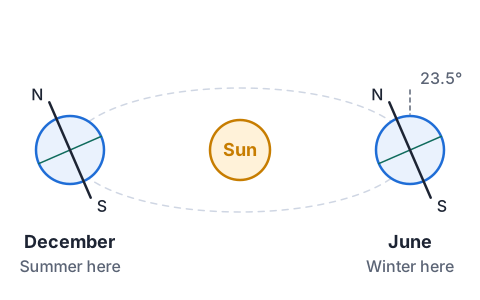
Try it: the tilt and the seasons
High sun, low sun
- When our half of Earth leans towards the Sun, the Sun climbs high in the sky at midday.
- Sunlight from a high sun hits the ground almost straight on, so its energy is packed into a small area. The ground warms up a lot.
- In winter the midday sun stays low. The same sunlight comes in at a slant and spreads over a bigger area, so each part of the ground gets less energy.
- You can check this with your shadow: at midday in summer it is short, and at midday in winter it is long.
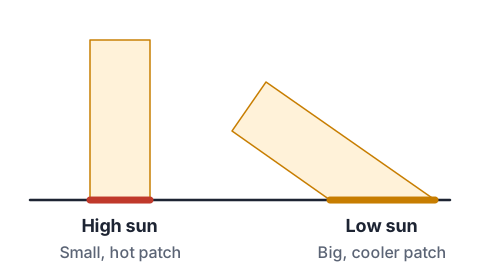
Long days and short days
- The tilt also changes how many hours of daylight we get.
- When the Southern Hemisphere leans towards the Sun, New Zealand spends more of each spin in sunlight. Days are long and nights are short.
- When it leans away, New Zealand spends more of each spin in darkness. Days are short and nights are long.
- Summer is warm for two reasons that add together: the sun is higher, and it shines for more hours.
| Season in New Zealand | Months | Midday sun | Daylight |
|---|---|---|---|
| Summer | December to February | High | Long |
| Autumn | March to May | Getting lower | Getting shorter |
| Winter | June to August | Low | Short |
| Spring | September to November | Getting higher | Getting longer |
Example: reading Auckland's day lengths
- The table shows how long the sun was up in Auckland on the 21st of each month in 2026.
- Which month had the longest day and which had the shortest? How big is the difference?
| Month | Daylight |
|---|---|
| January | 14 h 16 min |
| February | 13 h 13 min |
| March | 12 h 8 min |
| April | 10 h 57 min |
| May | 10 h 1 min |
| June | 9 h 38 min |
| July | 9 h 59 min |
| August | 10 h 55 min |
| September | 12 h 3 min |
| October | 13 h 14 min |
| November | 14 h 15 min |
| December | 14 h 42 min |
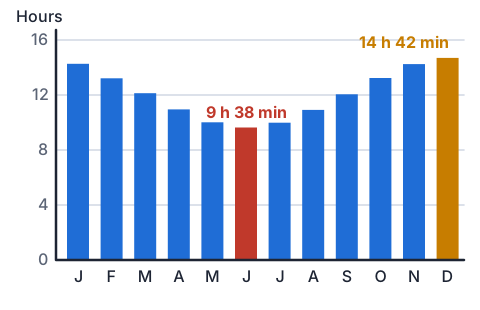
- Longest: December, 14 h 42 minread the biggest value
- Shortest: June, 9 h 38 minread the smallest value
- 14 h 42 min − 9 h 38 min = 5 h 4 minsubtract hours, then minutes
- December's day was 5 h 4 min longer than June's
Further south, bigger change
- The further a place is from the equator, the bigger the difference between summer days and winter days.
- Invercargill is much further south than Auckland. Its summer days are longer and its winter days are shorter.
| City | 21 June | 22 December | Difference |
|---|---|---|---|
| Auckland | 9 h 38 min | 14 h 42 min | 5 h 4 min |
| Invercargill | 8 h 35 min | 15 h 49 min | 7 h 14 min |
Different stars at different times of year
- At night our part of Earth has turned away from the Sun, so we look out into space.
- As Earth travels round its orbit, the night side faces a different part of space, so different stars are in the sky at different times of year.
- A constellation is a group of stars that people see as a pattern, such as Orion.
- Because the pattern repeats every year, people have long used the stars as a calendar.
Matariki and Puanga
- Matariki is a cluster of stars, also known as the Pleiades. A star cluster is a group of stars close together in the sky.
- In midwinter Matariki appears in the eastern sky just before dawn. For many Māori its rising marks the start of a new year, and iwi celebrate it in different ways and at different times.
- Since 2022 New Zealand has had a public holiday for Matariki in June or July.
- Puanga is the Māori name for Rigel, a bright star in the constellation Orion. It shows in the early morning sky before Matariki does.
- Some iwi on the west coast of the North Island, including Taranaki, Whanganui and Rangitīkei, use Puanga to mark the new year.
| Name | Also called | What it is |
|---|---|---|
| Matariki | The Pleiades | A cluster of stars |
| Puanga | Rigel | One bright star in Orion |
Try it: find Matariki
Common mistakes
- It is summer because Earth is closer to the Sun.Seasons come from the tilt; when it is summer in New Zealand it is winter in the Northern Hemisphere, at the same distance from the Sun.
- Earth's axis swings round so it always leans towards the Sun.The axis keeps leaning the same way in space, so each hemisphere leans towards the Sun for part of the year and away for the rest.
- Summer is warm only because the days are longer.Long days help, but the high midday sun matters too, because straight-on sunlight packs more energy into each patch of ground.
- Matariki is a single star.Matariki is a cluster of many stars; Puanga is the single star Rigel.
Model the seasons with a torch and a ball
You need: a ball, such as a tennis ball or an orange, a marker pen, a small sticker, a torch, a table in a dark room
- Draw a line round the middle of the ball for the equator, and put the sticker below it for New Zealand.
- Stand the torch on the table pointing sideways, and switch it on in the dark room.
- Hold the ball a short way from the torch with the bottom of the ball leaning towards the torch. Turn the ball slowly and count how long the sticker stays in the light.
- Now walk to the other side of the torch, keeping the ball leaning towards the same wall, and turn it again.
- Look for this: when the bottom leans towards the torch, the sticker spends longer in the light (summer); when it leans away, the sticker spends longer in the dark (winter).
Safety: Have an adult with you in the dark room, clear the floor so nobody trips, and never shine the torch into anyone's eyes.
Your turn
About how many degrees is Earth's axis tilted?
In December, does the Southern Hemisphere lean towards the Sun or away from it?
Use the Auckland table. Which month had the shortest day, and how long was it?
A torch beam shines straight down on the floor, then at a slant. Why does the slanted beam warm each part of the floor less?
In which season does Matariki appear in the dawn sky in New Zealand?
Show answer
1. About 23.5 degrees. 2. Towards the Sun, which is why December is summer in New Zealand. 3. June, with 9 h 38 min of daylight. 4. The same light is spread over a bigger area, so each part gets less energy. 5. Midwinter, around June or July.
Recap
- Earth spins on an axis tilted by about 23.5 degrees, and the tilt keeps pointing the same way.
- In December the Southern Hemisphere leans towards the Sun (summer); in June it leans away (winter).
- A high sun packs its energy into a small area; a low sun spreads it out.
- Summer days are long and winter days are short, and the change is bigger further from the equator.
- Different stars are seen at different times of year.
- Matariki is a star cluster and Puanga is the star Rigel; both mark the new year for different iwi.
The maths behind it
Report a mistake
How is Year 5 maths going?
See the Year 5 maths guide