Metric units, measuring and volume
What this lesson covers
- Measurements can be approximated by referencing previously measured benchmark lengths, volumes, or areas.
- Prefixes are added to base metric units to signify larger or smaller quantities. The prefix: 'milli–' (m) signifies a unit one thousand times smaller than the base unit 'centi–' (c) signifies a unit one hundred times smaller than the base unit 'kilo–' (k) signifies a unit one thousand times larger than the base unit.
- Converting between metric units can involve multiplying and dividing by 10, 100, or 1000.
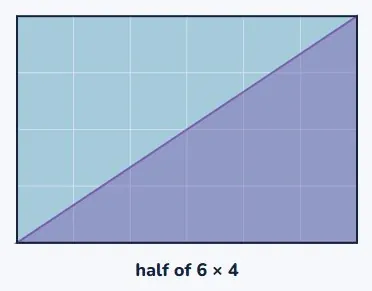
- The area of a right-angled triangle is equal to half the area of a rectangle with the same base and height.
You do not have to memorise a conversion table
- How many millimetres in a metre? Centimetres in a metre?
- Metres in a kilometre? Grams in a kilogram?
- That is four facts, and there are only three things to know.
- The words already tell you the numbers.
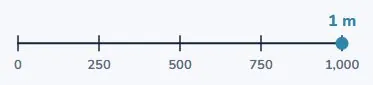
Milli means a thousandth
- A millimetre is a thousandth of a metre.
- So there are 1000 millimetres in a metre.
- The prefix is the fact. Nothing else to remember.
Centi means a hundredth
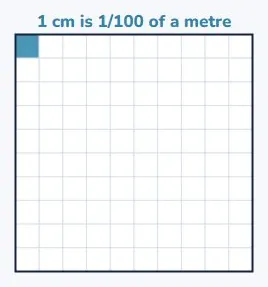
- A centimetre is a hundredth of a metre.
- So 100 centimetres make a metre.
- Same word as in "century": a hundred years.
Kilo means a thousand times bigger
- This one goes the other way: bigger, not smaller.
- A kilometre is a thousand metres.
- A kilogram is a thousand grams.
| Prefix | Means | So |
|---|---|---|
| milli– | a thousandth | 1000 mm = 1 m |
| centi– | a hundredth | 100 cm = 1 m |
| kilo– | a thousand times | 1000 m = 1 km |
And they work on everything
- The three prefixes are not about length. They are about size.
- So they attach to grams and litres in exactly the same way.
- Learn three words and you know every conversion in Year 6.
| Measures | Base unit | With prefixes |
|---|---|---|
| Length | metre | mm, cm, km |
| Mass | gram | mg, g, kg |
| Capacity | litre | mL, L |
Three rows, not twelve
- This is the whole of metric conversion.
- Every question is a multiply or divide by 10, 100 or 1000.
- Which one, and which direction: that is all you decide.
| Prefix | Means | So |
|---|---|---|
| milli– | a thousandth | 1000 mm = 1 m |
| centi– | a hundredth | 100 cm = 1 m |
| kilo– | a thousand times | 1000 m = 1 km |
Metres to centimetres
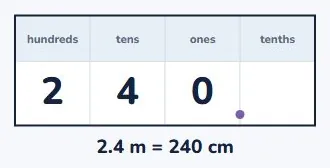
- Change 2.4 m into centimetres.
- 100 cm in a metre, so multiply by 100.
- 2.4 × 100 = 240 cm.
- Every digit moved up two columns, exactly as in the decimals lesson.
Grams to kilograms
- Change 2500 g into kilograms.
- 1000 g in a kilogram, so divide by 1000.
- 2500 ÷ 1000 = 2.5 kg.
| Change | Do this | Answer |
|---|---|---|
| 2.4 m to cm | × 100 | 240 cm |
| 2500 g to kg | ÷ 1000 | 2.5 kg |
| 3 km to m | × 1000 | 3000 m |
| 45 mm to cm | ÷ 10 | 4.5 cm |
Which way round? Ask which unit is bigger
- Going to a smaller unit needs MORE of them, so multiply.
- Going to a bigger unit needs FEWER, so divide.
- 2.4 m became 240 cm: more centimetres than metres. Correct.
- If your number went the wrong way, you divided instead of multiplying.
| Going to a… | You need | So |
|---|---|---|
| smaller unit | more of them | multiply |
| bigger unit | fewer of them | divide |
Combining mixed units
- 10 kg and 500 g. Write it as one number in kilograms.
- 500 g is half a kilogram, so 0.5 kg.
- 10 + 0.5 = 10.5 kg.
| Mixed | The small part | As one number |
|---|---|---|
| 10 kg and 500 g | 500 g is 0.5 kg | 10.5 kg |
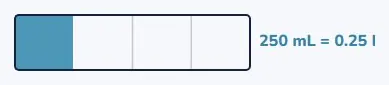
| 1 L and 250 mL | 250 mL is 0.25 L | 1.25 L |
| 2 m and 40 cm | 40 cm is 0.4 m | 2.4 m |
The same with capacity
- 1 L and 250 mL. There are 1000 mL in a litre.
- 250 out of 1000 is a quarter, so 0.25 L.
- 1 + 0.25 = 1.25 L.
- Two decimal places, and both of them mean something.
One thing is not metric: time
- 60 seconds in a minute. 60 minutes in an hour.
- No prefixes, and nothing divides by 10.
- So 2.5 hours is 2 hours 30 minutes, not 2 hours 50.
- Be careful when time turns up in a measuring question.
| Measurement | Divides by |
|---|---|
| Length, mass, capacity | 10, 100, 1000 |
| Time | 60 |
Reading a real instrument
- Ruler for length. Scales for mass. Jug for capacity.
- Thermometer for temperature. Timer for duration.
- For each one, check what the small marks are worth first.
- Not every ruler counts in millimetres, and not every jug in 100s.
| Measuring | Instrument | Units |
|---|---|---|
| Length | ruler | mm, cm, m |
| Mass | scales | g, kg |
| Capacity | measuring jug | mL, L |
| Temperature | thermometer | degrees |
| Duration | timer | min, s |
Estimating from things you already know
- A benchmark is a measurement you carry in your head.
- A doorway is about 2 m. A bag of sugar is 1 kg.
- A big drink bottle is 1 L. A fingernail is about 1 cm.
- Compare the unknown thing with one of those.
| Benchmark | Roughly |
|---|---|
| A doorway | about 2 m tall |
| A bag of sugar | 1 kg |
| A big drink bottle | 1 L |
| A fingernail | about 1 cm across |
Using one
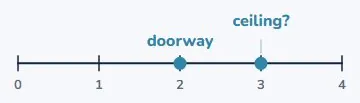
- How tall is your classroom? You cannot reach the ceiling.
- But the doorway is about 2 m, and the ceiling is higher.
- Looks like about one and a half doorways, so roughly 3 m.
- Not exact, and not meant to be. Sensible is the goal.
Volume is how many cubes fit inside
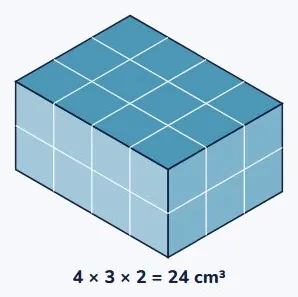
- Take a box 4 cm long, 3 cm wide and 2 cm tall.
- The bottom layer holds 4 × 3 = 12 centimetre cubes.
- There are 2 layers, so 12 × 2 = 24 cubes.
- That is 24 cubic centimetres.
So volume is just three lengths multiplied
- Length × width × height.
- It works in any order: 4 × 3 × 2 or 2 × 3 × 4.
- Counting the layers is why it works.
| Step | Working | Answer |
|---|---|---|
| One layer | 4 × 3 | 12 cubes |
| All layers | 12 × 2 | 24 cubes |
Why the little 3
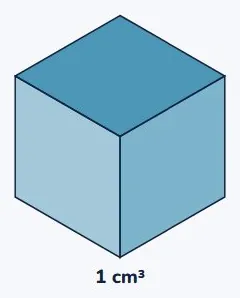
- cm³ is read "cubic centimetres": a cube 1 cm each way.
- The 3 says three lengths were multiplied together.
- A cubic metre, m³, is a cube a metre each way. Much bigger.
- Use cm³ for a lunchbox and m³ for a room.
One fact to carry into the next lesson
- Draw a rectangle and cut it corner to corner.
- You get two identical right-angled triangles.
- So a right-angled triangle is exactly half its rectangle.
- Part 2 uses that to work out areas.
Four to try
- 1. How many millimetres in 7 cm?
- 2. Write 3 kg and 250 g as one number in kilograms.
- 3. A box is 5 cm by 2 cm by 3 cm. What is its volume?
- 4. Estimate the height of a normal room, using a benchmark.
Show answer
Answers: 1. 70 mm: 10 mm in a centimetre, and going to a smaller unit means more of them. 2. 3.25 kg, because 250 g is a quarter of a kilogram. 3. 30 cm³ (5 × 2 × 3), and the units must be cubic. 4. Around 2.4 to 3 m; accept anything sensible with a stated benchmark, and reject a number with no reasoning behind it. On 3, watch for an answer written cm or cm² instead of cm³.
Three prefixes and one direction check
- Milli, centi, kilo: on metres, grams and litres alike.
- Smaller unit means more of them, so multiply.
- And volume is three lengths multiplied, in cubic units.
| Prefix | Means | So |
|---|---|---|
| milli– | a thousandth | 1000 mm = 1 m |
| centi– | a hundredth | 100 cm = 1 m |
| kilo– | a thousand times | 1000 m = 1 km |
Is your child on track?
Take the free placement test