 Vertex Learn
Darwin, Wallace, new species and common ancestry
What this lesson covers
- How Darwin and Wallace presented natural selection together
- How helpful inherited traits spread through a population over generations
- Why populations evolve but individuals do not
- How new species form from a shared ancestor
- Extinction when a species cannot cope with change
- Common ancestry, and inferring how a fossil organism lived
Two naturalists, one idea
- Charles Darwin sailed round the world on HMS Beagle from 1831 to 1836, collecting animals, plants and fossils. He even stopped in the Bay of Islands in December 1835.
- Back in England he spent over twenty years gathering evidence for natural selection, but did not publish.
- Alfred Russel Wallace, collecting animals in the islands of South-East Asia, came to the same idea on his own and in 1858 sent Darwin an essay describing it.
- Their work was presented together at a scientific meeting in London in July 1858, and Darwin published his book On the Origin of Species the next year.
- Two people reaching the same explanation from different evidence made the idea much harder to dismiss.
Helpful traits spread over generations
- Natural selection works over many generations, not overnight.
- Individuals with a heritable trait that helps them survive or breed are a little more likely to leave offspring.
- Their offspring inherit the trait, so in the next generation a slightly bigger share of the population has it.
- Repeat that over many generations and a rare trait can become the common one.
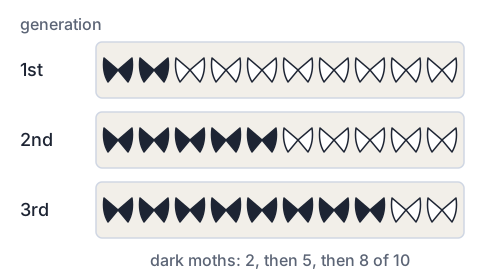
The peppered moth
- Peppered moths in England come in a pale speckled form and a dark form. Before the 1800s the pale form was common. As factories spread, soot blackened tree trunks, and by the late 1800s dark moths were common in industrial areas. Explain why.
- Variation: some moths are pale, some dark, and colour is inheritedthe raw material
- Selection pressure: birds hunt moths resting on tree trunkswhat decides survival
- On soot-blackened bark, dark moths are harder to seeso more dark moths survive and breed
- Over many generations, dark moths became the common form in sooty areas
- When clean-air laws reduced soot, pale moths became common againthe pressure reversed
Populations evolve, individuals do not
- A single moth cannot change its colour to survive. It is born pale or dark and stays that way.
- What changes is the population: the share of dark and pale moths shifts from one generation to the next.
- Evolution means a change in the inherited traits of a population over generations.
- So it is wrong to say an animal evolves during its life. It grows and learns, but it does not evolve.
From one ancestor to new species
- If groups of one species live in different places with different selection pressures, each group changes in its own way.
- Over very long periods the changes add up until the groups are so different that they can no longer breed together. They are now separate species.
- New Zealand's kea, kākā and kākāpō are all descended from one ancestral parrot.
- The kākāpō became a heavy, flightless parrot that feeds at night on the ground. The kea adapted to cold South Island mountains, and the kākā to life in native forest.
- Their shared ancestry shows in their features and their DNA.
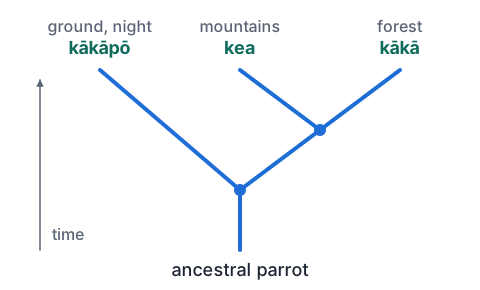
Try it: kea, kākā or kākāpō?
Some species cannot keep up
- Natural selection can only work on variation a population already has, and it needs many generations.
- If the environment changes faster than that, the species may die out.
- New Zealand had nine species of moa, huge flightless birds. After people arrived, moa were hunted and much of their habitat was burned, and within a few centuries every species was extinct.
- Haast's eagle, which hunted moa, then died out too, because it lost its main food.
Try it: why did it die out?
All life is related
- All vertebrates (animals with a backbone) share a body plan: a backbone, a skull, and limbs built from the same set of bones.
- The same upper-arm bone, two forearm bones, wrist bones and finger bones appear in your arm, a bat's wing, a whale's flipper and a bird's wing, shaped for different jobs.
- All living things use DNA in the same way to carry their genetic information.
- The evidence collected so far supports the idea that all living organisms are related, descended from shared ancestors over billions of years.
Reading a fossil
- A fossil skeleton has a long, streamlined body, paddle-shaped limbs, a long snout full of sharp cone-shaped teeth, and was found in rock that also holds fossil sea shells. What was the animal like and where did it live?
- Streamlined body and paddle limbsbuilt for swimming
- Sharp cone-shaped teethfor gripping slippery prey such as fish
- Rock with sea shellsthe rock formed on the sea floor
- A swimming predator that hunted fish in the sea
Common mistakes
- The moths turned dark so they could hide on sooty trees.No moth changed colour; dark moths already existed and survived better, so their share of the population grew.
- Humans evolved from chimpanzees.Humans and chimpanzees share a common ancestor; neither evolved from the other.
- Darwin came up with natural selection completely on his own.Wallace reached the same idea independently, and their work was presented together in 1858.
- Evolution happens to an animal during its lifetime.Evolution is a change in a population's inherited traits across generations.
A camouflage hunt
You need: a sheet of newspaper, a sheet of plain white paper, a hole punch or scissors, a timer, a helper
- Punch or cut 20 small circles from the newspaper and 20 from the white paper. These are your moths.
- Lay the full sheet of newspaper on the floor and have your helper scatter all 40 circles over it while you look away.
- Turn round and pick up as many circles as you can, one at a time, in 20 seconds. These have been eaten by a bird.
- Count how many of each kind are left: these survived and will breed.
- Look for the pattern: more newspaper circles survive because they blend in, so in the next generation the camouflaged form would be more common.
Safety: Small paper circles are a choking hazard for babies and toddlers, so play away from little children and pick up every circle afterwards.
Your turn
Why was it important that Wallace reached the same idea as Darwin?
A rabbit population lives where winter snow now lasts longer. Rabbits with whiter fur are seen less by hawks. What happens to the population over many generations?
Can a single rabbit evolve whiter fur? Explain.
Kea and kākā look alike but cannot interbreed. What does this tell you about where they came from?
A fossil has broad, flat, ridged teeth and was found among fossil leaves. What did it probably eat?
Show answer
1. Two people reaching it independently from different evidence made it far more convincing. 2. Whiter rabbits survive and breed more, so white fur becomes more common in the population. 3. No; an individual's inherited fur colour does not change, only the population's mix changes over generations. 4. They are separate species that evolved from a shared ancestor. 5. Plants, because flat ridged teeth grind tough leaves.
Natural Selection
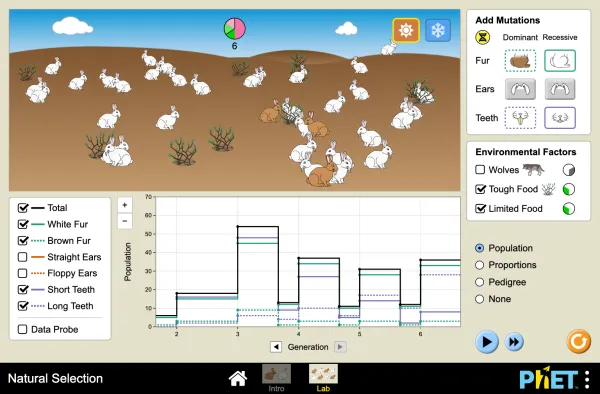
Full screen · PhET Interactive Simulations, University of Colorado Boulder, CC BY 4.0
Recap
- Darwin and Wallace reached natural selection independently and presented it together in 1858.
- Over many generations, inherited traits that help survival or breeding become more common, like dark peppered moths on sooty trees.
- Evolution is change in a population across generations, never in one individual.
- Changes that build up over long periods split one ancestor into new species, such as the kea, kākā and kākāpō.
- Species that cannot cope with fast change die out, like the moa, and shared features and DNA show all life is related.
Report a mistake
How is Year 8 maths going?
See the Year 8 maths guide