 Vertex Learn
Sexual and asexual reproduction, and how a mammal develops
What this lesson covers
- Why every kind of living thing must reproduce
- Sexual reproduction: two parents and a mix of traits
- Asexual reproduction: one parent and identical offspring
- Sperm, eggs and fertilisation in animals
- Gametes, zygote, embryo and foetus in mammals
- Puberty as the start of being able to reproduce
Every living thing reproduces
- Reproduction is making new individuals of the same kind. It is one of the life processes shared by all living things.
- No individual lives forever, so a species survives only if its members reproduce.
- There are two main ways to do it: sexual reproduction, with two parents, and asexual reproduction, with one.
Sexual and asexual reproduction
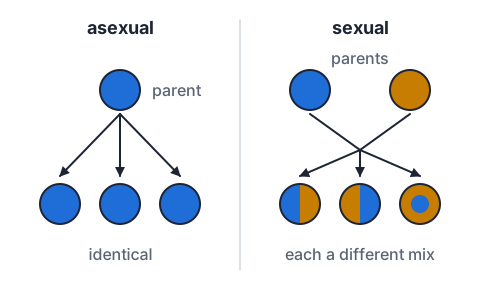
- Sexual reproduction needs two parents. Each provides a special sex cell called a gamete, and the two gametes join.
- The offspring get a mix of features from both parents, so brothers and sisters differ from each other and from their parents.
- Asexual reproduction needs only one parent and no gametes. The offspring are genetically identical copies, or clones, of that parent.
- Strawberry plants send out runners that grow into new plants, potatoes sprout from tubers, and bacteria simply split in two. All of these are asexual.
Try it: sexual or asexual?
Advantages of each
- Each way of reproducing suits different situations.
| Sexual | Asexual | |
|---|---|---|
| Parents | Two | One |
| Gametes | Yes, they join at fertilisation | None |
| Offspring | A mix of both parents; all different | Identical to the parent |
| Speed | Slower, needs a partner | Fast, no partner needed |
| Advantage | Variation, so some may survive a change such as a new disease | Can fill a good habitat quickly |
Animals: sperm, eggs and fertilisation
- Most animals reproduce sexually. Males make small gametes called sperm that can swim; females make larger gametes called eggs (ova).
- Fertilisation is when a sperm and an egg join, so their genetic information combines into one new cell.
- In many fish and frogs, fertilisation happens outside the body, in the water. Birds, reptiles and mammals use internal fertilisation, inside the female's body.
- A kiwi egg is fertilised inside the female, then laid; a mammal's young develop inside the mother.
From gametes to birth in a mammal
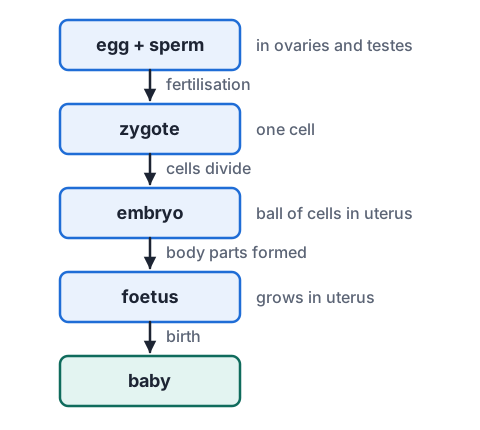
- Gametes form: sperm in the testes of the male, eggs in the ovaries of the female.
- Fertilisation: a sperm joins an egg in the oviduct (the tube leading to the uterus), making a single cell called a zygote.
- The zygote divides again and again into a ball of cells, the embryo, which settles into the soft lining of the uterus.
- Once the main body parts have formed, the developing young is called a foetus. In humans this is from about the ninth week.
- The foetus keeps growing in the uterus until birth, which in humans is about nine months after fertilisation.
Putting the stages in order
- A student's cards say: foetus, egg and sperm, birth, embryo, zygote. Put them in order and say what happens at each change.
- Egg and spermgametes made in the ovaries and testes
- → zygotefertilisation joins them into one cell
- → embryothe cell divides many times and settles in the uterus
- → foetusbody parts have formed; it grows larger
- Egg and sperm, zygote, embryo, foetus, birth
Try it: zygote, embryo or foetus?
Puberty
- Animals are not able to reproduce from birth. They first have to grow and develop.
- In humans, puberty is the stage when the body develops the ability to reproduce.
- It is triggered by chemical messengers called hormones, and brings changes such as growth spurts, body hair, and the ovaries or testes starting to release eggs or make sperm.
- Puberty starts at different ages for different people, and the changes happen gradually. Your Health and PE lessons cover it in more detail.
Comparing plants, animals and fungi
- Organise what you know about reproduction in three kingdoms into a table, then pick out one similarity and one difference.
| Flowering plants | Animals | Fungi | |
|---|---|---|---|
| Sexual? | Yes: pollen and egg cells in flowers | Yes: sperm and eggs | Many can |
| Asexual? | Often: runners, bulbs, tubers, cuttings | Rarely: some, like sea anemones, split into copies | Yes: spores, and yeast buds |
| How offspring spread | Seeds carried by wind, water or animals | Young move or are carried | Tiny spores blown by the wind |
- Similarity: all three groups can reproduce sexuallyread the first row
- Difference: fungi spread by spores, plants by seedsread the last row
- One similarity and one difference, each backed by the table
Common mistakes
- Plants only reproduce asexually.Flowering plants reproduce sexually through their flowers, and many can also reproduce asexually.
- Offspring of sexual reproduction are half copies of each parent, so they look exactly like a blend.Each offspring gets a different mix of the parents' genes, which is why siblings differ.
- The zygote, embryo and foetus are three different babies.They are three stages of the same developing individual, named by how far it has developed.
- A zygote is a sperm.A zygote is the single new cell made when a sperm and an egg join at fertilisation.
Grow a clone from a cutting
You need: a stem of mint or basil about 10 cm long, scissors, a clear glass or jar, water
- Cut a healthy stem just below a leaf joint, where the leaves join the stem.
- Pull off the leaves from the bottom half of the stem.
- Stand the stem in the glass with water covering the bare part but not the top leaves, and put it on a bright windowsill out of strong sun.
- Change the water every two days and check the stem daily for a week or two.
- Look for white roots growing from the leaf joints: you have made a new plant from one parent, an asexual clone of it.
Safety: Only take cuttings from plants you know, such as mint or basil, because some garden plants have sap that irritates skin; use the scissors carefully and wash your hands afterwards.
Your turn
A flax bush (harakeke) is divided and replanted as five new plants. Is this sexual or asexual reproduction?
Why are siblings from the same two parents usually different from each other?
What is made at fertilisation?
Give the stage that follows the embryo in a mammal.
Give one advantage of asexual reproduction.
Show answer
1. Asexual: there is one parent and the new plants are identical to it. 2. Each gets a different mix of genes from the two parents. 3. A zygote, a single new cell from a sperm and an egg joining. 4. The foetus. 5. It is fast and needs no partner, so a good habitat can be filled quickly.
Recap
- All living things reproduce, or their species would die out.
- Sexual reproduction has two parents and gives offspring a mix of their traits; asexual reproduction has one parent and gives identical clones.
- Animals reproduce sexually: sperm and eggs join at fertilisation.
- In mammals the stages are gametes, zygote, embryo, foetus and birth.
- Puberty is when the body develops the ability to reproduce.
Report a mistake
How is Year 8 maths going?
See the Year 8 maths guide