 Vertex Learn
Evidence for evolution, variation and natural selection
What this lesson covers
- What fossils show about life in the past, from crocodiles to trilobites
- Fossils, shared features and DNA as evidence that species change
- Variation between individuals of one species
- Heritable and non-heritable differences
- Selection pressures and how natural selection works
- How environmental change can drive species to extinction
What the fossil record shows
- Fossils show that living things have taken a huge range of forms over Earth's history.
- Some ancient forms look a lot like living ones. Fossil crocodiles from many millions of years ago have the same long snout and armoured back as crocodiles today.
- Others belong to whole groups that have died out. Trilobites, sea animals with jointed legs and a three-part body, were common for hundreds of millions of years and are now extinct. So are ammonites, coiled-shell sea animals often found as fossils in New Zealand rock.
- The tuatara is the only living member of a reptile group known mostly from fossils, so it is a living link to that ancient group.
Three kinds of evidence
- The theory of evolution says that populations and species change over time. In science, a theory is a big explanation backed by a large body of evidence, not a guess.
- Fossils: deeper rock layers are older, and the kinds of fossils change from layer to layer, so you can see life changing through time.
- Shared features: a human arm, a bat's wing and a whale's flipper have the same set of bones arranged in the same order, which makes sense if they came from a common ancestor.
- DNA: species that look closely related, such as different parrots, also have very similar DNA, and the similarity matches what the fossils and features suggest.
Reading the order of fossils
- A cliff shows four layers of sedimentary rock, numbered 1 at the bottom to 4 at the top, each with different fossils. What can you conclude?
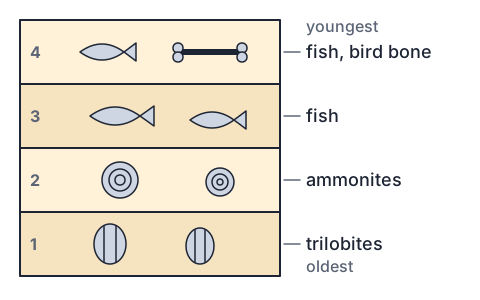
- Layer 1 is the oldest and layer 4 the youngestsediment settles on top of older sediment
- Trilobites only in layer 1they lived early, then vanished
- Fish appear in layer 3 and stay in layer 4; the bird bone is only in layer 4some groups appear later
- The kinds of living things changed over time: some groups died out and new ones appeared
Variation within a species
- Individuals of the same species are never exactly alike. These differences are called variation.
- Male Wellington tree wētā show striking variation: some have much bigger heads and jaws than others, which they use when fighting other males over a hole in a tree.
- In people, height, hair colour and the shape of ears all vary.
- Variation is the raw material evolution works on. Without differences, there would be nothing to select between.
Which differences are passed on?
- Some variation is heritable: it is coded in an organism's genes and can be passed from parents to their offspring.
- Other variation comes from the environment or from a lifetime of experience, and is not passed on.
- Only heritable variation matters for evolution, because only it can show up in the next generation.
| Difference | Heritable? | Why |
|---|---|---|
| Natural eye colour | Yes | Set by genes from the parents |
| Shell colour in a snail | Yes | Set by genes |
| A scar from a cut | No | Caused by an injury |
| Big muscles from training | No | Built up during a lifetime |
| Speaking te reo Māori | No | Learned, not in the genes |
Try it: heritable or not?
Selection pressures
- A selection pressure is any feature of the environment that affects which individuals survive or how many offspring they have.
- Examples include a shortage of food, predators, disease, cold spells, strong sunlight and competition for mates.
- Each pressure favours some variations over others. When birds hunt beetles on dark soil, dark beetles are harder to spot than pale ones.
How natural selection works
- Natural selection is the process that links variation and selection pressures.
- 1: Individuals in a population vary, and some of that variation is heritable.
- 2: A selection pressure means some variations give a better chance of surviving and breeding.
- 3: Individuals with those helpful variations, on average, leave more offspring.
- 4: Those offspring inherit the helpful variations, so the next generation has more of them.
Room 7's toothpick predators
- Room 7 scattered 20 green and 20 red toothpicks on a grassy patch. Students acted as birds, picking up as many toothpicks as they could find in one minute.
| Colour | Scattered | Found by birds | Survived |
|---|---|---|---|
| Green | 20 | 4 | 16 |
| Red | 20 | 17 | 3 |
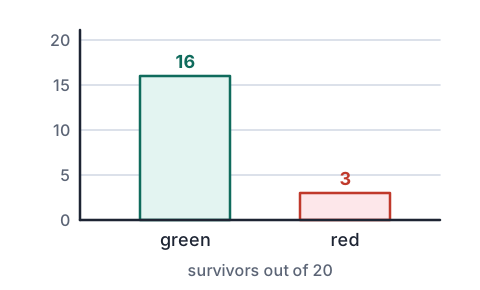
- Selection pressure: being seen and eaten by birdsthe hunters
- Green survived 16 out of 20; red only 3 out of 20compare survivors
- Green blends in with grass, so fewer were foundthe helpful variation
- If survivors bred, the next generation would be mostly green: camouflage is selected for
Try it: toothpicks the birds missed
When the environment changes too fast
- If the environment changes, a species may survive if some individuals already have variations that suit the new conditions.
- If none do, or the change is too fast for the population to keep up, the species can become extinct: every last individual dies.
- Habitat destruction is a major cause. The huia, a New Zealand bird of the North Island forests, became extinct in the early 1900s after much of its forest was cleared and it was hunted for its feathers.
- Changes in temperature, new predators, new diseases and the loss of a food supply can all push a species to extinction.
How the theory developed
- For a long time many people thought species never changed and never died out.
- Around 1800 the French scientist Georges Cuvier studied fossil bones such as those of mammoths and showed they belonged to animals no longer alive, so extinction is real.
- Jean-Baptiste Lamarck suggested that animals change by using body parts more, and pass on those changes. Later evidence did not support this, because features gained in a lifetime are not inherited.
- As more fossils, more careful studies of variation and finally DNA evidence came in, natural selection explained the evidence far better, which is how a scientific theory grows.
Common mistakes
- A theory in science is just a hunch.A scientific theory is a well-tested explanation supported by many lines of evidence.
- A giraffe that stretches its neck will have longer-necked babies.Changes gained during a lifetime are not passed on; only heritable variation is inherited.
- Animals choose to change so they can survive a new environment.Variation already exists by chance, and the environment selects which variations survive and breed.
- The strongest individual always survives natural selection.The best-suited survive, which might mean the best camouflaged or the one that copes with cold, not the strongest.
Measure variation in leaves
You need: 20 leaves from one tree or shrub, a ruler, a pencil and paper
- Collect 20 fallen leaves from one plant, choosing them without looking at their size.
- Measure the length of each leaf in millimetres, from the tip to where the stalk starts, and write the values down.
- Group the lengths into bands, such as 40 to 49 mm, 50 to 59 mm and so on, and tally how many leaves fall in each band.
- Draw a bar graph of the tallies.
- Look for the shape: most leaves cluster around a middle length with fewer very short or very long ones, which shows variation even within one plant.
Safety: Some garden plants, such as karaka and tutu, are poisonous, so use fallen leaves you can name, wash your hands afterwards, and never put leaves or berries in your mouth.
Your turn
Give two kinds of evidence that species change over time.
Is a tattoo heritable variation? Explain.
In a dry year, only finches with thick, strong beaks can crack the remaining hard seeds. What is the selection pressure?
In Room 7's activity, what would you expect if the toothpicks were scattered on red carpet instead?
Give one way habitat destruction can cause extinction.
Show answer
1. Any two of: fossils in rock layers, shared features such as the same limb bones, similar DNA. 2. No, because it is gained during a lifetime and is not in the genes. 3. Shortage of soft food, so only hard seeds are left. 4. Red toothpicks would survive better and green ones would be found more often. 5. Species lose their food and shelter, so if they cannot move or adapt, every individual dies.
Natural Selection
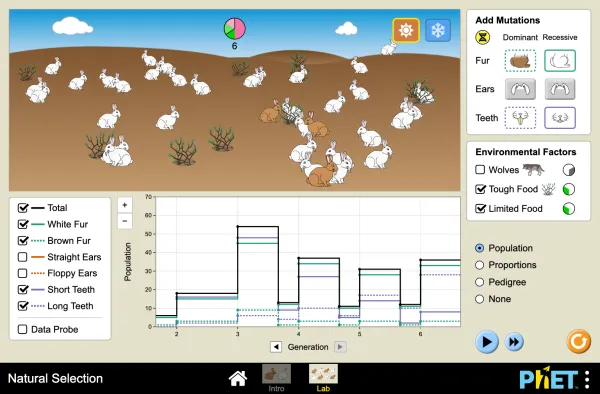
Full screen · PhET Interactive Simulations, University of Colorado Boulder, CC BY 4.0
Recap
- Fossils show life has taken many forms: some like living species, others from groups that are now extinct.
- Fossils, shared features and DNA are evidence that populations and species change over time.
- Individuals of one species vary, and only heritable variation can be passed on.
- Selection pressures such as predators, cold or food shortage favour some variations, so those individuals leave more offspring.
- If the environment changes too fast for a species, it can become extinct, as the huia did.
The maths behind it
Report a mistake
How is Year 8 maths going?
See the Year 8 maths guide