 Vertex Learn
Hormones, the menstrual cycle, flowers and fungi
What this lesson covers
- What a hormone is and how it reaches its target
- How hormones control ovulation and the uterus lining
- Hormones and sperm production
- The stages of reproduction in flowering plants
- How most fungi reproduce with spores
- Organising information to compare processes
Hormones: messages in the blood
- A hormone is a chemical messenger. It is made in one part of the body, released into the blood, and carried all round the body.
- It only affects certain target cells or tissues, which have the right receptors to respond to it, and it changes what those cells do.
- For example, insulin from the pancreas tells liver and muscle cells to take up sugar, and adrenaline gets the body ready for action when you are scared.
- Reproduction is controlled by hormones too, mainly from the pituitary gland at the base of the brain and from the ovaries or testes.
The menstrual cycle
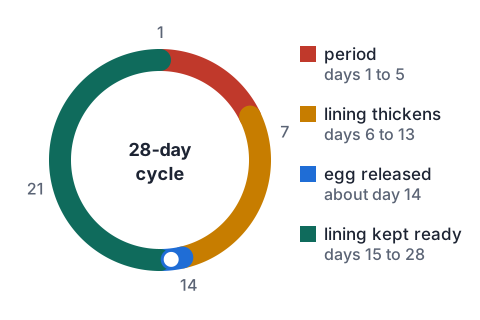
- From puberty, a female's body goes through a repeating cycle, often about 28 days long, though it varies from person to person and month to month.
- Hormones make an egg mature in an ovary and the lining of the uterus grow thick and full of blood vessels, ready to receive a fertilised egg.
- About halfway through the cycle, an egg is released from the ovary. This is ovulation.
- If the egg is not fertilised, hormone levels fall and the thick lining breaks down and leaves the body through the vagina over a few days. This bleeding is menstruation, or a period.
- Then the cycle starts again. If the egg is fertilised, hormones keep the lining in place and periods stop during pregnancy.
Hormones and sperm production
- From puberty, the testes make sperm all the time, millions every day, rather than in a monthly cycle.
- This is controlled by hormones from the pituitary gland, which signal the testes.
- The testes make the hormone testosterone, which keeps sperm production going and also causes changes at puberty, such as a deeper voice and more body hair.
Organising: female and male gametes
- Organise the facts about gamete production into a table, then state one similarity and one difference.
| Female | Male | |
|---|---|---|
| Gamete | Egg (ovum) | Sperm |
| Where made | Ovaries | Testes |
| How often released | About once a month | Made continuously |
| Controlled by | Hormones from the pituitary and ovaries | Hormones from the pituitary and testes |
- Similarity: both are controlled by hormones, including ones from the pituitarythe last row matches
- Difference: eggs are released in a monthly cycle, sperm are made all the timethe third row differs
- One similarity and one difference, each taken from a row of the table
Try it: egg or sperm?
How flowering plants reproduce
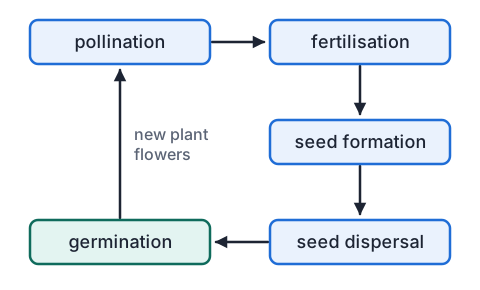
- Pollination: pollen, carrying the male gamete, moves from an anther to the stigma of a flower, carried by wind, insects or birds. Tūī and korimako (bellbirds) pollinate kōwhai and harakeke as they feed on nectar.
- Fertilisation: a tube grows from the pollen grain down to the ovary, and the male gamete joins an egg cell inside an ovule.
- Seed formation: the fertilised ovule becomes a seed holding a tiny plant and a food store, and the ovary around it often becomes a fruit.
- Seed dispersal: seeds are spread away from the parent by wind, water or animals. Kererū swallow large berries such as those of taraire and tawa and drop the seeds far away.
- Germination: with water, warmth and oxygen, the seed swells, a root grows down and a shoot grows up, starting a new plant.
Try it: put the steps in order
Why a forest needs kererū
- Some native trees have berries so large that only the kererū can swallow them. Explain what could happen to these trees if kererū disappeared from a forest.
- Kererū swallow the berries and drop the seeds elsewherethis is seed dispersal
- Without kererū, the berries fall under the parent treeno other animal carries them
- Seedlings there compete with the parent for light and watermost fail
- Fewer new trees grow in new places, so these trees slowly become rarer
Fungi reproduce with spores
- Most fungi reproduce by making spores: tiny cells, far too small to see one by one, that can grow into a new fungus.
- Moulds, such as the fuzz on old bread, make spores directly on short stalks that grow up from their threads. The dark dots you see are clusters of spores.
- Mushrooms make spores on thin gills or in tiny tubes under the cap. A single mushroom can release millions.
- Spores are so light that air currents carry them a long way. If one lands somewhere damp with food, it germinates and grows threads, starting a new fungus.
Common mistakes
- A hormone works on every cell it reaches in the blood.A hormone travels everywhere in the blood but only changes the target cells that can respond to it.
- A period is when the egg is released.The egg is released at ovulation, about halfway through the cycle; a period is the lining being shed when no fertilisation happened.
- Pollination and fertilisation are the same thing.Pollination moves pollen to the stigma; fertilisation happens later, when the male gamete joins the egg inside the ovule.
- Mushrooms grow from seeds.Fungi have no seeds; they grow from spores, which are single tiny cells.
Make a mushroom spore print
You need: a fresh flat (open) mushroom from the supermarket, a sheet of white paper, a sheet of dark paper, a bowl or glass to cover it
- Gently pull the stalk off the mushroom so the gills underneath are showing.
- Put the cap gills-down so it sits half on the white paper and half on the dark paper.
- Cover it with the upturned bowl so no draught moves the air, and leave it overnight.
- Lift the bowl and the cap off very carefully.
- Look for a print of fine lines matching the gills: it is made of millions of spores that fell from the gills, too small to see one at a time.
Safety: Use only mushrooms bought from a shop and never pick wild ones, because some New Zealand wild mushrooms are deadly; wash your hands after handling it, and throw it away afterwards rather than eating it.
Your turn
Give the three parts of the definition of a hormone.
What happens to the lining of the uterus if an egg is not fertilised?
Which hormone made by the testes keeps sperm production going?
Put these in order: germination, pollination, seed dispersal, fertilisation, seed formation.
Why can a mould appear on bread in a closed bag, even though nobody put it there?
Show answer
1. A chemical messenger, carried in the blood, that changes how its target cells work. 2. It breaks down and leaves the body as menstruation, a period. 3. Testosterone. 4. Pollination, fertilisation, seed formation, seed dispersal, germination. 5. Mould spores are tiny and floating in the air everywhere, so some were already on the bread or in the bag and germinated.
Recap
- A hormone is a chemical messenger carried in the blood that changes how its target cells work.
- In the menstrual cycle, hormones control ovulation and the thickening of the uterus lining, which is shed as a period if no fertilisation happens.
- Hormones from the pituitary and the testes keep sperm production going.
- Flowering plants go through pollination and fertilisation, then form seeds, which are dispersed and germinate.
- Most fungi reproduce by spores that drift in the air and germinate where it is damp and there is food.
Report a mistake
How is Year 8 maths going?
See the Year 8 maths guide