 Vertex Learn
Producers, consumers, decomposers and how organisms interact
What this lesson covers
- Producers, consumers and decomposers, and how they depend on each other
- How energy flows and matter cycles through an ecosystem
- Predators and prey, mutualism and parasitism
- What soil is made of and its part in recycling nutrients
- Measuring abiotic conditions with quadrats and transects
- Finding patterns in data about organisms and their surroundings
Three roles in an ecosystem
- An ecosystem is all the living things in an area together with their non-living surroundings, such as light, water, soil and temperature.
- Producers make their own food. Plants, algae and some bacteria use light energy to turn carbon dioxide and water into glucose, a carbohydrate, by photosynthesis.
- Consumers cannot make food, so they get energy and nutrients by eating producers or other consumers. Herbivores eat plants, carnivores eat animals, and omnivores eat both.
- Decomposers, mainly fungi and bacteria, break down dead plants, dead animals and waste, releasing nutrients back into the soil and water.
- Each group depends on the others, so the organisms are interdependent: remove one group and the rest suffer.
Energy flows, matter cycles
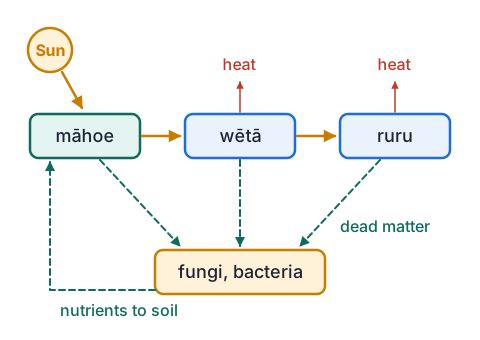
- A food chain shows what eats what, with arrows pointing the way energy goes: māhoe leaves → tree wētā → ruru (morepork).
- Energy enters as sunlight and passes along the chain, but at every step much of it is used for living and lost as heat. So energy flows through an ecosystem in one direction and must keep coming from the Sun.
- Matter is different. The carbon, nitrogen and other nutrients in living things are used again and again.
- When the leaf, the wētā and the ruru die, decomposers break them down and return their nutrients to the soil, where plant roots take them up. This is nutrient cycling.
Ways organisms interact
- Organisms in an ecosystem affect each other in several ways, as the table shows.
- A predator hunts and eats other animals, its prey. Numbers of predators and prey affect each other: more prey can feed more predators, and more predators mean fewer prey.
- In mutualism both partners benefit. In parasitism one organism, the parasite, lives on or in another, its host, and benefits while harming it.
| Relationship | Who gains, who loses | New Zealand example |
|---|---|---|
| Predator and prey | Predator gains, prey loses | Stoats hunt kiwi chicks; ruru hunt wētā |
| Mutualism | Both gain | Tūī get nectar from harakeke flowers and carry their pollen |
| Mutualism | Both gain | Bees get nectar and pollen from flowers and pollinate them |
| Parasitism | Parasite gains, host loses | Fleas feed on a dog's blood and make it itch |
Try it: name the relationship
Removing a predator
- A reserve traps out stoats. Predict and explain what happens to the kiwi population over the next few years.
- Stoats are predators of kiwi chicksthe relationship
- Fewer stoats, so more chicks survive to adulthoodless predation
- More adults, so more eggs and chicks in later yearsthe effect builds
- The kiwi population increases, as long as there is enough food and space
Soil: where nutrients are recycled
- Soil is made of rock particles, decaying organic matter (humus), living organisms, air and water.
- The living part is huge: plant roots, fungi, bacteria, earthworms, mites, slaters and insect larvae.
- Earthworms and slaters break dead leaves into small pieces, then fungi and bacteria decompose them, releasing nutrients such as nitrogen that plants need.
- Without soil organisms, dead leaves would pile up and plants would run short of nutrients.
Measuring an ecosystem
- Abiotic factors are the non-living conditions: light, temperature, water, wind and soil type. Biotic factors are the living things.
- Light intensity can be measured with a light meter (many phones have one in an app), temperature with a thermometer, and soil moisture with a probe or by weighing soil before and after drying.
- A quadrat is a square frame, often 1 m by 1 m, placed on the ground so you can count or estimate what is inside it.
- A transect is a straight line, such as a measuring tape, laid across an area where conditions change. Placing quadrats at regular distances along it shows how organisms change as the conditions change.
- Repeat counts and readings at each point, and record them in a table planned beforehand.
Try it: estimate with quadrats
A sand dune transect
- Room 15 laid a tape from the high-tide line up a dune and put a quadrat every 10 m. In each one they counted sandhoppers under seaweed and debris, and estimated the percentage of ground covered by marram grass.
| Distance from high tide | Sandhoppers | Marram grass cover |
|---|---|---|
| 0 m | 34 | 0% |
| 10 m | 12 | 10% |
| 20 m | 3 | 55% |
| 30 m | 0 | 80% |
| 40 m | 0 | 60% |
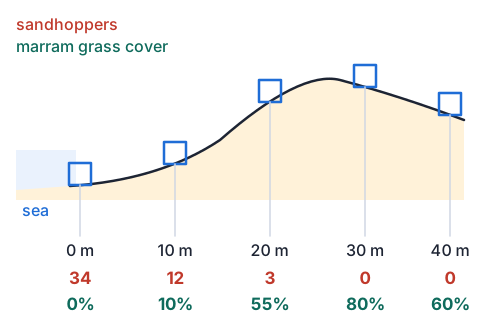
- Sandhoppers fall from 34 to 0 moving inlandthey shelter in damp seaweed washed up near the tide line
- Marram rises to a peak of 80% at 30 mit grows best on the dune itself, away from the waves
- Each organism lives where conditions suit itthe abiotic factors change along the transect
- Sandhoppers near the tide line, marram higher on the dune
Try it: sandhoppers along the dune
Leaf litter or bare ground?
- Room 15 also counted invertebrates (animals without backbones) in five small quadrats under leaf litter and five on bare ground nearby, and took the soil temperature.
| Site | Invertebrates in each quadrat | Mean | Soil temperature |
|---|---|---|---|
| Leaf litter | 23, 18, 27, 20, 22 | 22 | 14 °C |
| Bare ground | 3, 1, 4, 2, 0 | 2 | 21 °C |
- Litter: (23 + 18 + 27 + 20 + 22) ÷ 5 = 110 ÷ 5 = 22mean count
- Bare: (3 + 1 + 4 + 2 + 0) ÷ 5 = 10 ÷ 5 = 2mean count
- Litter is cooler and gives food and shelter from drying outlink to abiotic factors
- About 11 times as many invertebrates live under leaf litter as on bare ground
Common mistakes
- In a food chain the arrow means 'eats', so it points from the ruru to the wētā.The arrow shows where energy goes, so it points from the food to the eater: wētā → ruru.
- Decomposers are not important because they only deal with dead things.Decomposers return nutrients to the soil, and without them plants would run out of nutrients.
- Energy is recycled round an ecosystem like nutrients are.Matter cycles, but energy flows one way and is lost as heat, so it must keep coming from the Sun.
- Any relationship where two animals live together is mutualism.It is only mutualism if both benefit; if one is harmed, as with fleas on a dog, it is parasitism.
Leaf litter hunt
You need: 4 sticks and a 4 m piece of string, a white tray or old pillowcase, garden gloves, a spoon, a notebook and pencil
- Push the sticks into the ground to make a 1 m square quadrat under a tree or hedge, with string round the edge.
- Wearing gloves, scoop the leaf litter from inside the square onto the white tray with the spoon.
- Count each kind of invertebrate you find (slaters, worms, beetles, spiders, millipedes) and tally them in your notebook.
- Put everything back, then repeat with a 1 m square on a bare or mown patch of the same garden.
- Look for the difference: the leaf litter usually holds far more animals, because it is cooler, damper and full of food.
Safety: Wear gloves because some spiders bite and soil can carry tetanus germs, move slowly so you do not crush anything, and return every animal and the litter to where you found it.
Your turn
In the chain kawakawa → looper caterpillar → tauhou (silvereye), which organism is the producer?
Name the role of the fungi growing on a fallen log.
A tapeworm lives in a dog's gut and takes its food. What type of relationship is this?
In Room 15's transect, at what distance was marram grass cover highest?
Why does an ecosystem need a constant supply of energy from the Sun but not a constant supply of new nutrients?
Show answer
1. Kawakawa, because it makes its own food by photosynthesis. 2. Decomposers, breaking the log down and returning nutrients to the soil. 3. Parasitism: the tapeworm gains and the dog is harmed. 4. At 30 m, with 80% cover. 5. Energy is lost as heat at every step, but nutrients are recycled by decomposers and used again.
Recap
- Producers make glucose by photosynthesis, consumers eat other organisms, and decomposers break down dead matter and waste.
- Energy flows one way from the Sun along food chains, while matter is cycled back to the soil by decomposers.
- Predators eat prey, both partners gain in mutualism, and a parasite gains while harming its host.
- Soil is rock particles, humus, living organisms, air and water, and its organisms keep nutrients cycling.
- Quadrats and transects, with readings of light, temperature and soil, reveal patterns in where organisms live.
The maths behind it
Report a mistake
How is Year 8 maths going?
See the Year 8 maths guide