 Vertex Learn
Earth's layers, minerals and rocks
What this lesson covers
- The geosphere and how it differs from the other parts of the Earth system
- The four main layers inside the Earth
- Minerals: natural, solid and built from a repeating pattern
- Rocks as mixtures of minerals, and the properties that tell them apart
- Classifying rocks and soils by what you can observe
- What fossils in a rock say about the past
The geosphere
- Scientists divide the Earth system into four connected parts: the air (atmosphere), the water (hydrosphere), living things (biosphere) and the solid Earth (geosphere).
- The geosphere is all the solid, non-living ground of the planet: every rock, mineral, grain of soil and landform, from mountains to sea-floor trenches.
- It does not stop at the surface. It reaches right down through the Earth's interior to the very centre.
- Aoraki, the Canterbury Plains and the sand on Piha beach are all part of it.
Four layers inside the Earth
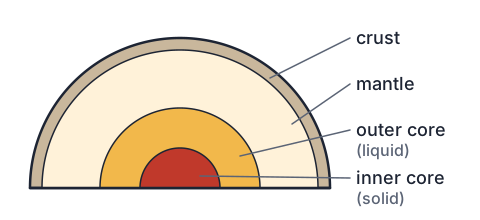
- The crust is the thin, rocky outer skin we live on. It is thinner under the oceans than under the continents.
- The mantle lies under the crust. It is very hot rock that is mostly solid but can flow extremely slowly, like very stiff toffee.
- The outer core is a layer of liquid metal, mostly iron and nickel.
- The inner core, at the centre, is also iron and nickel. It is the hottest part, but the huge pressure squeezes it into a solid ball.
- No one has drilled through the crust. We know about the deeper layers mainly from how earthquake waves travel through the Earth.
Try it: which layer?
What is a mineral?
- The crust is made of rocks, and rocks are made of minerals.
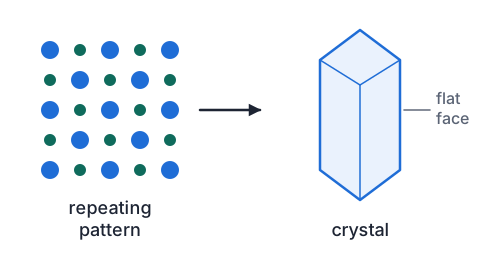
- A mineral is a solid that forms naturally, not made by people, and has its own fixed chemical make-up.
- Its particles are packed in a neat pattern that repeats over and over. That repeating pattern is why minerals grow as crystals with flat faces and straight edges.
- The pattern also gives each mineral its own properties: colour, shine (lustre), the way it breaks, and hardness.
- Quartz, feldspar, mica and calcite are common minerals. Ice is a mineral too; plastic and glass are not, because their particles have no repeating pattern.
Testing hardness
- Hardness means how well a mineral resists being scratched.
- A harder material scratches a softer one, never the other way round, so you can rank minerals by testing which scratches which.
- Geologists use the Mohs scale, which ranks ten minerals from talc, the softest, at 1 to diamond, the hardest, at 10.
- A quick field test uses everyday objects: a fingernail, a copper coin, a steel nail and a piece of glass, from softest to hardest.
- Talc can be scratched by a fingernail; quartz is hard enough to scratch glass.
Rocks are mixtures of minerals
- A rock is a solid mixture of one or more minerals. Granite is mostly quartz, feldspar and mica, while limestone is mostly the single mineral calcite.
- Which minerals a rock contains, and how they are arranged, decide what it looks and feels like.
- Colour comes from the minerals. Texture describes the grains: coarse grains you can see easily, or fine grains too small to see.
- Structure describes how the grains sit: interlocking crystals, grains cemented together, or layers like the pages of a book.
- Hardness depends on how hard the minerals are and how strongly they are held together.
Classifying four rock samples
- A class examined four rock samples with a hand lens and a scratch test. Sort them using a key.
| Sample | Grains | Crystals? | Layers or fossils? | Scratches glass? |
|---|---|---|---|---|
| A | Coarse | Yes, interlocking | No | Yes |
| B | Fine | Yes, too small to see without a lens | No | Yes |
| C | Medium, rounded sand grains | No | Thin layers | No |
| D | Fine | No | Shell fossils | No |
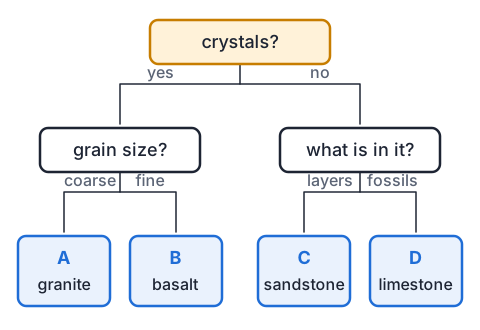
- Crystals? A and B yes; C and D nofirst question in the key
- A: coarse crystals; B: fine crystalssplit by grain size
- C: sand grains in layers; D: fossilssplit by what is in the rock
- A could be granite, B basalt, C sandstone, D limestone
Classifying soils
- Soils can be compared in the same way, by grain size and feel.
- Sandy soil has big grains you can see; it feels gritty and water drains through it fast.
- Clay soil has tiny grains; it feels sticky when wet, can be rolled into a thin sausage, and holds water.
- Silty soil sits in between and feels smooth, a little like flour.
- A loam is a mix of all three with plenty of rotting plant matter, which is why gardeners prize it.
Try it: sandy, clay or silty?
Fossils are clues to the past
- A fossil is the preserved remains or trace of a living thing from long ago, such as a shell, a bone, a leaf print or a footprint.
- Fossils tell you what lived at the time the rock formed, and so what the place was like then.
- Sea shells in a rock mean that rock formed under the sea, even if it is now high on a hill.
- Limestone in many parts of New Zealand, such as around Ōamaru and Waitomo, is packed with fossils of sea creatures, so that land was once under the sea.
Reading a cliff
- A road cutting on a hillside shows three rock layers. The bottom layer has fossil sea shells, the middle layer has fossil leaves and tree roots, and the top layer is soil. What happened here?
- Lower layers formed firstnew layers settle on top of older ones
- Bottom: sea shells, so this place was under the seathe oldest clue
- Middle: leaves and roots, so it later became land with plantsthe next clue
- The area was once sea floor, was later lifted up to become forested land, and soil formed on top
Common mistakes
- Rocks and minerals are the same thing.A mineral is one substance with a repeating pattern; a rock is a mixture of one or more minerals.
- The Earth's core is hot liquid all the way through.The outer core is liquid, but the inner core is solid because of the enormous pressure.
- A shiny or brightly coloured rock must be hard.Colour and shine do not tell you hardness; only a scratch test does.
- Fossils found on a mountain mean sea animals once lived on mountains.The rock formed under the sea and was later pushed up to become a mountain.
Scratch-test garden rocks
You need: 4 or 5 different small rocks or pebbles, a copper-coloured coin, a steel teaspoon, a magnifying glass if you have one, a notebook
- Rinse the rocks and let them dry, then number them 1 to 5 on a page of your notebook.
- Look at each with the magnifying glass and record its colour, whether you can see grains or crystals, and whether it has layers.
- Try to scratch each rock with your fingernail, then the coin, then the edge of the spoon, and record the first one that leaves a scratch.
- Rub away any powder to check it is a real scratch and not just a mark left by the coin.
- Look for the pattern: rank your rocks from softest to hardest, and see whether the crystal-filled ones tend to be harder.
Safety: Only collect loose rocks from your own garden or driveway, never from reserves or beaches where taking them is not allowed, and wash your hands after handling soil.
Your turn
Name the four layers of the Earth from the outside in.
Is glass a mineral? Explain.
Rock X scratches glass. Rock Y can be scratched by a copper coin. Which is harder?
A rock has thin layers of rounded sand grains and no crystals. Which rock from the example is it most like?
A rock near the top of a hill contains fossil fish. What does this tell you about the past?
Show answer
1. Crust, mantle, outer core, inner core. 2. No: its particles do not form a repeating pattern, so it has no crystals. 3. Rock X, because it scratches glass, which is harder than a coin. 4. Sandstone, like sample C. 5. That rock formed under water, so the area was once under the sea or a lake and has since been lifted up.
Recap
- The geosphere is the solid Earth, from the rocks, soil and landforms at the surface all the way to the centre.
- Inside the Earth are the crust, mantle, liquid outer core and solid inner core.
- Minerals form naturally and have a repeating pattern of particles, which gives them crystals and their own properties.
- Rocks are made of one or more minerals; colour, texture, structure and hardness depend on which minerals and how they are arranged.
- Fossils in a rock tell you what lived when it formed, and so what the place was like long ago.
Report a mistake
How is Year 8 maths going?
See the Year 8 maths guide