 Vertex Learn
The rock cycle, fossils, soil and using Earth materials
What this lesson covers
- Igneous, sedimentary and metamorphic rock
- The rock cycle and the processes that drive it
- How fossils form in sediment
- What soil is made of
- Choosing Earth materials for a job by their properties
Three main types of rock
- Geologists group rocks by how they formed, not by how they look.
- Igneous rock forms when molten rock (magma underground, lava at the surface) cools and hardens.
- Sedimentary rock forms from bits of older rock, shells or plant remains (sediment) that settle in layers, get buried, and are squeezed and cemented together.
- Metamorphic rock forms when existing rock is changed by great heat and pressure deep underground, without melting.
| Type | How it forms | New Zealand examples |
|---|---|---|
| Igneous | Molten rock cools | Basalt of Auckland's volcanic cones, pumice from Taupō |
| Sedimentary | Layers of sediment buried and cemented | Greywacke of the main ranges, Ōamaru limestone |
| Metamorphic | Heat and pressure change a rock | Otago schist, used for stone walls in Central Otago |
Crystal size tells you how fast it cooled
- As molten rock cools, mineral crystals grow in it.
- Magma that cools slowly, deep underground, gives crystals time to grow large, like the big crystals in granite.
- Lava that cools quickly at the surface gives only tiny crystals, like those in basalt.
- Lava that cools almost instantly can form glassy obsidian with no crystals at all, and lava full of gas bubbles cools into light, frothy pumice that floats.
Try it: igneous, sedimentary or metamorphic?
The rock cycle
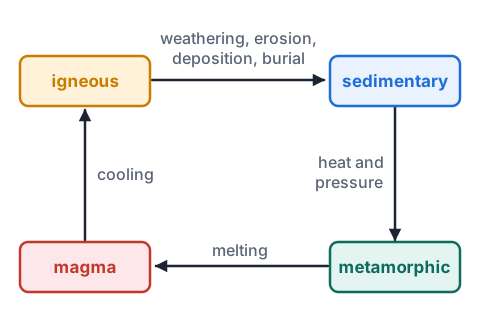
- Rocks are not permanent. Over thousands to millions of years they are broken down, moved, buried, heated and melted, so one type of rock becomes another.
- Weathering breaks rock at the surface into pieces; erosion carries the pieces away by water, wind or ice; deposition drops them in layers.
- Burial, compaction and cementation turn those layers into sedimentary rock.
- Heat and pressure turn any rock into metamorphic rock; enough heat melts it into magma, which cools into igneous rock.
- There is no single route: any type of rock can be weathered, changed by heat and pressure, or melted.
Tracing a journey round the cycle
- A piece of basalt on Rangitoto ends up, millions of years later, as part of a band of schist deep underground. Describe one possible route.
- Basalt is igneouscooled lava
- Rain, waves and plant roots break it into grainsweathering
- Streams and the sea carry grains off and drop them on the sea floorerosion and deposition
- Buried under more layers, the grains are squeezed and cementedbecomes sedimentary rock
- Pushed deep where it is hot and squeezed, it turns to schistbecomes metamorphic rock
- Igneous, then sediment, then sedimentary, then metamorphic
How a fossil forms
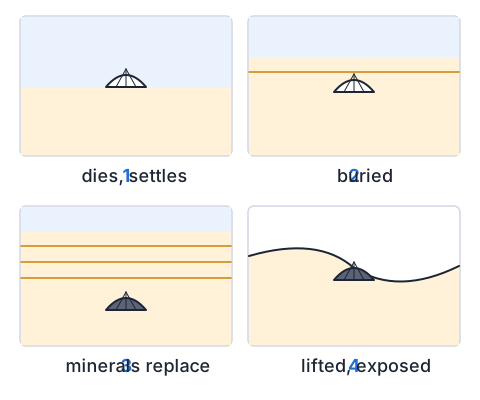
- An animal or plant dies and is quickly covered by sediment, such as mud or sand on a sea floor or lake bed. Being buried fast stops it being eaten or rotting away completely.
- Soft parts usually rot; hard parts such as shells, bones and teeth last longer.
- More layers pile on top. Water seeping through the sediment carries dissolved minerals, which slowly fill and replace the material of the hard parts.
- Over a very long time the remains become a stony copy inside sedimentary rock. Much later the rock may be lifted and worn away, exposing the fossil.
- This is why fossils are found in sedimentary rock and almost never in igneous rock, which forms from melted material.
What soil is made of
- Soil is much more than crumbled rock. It has five main parts.
- Rock particles of sand, silt and clay, made by weathering.
- Humus: the dark, decaying remains of plants and animals.
- Living things: plant roots, fungi, bacteria, worms, insects and many more.
- Air and water, held in the spaces between the particles.
Properties decide uses
- People choose Earth materials by matching their properties to the job.
| Material | Key property | Use |
|---|---|---|
| Iron (made into steel) | Strong and dense | Bridges, building frames, nails |
| Aluminium | Strong but much less dense than steel | Aircraft, boats, window frames |
| Salt | Dissolves in water, stops bacteria growing | Preserving food, flavouring |
| Mica | Splits into thin sheets that resist heat and do not conduct electricity | Insulating parts in toasters and heaters |
| Limestone | Neutralises acid, easy to crush | Lime to sweeten farm soils, gravel for paths, cement |
| Pounamu | Very tough, takes a sharp edge and a polish | Traditional adzes (toki) and taonga |
| Volcanic hāngī stones | Hold heat and do not crack when heated | Cooking food in a hāngī |
Try it: match the material to the job
Why not any old river stone?
- A school is planning a hāngī. Someone suggests using sandstone pebbles from a nearby stream. Explain why the hāngī team will say no.
- A hāngī stone must be heated until very hot without breakingthe job
- Sandstone is grains cemented together and can soak up waterits properties
- Heated, the water in it turns to steam and can split the stone apart violentlythe danger
- Use dense volcanic stones chosen for the job, because they hold heat and do not shatter
Common mistakes
- Metamorphic rock forms when rock melts and cools again.Melting and cooling makes igneous rock; metamorphic rock is changed by heat and pressure without melting.
- The rock cycle always goes igneous, sedimentary, metamorphic in that order.Any rock type can turn into any other, so there are many routes round the cycle.
- A fossil is the actual bone or shell of the animal.In most fossils, minerals have replaced the original material, leaving a stony copy.
- Soil is just ground-up rock.Soil also holds humus, living things, air and water, which is why it can grow plants.
Make sediment layers in a jar
You need: a large clear jar with a lid, a cup of garden soil, a cup of sand, a handful of small gravel, water
- Put the gravel, sand and soil into the jar.
- Fill the jar about three-quarters full with water and screw the lid on tightly.
- Shake it hard for 30 seconds, then stand it on a shelf where it will not be bumped.
- Check it after 5 minutes, after an hour and the next day, and draw the layers each time.
- Look for sorting: the gravel settles first at the bottom, then sand, then fine silt and clay on top, with bits of humus floating; this is how sediment layers build up before they become sedimentary rock.
Safety: Garden soil can carry germs such as tetanus bacteria, so wear gloves or wash your hands well afterwards, and keep the lid tight while shaking.
Your turn
A rock has large interlocking crystals. Is it more likely to have cooled quickly at the surface or slowly underground?
Which type of rock forms when limestone is changed by heat and pressure into marble?
Name the three processes, in order, that move a rock at the surface into a new sediment layer.
Why are fossils rarely found in igneous rock?
Why is aluminium chosen over steel for an aircraft body?
Show answer
1. Slowly underground, which gives crystals time to grow large. 2. Metamorphic rock. 3. Weathering, erosion, then deposition. 4. Igneous rock forms from molten rock, which would destroy any remains. 5. It is strong but much less dense, so the aircraft is lighter.
Recap
- Igneous rock forms from cooled molten rock, sedimentary rock from buried and cemented sediment, and metamorphic rock from heat and pressure.
- In the rock cycle, weathering, erosion, deposition, burial, heat, pressure, melting and cooling keep turning one type of rock into another.
- Fossils form when remains are buried in sediment and minerals slowly replace them.
- Soil is rock particles, humus, living things, air and water.
- People choose Earth materials, from steel to pounamu, by matching their properties to the job.
Report a mistake
How is Year 8 maths going?
See the Year 8 maths guide