 Vertex Learn
Mass, unbalanced forces and balancing a seesaw
What this lesson covers
- Why more mass needs a bigger unbalanced force for the same change
- Levers, pivots and the seesaw
- Turning effect: force multiplied by distance from the pivot
- When a seesaw balances and when it tips
- Unbalanced forces in everyday activities
- Designing a fair test with mass or distance
More mass, harder to change
- Mass measures how much matter an object contains, in kilograms (kg).
- Push an empty supermarket trolley and a full one with the same force: the empty one speeds up much more quickly.
- The more mass an object has, the bigger the unbalanced force needed to change its motion by the same amount.
- This works for slowing down too. A loaded truck needs a much bigger braking force than a car to stop in the same distance.
Room 9 tests mass
- Room 9 launched a toy cart along the floor with a rubber band stretched by the same 10 cm each time, adding 100 g weights to the cart. They measured how far it rolled.
| Mass added | Trial 1 | Trial 2 | Trial 3 | Mean distance |
|---|---|---|---|---|
| 0 g | 182 cm | 176 cm | 179 cm | 179 cm |
| 100 g | 121 cm | 125 cm | 123 cm | 123 cm |
| 200 g | 90 cm | 86 cm | 88 cm | 88 cm |
| 300 g | 70 cm | 66 cm | 68 cm | 68 cm |
- Same stretch each timeso the launching force was kept the same
- Mean distance falls from 179 cm to 68 cm as mass goes upread down the last column
- The same force gave the heavier cart less speed, so it rolled less farlink to the idea
- More mass: the same unbalanced force changes the motion less
A seesaw is a lever
- A lever is a rigid bar that can turn about a fixed point called the pivot (or fulcrum).
- A seesaw is a lever with the pivot in the middle and a person pushing down on each side.
- Each force tries to turn the seesaw: the force on the left tries to turn it one way, the force on the right the other way.
- Scissors, spanners, wheelbarrows and bottle openers are levers too.
Turning effect depends on force and distance
- How hard a force turns something depends on two things: the size of the force and how far from the pivot it acts.
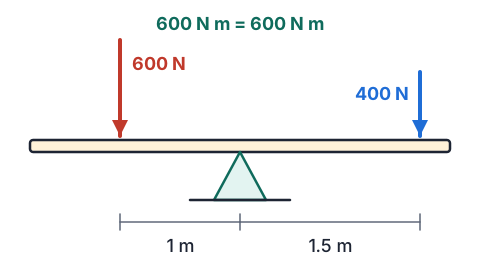
- Turning effect = force × distance from the pivot. With force in newtons and distance in metres, the unit is newton metres (N m).
- A small force far from the pivot can turn things as much as a large force close to it. That is why a door handle sits far from the hinges.
- A seesaw balances when the turning effect on the left equals the turning effect on the right.
Try it: balance the seesaw
Where should he sit?
- Aroha weighs 360 N and sits 2 m from the pivot of a seesaw. Her brother weighs 480 N. How far from the pivot must he sit, on the other side, to balance it?
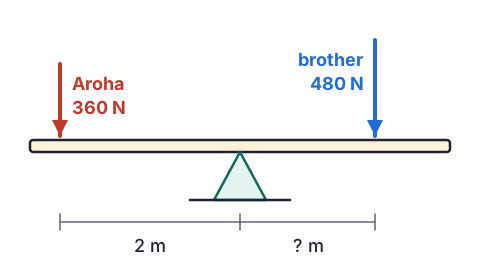
- Aroha's turning effect = 360 N × 2 m = 720 N mforce × distance
- To balance, his side must also be 720 N mturning effects equal
- 480 N × distance = 720 N mhis force times the unknown distance
- distance = 720 ÷ 480 = 1.5 mdivide to undo the multiply
- He sits 1.5 m from the pivot, closer than Aroha because he is heavier
When a seesaw tips
- If one side has a bigger turning effect, the seesaw is unbalanced and turns towards that side.
- This can happen because that person is heavier, sits further from the pivot, or both.
- In the example above, if Aroha's brother moved back to 2 m, his side would have 480 × 2 = 960 N m against her 720 N m, so his end would go down.
- A lighter child can tip a heavier adult by sitting right at the end while the adult sits near the middle.
Designing a fair test with a ruler seesaw
- Question: how does the distance from the pivot change how many coins it takes to balance a load?
- Balance a 30 cm ruler on a pencil at its 15 cm mark. Put a stack of 4 coins 5 cm left of the pivot and leave it there for every trial.
- Independent variable: the distance from the pivot on the right side. Dependent variable: the number of coins needed there to balance.
- Controlled variables: the same ruler, the same pivot point, the same type of coin, and the same load on the left.
| Distance right of pivot | Coins needed to balance |
|---|---|
| 5 cm | 4 |
| 10 cm | 2 |
| 20 cm | 1 |
- Left side: 4 coins × 5 cm = 20 coin cmturning effect, with coins as the force
- Right side: 4 × 5 = 20, 2 × 10 = 20, 1 × 20 = 20each balanced row
- Doubling the distance halves the coins needed
Unbalanced forces all around you
- Every time something speeds up, slows down or turns, an unbalanced force is at work.
| Activity | Unbalanced force | Change in motion |
|---|---|---|
| Kicking a rugby ball off a tee | Boot pushes the ball forward | Speeds up from rest |
| Braking on a bike | Friction from the brakes and road, backward | Slows down |
| Heading a football | Head pushes the ball at an angle | Changes direction and speed |
| Tacking a yacht on the Waitematā | Wind on the sail from a new side | Changes direction |
Try it: what does the force do?
Common mistakes
- A seesaw balances when the two people weigh the same.It balances when the turning effects are equal, so a heavier person can balance a lighter one by sitting closer to the pivot.
- Turning effect = force + distance.Turning effect is force multiplied by distance from the pivot, in N m.
- A heavy object needs a force to keep moving at a steady speed but a light one does not.Mass decides how big an unbalanced force is needed to change motion, not whether a steady speed needs a force.
- Measure the distance from the end of the seesaw.Always measure from the pivot, because that is the point everything turns around.
Balance a ruler seesaw
You need: a 30 cm ruler, a round pencil, 10 identical coins, sticky tape
- Tape the pencil to the table and balance the ruler across it at the 15 cm mark.
- Place 2 coins stacked at the 10 cm mark, which is 5 cm left of the pivot.
- Find where 1 coin on the right side balances them, and write down its distance from the pivot.
- Repeat with 3 coins, then 4 coins on the left, each time finding where 2 coins on the right balance them.
- Look for the pattern: coins × distance should come out the same on both sides whenever the ruler balances.
Safety: Coins are a choking hazard for babies and toddlers, so do this away from little children and count the coins back into a container afterwards.
Your turn
The same push is given to a 5 kg box and a 20 kg box on the same smooth floor. Which speeds up more?
A 300 N force acts 2 m from a pivot. What is its turning effect?
A 500 N person sits 1.2 m from a seesaw's pivot. How far from the pivot must a 400 N person sit to balance?
On a seesaw, the left side has 800 N m of turning effect and the right side 650 N m. Which way does it tip?
Why is it easier to open a door by pushing near the handle than near the hinges?
Show answer
1. The 5 kg box, because less mass needs less force for the same change. 2. 300 × 2 = 600 N m. 3. 500 × 1.2 = 600 N m, so 600 ÷ 400 = 1.5 m. 4. The left side goes down, because its turning effect is bigger. 5. The handle is further from the pivot (the hinges), so the same force gives a bigger turning effect.
Balancing Act
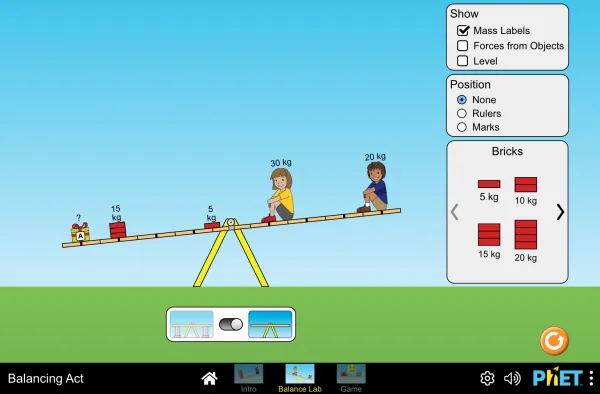
Full screen · PhET Interactive Simulations, University of Colorado Boulder, CC BY 4.0
Recap
- The more mass an object has, the bigger the unbalanced force needed for the same change in motion.
- A seesaw is a lever turning about a pivot, with forces on both sides.
- Turning effect = force × distance from the pivot, in newton metres.
- A seesaw balances when both turning effects are equal, and tips towards the side with the bigger one.
- In a fair test, change one variable, measure one, and keep the rest the same.
The maths behind it
Report a mistake
How is Year 8 maths going?
See the Year 8 maths guide