Algebraic modelling: 6 exam questions solved step by step
What this lesson covers
- A model is completed by substituting known facts from the context into its given form.
- Every answer from a model has to be checked against the context it came from.
6 models, one routine
- 1. Write the form the context gives.
- 2. Substitute known facts to finish it.
- 3. Solve: get to zero, or use ±√.
- 4. Keep only answers that fit.
- 5. Answer in words, with units.
Question 1 · Achieved, in context
- A fountain jet lands 4 m from its nozzle.
- Height: h = kx(4 − x) m, x m along.
- At x = 1 m the jet is 1.5 m high.
- Find k, then the greatest height.
Q1: complete the model
- Substitute the known point.
- Top: halfway between roots.
- h = kx(4 − x)zero at x = 0 and 4
- 1.5 = k × 1 × (4 − 1)x = 1, h = 1.5
- 1.5 = 3k
- k = 0.5÷ 3
- h = 0.5x(4 − x)
- top at x = 2halfway between roots
- h = 0.5 × 2 × (4 − 2)
- = 0.5 × 2 × 2 = 2
- The jet is at most 2 m high.
Question 2 · Achieved, in context
- A rugby ball is kicked from the ground.
- It is highest, 16 m up, at x = 10 m.
- Model: y = a(x − 10)² + 16
- Find a, then the height at x = 15 m.
Q2: vertex form
- The kick starts at (0, 0).
- Square before × a.
- y = a(x − 10)² + 16top at (10, 16)
- 0 = a(0 − 10)² + 16starts at (0, 0)
- 0 = 100a + 16
- 100a = −16−16 both sides
- a = −0.16÷ 100
- y = −0.16(x − 10)² + 16
- y = −0.16(15 − 10)² + 16x = 15
- = −0.16 × 25 + 16 = −4 + 16
- = 12: the ball is 12 m high
Question 3 · Merit, in context
- A lawn 10 m by 6 m has a path x m wide
- all the way round it.
- Lawn and path together cover 96 m².
- Find the width of the path.
- Careful: the path is on both sides.
Q3: an area model
- Add 2x to each side.
- A width cannot be negative.
- (10 + 2x) by (6 + 2x)path on every side
- (10 + 2x)(6 + 2x) = 96area
- 60 + 20x + 12x + 4x² = 96expand
- 4x² + 32x − 36 = 0collect, −96
- x² + 8x − 9 = 0÷ 4
- (x + 9)(x − 1) = 09 × −1, 9 + −1
- x = −9a width is positive
- x = 1: 12 × 8 = 96
- The path is 1 m wide.
Question 4 · Merit, in context
- The kick from question 2:
- y = −0.16(x − 10)² + 16
- How far away is the ball 10 m high?
- Give answers to 1 decimal place.
Q4: solve the finished model
- Undo in reverse order.
- Keep ±. Round at the end.
- −0.16(x − 10)² + 16 = 10y = 10
- −0.16(x − 10)² = −6−16 both sides
- (x − 10)² = 37.5÷ −0.16
- x − 10 = ±√37.5square root: ±
- = ±6.1237…
- x = 10 − 6.1237 = 3.8763
- x = 10 + 6.1237 = 16.1237
- both before it lands at x = 20
- 3.9 m (up) and 16.1 m (down)
Question 5 · Excellence, in context
- A tunnel mouth is a parabola 8 m wide
- at the road and 6 m high in the middle.
- Model: y = ax² + 6, x m from the centre.
- Can a truck 3 m wide and 4.5 m tall fit,
- driving down the middle? Pause and try it.
Q5: complete the model
- The road meets it at x = ±4.
- Use one of those points.
- y = ax² + 6top at (0, 6)
- 0 = a(4)² + 6meets road at x = 4
- 0 = 16a + 6
- 16a = −6−6 both sides
- a = −0.375÷ 16
- y = 6 − 0.375x²
Q5: test the tightest point
- Not the centre: the corner.
- Corner is 1.5 m out.
- y = 6 − 0.375x²
- corner at x = 1.5half of 3 m
- y = 6 − 0.375 × 1.5²height there
- = 6 − 0.375 × 2.25
- = 6 − 0.84375 = 5.15625
- 5.16 m > 4.5 mroof above the corner
- 5.15625 − 4.5 = 0.65625
- Yes: about 0.66 m to spare
Question 6 · Excellence, in context
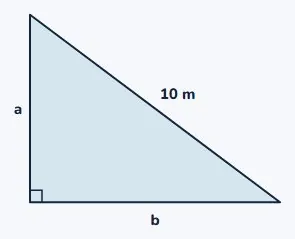
- A garden bed is a right-angled triangle.
- Its longest side is 10 m.
- Its area is 24 m².
- Find the two shorter sides.
Q6: two facts, one equation
- Pythagoras and area.
- Substitute for b.
- Let the shorter sides be a and b
- a² + b² = 100Pythagoras
- ½ab = 24, so ab = 48area
- b = 48/a÷ a
- a² + (48/a)² = 100substitute
- a² + 2304/a² = 100square
- a⁴ + 2304 = 100a²× a²
- a⁴ − 100a² + 2304 = 0rearrange to zero
Q6: a quadratic in a²
- Let u = a².
- Reject negative lengths.
- a⁴ − 100a² + 2304 = 0
- u² − 100u + 2304 = 0let u = a²
- (u − 36)(u − 64) = 036 × 64, 36 + 64
- a² = 36 or a² = 64u = a²
- a = ±6 or a = ±8square root
- a = −6, a = −8a length is positive
- a = 6, b = 8 or a = 8, b = 6
- 36 + 64 = 100, ½ × 6 × 8 = 24
- The shorter sides are 6 m and 8 m.
The routine that solved all six
- Form, complete, solve, reject with a reason, answer.
| Step | How |
|---|---|
| Roots | y = kx(w − x), then a point |
| Top | y = a(x − h)² + k, a point |
| Shapes | Pythagoras, area formulae |
| Solve | to zero, factorise or ±√ |
| Reject | only with a reason |
| Answer | a sentence, with units |
Is your child on track?
Take the free placement test