Number
7 lessons Scientific notation, and three names for one number8 min
 Powers of two, unit fractions, and roots on the line7 min
 Order of operations, integers, and a sensible estimate8 min
 Reciprocals, and why decimal rules are fraction rules7 min
 Percentages as multipliers, and working backwards7 min
 Ratios you can scale, and rates that carry units7 min
 Mark-ups, discounts, GST and interest7 min
24 curriculum objectives
Number structures and operations
- Identifying, reading, writing, representing, comparing, ordering, and converting between fractions, decimals, and percentages
- Recording, comparing, and ordering whole and decimal numbers using scientific notation (e.g. 3.14 × 10³)
- Finding equivalent fractions, simplifying fractions, and converting between improper fractions and mixed numbers
- Expressing remainders from division as fractions or decimals, depending on the context
- Identifying powers of 2 through to 2¹⁰
- Converting between negative powers and unit fractions (e.g. 3⁻² = 1/9 )
- Approximately locating roots on the number line with reference to the closest perfect square (e.g. √48 is between √36 = 6 and √49 = 7, but closer to 7)
- Using rounding and estimation to predict results and to check the reasonableness of calculations
- Rounding to the degree of precision required for the context
- Generalising about exponents of 0 and 1
- Adding, subtracting, multiplying, and dividing integers
- Generalising the rule for dividing by a fraction by starting with dividing a whole number by a fraction
- Adding, subtracting, multiplying, and dividing fractions and decimals
- Connecting multiplying or dividing decimals with multiplying or dividing fractions (e.g. 0.3 × 0.15 = 3/10 × 15/100).
- Checking for equivalence in expressions involving negative numbers (e.g. (−3)² ≠ −3², −2 + 3 = 3 + (−2), 2 × (−3) = (−3) × 2 = (−2) × 3, 2/(−3) = (−2)/3 = −2/3
- Finding a fraction or percentage of a number
- Finding the whole amount, given a fraction or percentage (e.g. 20% of an amount is 30. What is the original amount?)
- Expressing a number as a fraction or percentage of another number
- Increasing or decreasing a number by a given proportion
- Representing proportional relationships using whole-number ratios, including reducing the ratios to their simplest form
- Dividing a quantity into two parts, given the part:part or part:whole ratio
- Finding equivalent ratios and rates by scaling up or down
Financial mathematics
- Applying percentage mark-ups and discounts
- Calculating simple interest and GST on dollar amounts (e.g. finding 15% GST on $432)
Algebra
3 lessons Expressions, equations, and the inequality that flips8 min
 Straight lines: what m and c actually do8 min
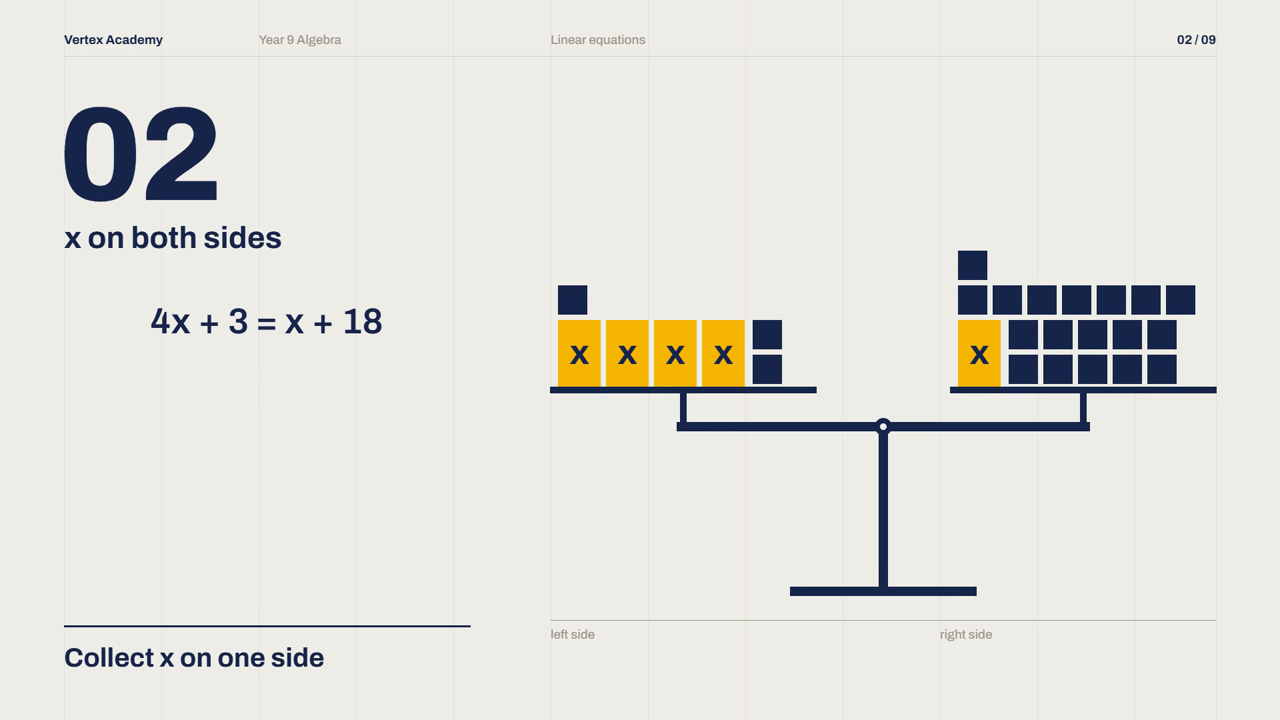 Multi-step equations, and word problems in four moves10 min
11 curriculum objectives
Equations and relationships
- Simplifying and manipulating algebraic expressions involving sums, products, differences, and positive integer powers, by: collecting like terms factorising using common factors expanding products, including multiplying a single term by a bracketed term.
- Generalising the properties of operations with variables (e.g. multiplication is distributive over subtraction)
- Multiplying or dividing by −1 in inequalities (e.g.−3 < 5)
- Forming and solving linear equations with rational number coefficients and linear inequalities with positive coefficients
- Using substitution to find the value of an expression or a formula, given the values of its variables
- Rearranging formulae (e.g. solving P = 2l + 2w for w)
- Interpreting rules of the form y = mx + c and using a combination of substitution and tables to plot points from the linear graph, connecting the points to form a line
- Identifying the sign of m from tables of values, and linear graphs
- Identifying the value of c for a straight line, from tables of values and from linear graphs
- Using tables and graphs in the coordinate plane (showing all four quadrants), and diagrams to recognise the relationship between the ordinal position and its corresponding element in a linear pattern developing a rule for the pattern in words and making conjectures about further elements in the pattern
- Identifying the constant increase or decrease in a linear pattern, using variables and algebraic notation to represent the rule in an equation, and drawing on the rule to make conjectures
Measurement
4 lessons Units, prefixes, and how precise an answer can be7 min
 Circles, and every area formula as a rectangle8 min
 Pythagoras: the squares are actual squares8 min
 Speed, distance, time, and the 2.30 trap7 min
11 curriculum objectives
Measuring
- Estimating, calculating, converting, and accurately representing measurements
- Selecting and using appropriate measurement units for a given context, converting between metric units if necessary and using appropriate prefixes
- Finding: the perimeter of 2D shapes the circumference of circles the area of parallelograms, trapeziums, and kites, relating the formulae used to the formula for a rectangle
- Deriving the formulae for the perimeter of half and quarter circles from the formula for a full circle
- Calculating the perimeter of half circles and quarter circles
- Using Pythagoras’ theorem to: verify that given side lengths in a right-angled triangle satisfy the theorem find the length of the hypotenuse in a right-angled triangle, given the lengths of the other two sides
- Proving Pythagoras’ theorem (e.g. by rearranging four congruent right-angled triangles into a square)
- Finding another Pythagorean triple from a given Pythagorean triple
- Finding distance, given speed and time
- Finding time, given distance and speed
- Reasoning about duration using different units of time, including decimal fractions of milliseconds where appropriate
Is your child on track?
Take the free placement testGeometry
1 lesson
5 curriculum objectives
Shapes
- Identifying and describing parts of a circle (e.g. a chord; the diameter, radius, and circumference) and how they relate to each other
- Reasoning about unknown angles in situations involving intersecting and parallel lines and transversals.
- Verifying that two lines are parallel, using angles at the intersections of a transversal
Spatial reasoning
- Representing and constructing 3D shapes, including rectangular and triangular prisms and pyramids, from nets and plan views drawings
- Transforming 2D shapes in the coordinate plane by translation, reflection about a given line of symmetry, and rotation about a given point by a multiple of 90 degrees
Statistics
3 lessons Statistical questions, and the five-point summary8 min
 Choosing a graph, and the line of best fit7 min
 Reading data critically, and claiming only what you can7 min
11 curriculum objectives
Developing knowledge from data
- Planning and collecting multivariate data to respond to a statistical question and where at least one variable is categorical and at least one is numerical
- Calculating the five-point-summary for numerical data: the minimum value the value of quartile 1, or Q 1 the value of the median or quartile 2, or Q 2 the value of quartile 3, or Q 3 the maximum value
- Calculating the interquartile range as IQR = Q 3 − Q 1
Visualisation of data
- Creating multiple data visualisations for an investigation
- Selecting appropriate scales for data
- For relationship investigations, drawing an eyeballed line or curve of best fit to predict possible y-values (the response variable) for given x-values (the explanatory variable)
Interpretation of data
- Critically considering data visualisations, including those from contemporary media, to see if they support or misrepresent the data
- Communicating findings in context to answer an investigative question, using evidence
- Providing possible explanations for findings
- Comparing findings to initial conjectures or assertions and existing knowledge
- Evaluating findings and data-collection methods to check whether claims or statements are supported by the data
Probability
2 lessons Sample spaces, experiments, and the Law of Large Numbers8 min
 Joint events, and why you cannot just add probabilities8 min
6 curriculum objectives
Experimental and theoretical probability
- Carrying out a chance experiment, including running simulations for a large number of trials using digital tools
- Systematically listing outcomes for the sample space
- Comparing experimental probability (from at least 30 trials) to theoretical probability for a chance experiment, and explaining why they differ and how increasing the number of trials reduces this difference
- Carrying out chance experiments of at least 100 trials and comparing the experimental probability of each individual outcome to its theoretical probability, in order to demonstrate the Law of Large Numbers
- Creating and describing data visualisations for the distribution of observed outcomes from a chance experiment
- Calculating probability estimates for different outcomes
Want to practise, right now?
Practise Year 9 maths freeQuestions parents ask
What should a Year 9 student know in maths?
The New Zealand Curriculum sets 68 Year 9 maths objectives across Number, Algebra, Measurement, Geometry, Statistics and Probability. Number has the most, with 24. Every one is listed on this page.
How can I tell if my child is on track in Year 9 maths?
Take the free Vertex Academy placement test online. The score and level show straight away. Start here.
Where can my child practise Year 9 maths for free?
The free Vertex Academy practice tool sets Year 9 questions and marks them instantly, and this page has 19 free video lessons. Start here.
Want help getting there?
Book a free assessmentLearning objectives sourced from the New Zealand Curriculum (Mathematics and Statistics, 2025) © Ministry of Education, licensed under CC BY 4.0. Vertex Academy is not affiliated with or endorsed by the Ministry of Education.