Complex loci, purely real conditions and proofs
What this lesson covers
- A locus condition on z becomes an equation in x and y once z = x + iy is substituted.
- Purely real means the imaginary part is zero; purely imaginary means the real part is zero.
A locus on the Argand diagram
- z = x + iy is the point (x, y).
- |z − w| is the distance from z to w.
- Substitute x + iy to get x and y.
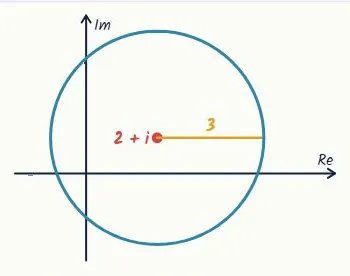
|z − 2 − i| = 3
- Every z is 3 from 2 + i.
- Centre 2 + i, the point (2, 1).
- A circle of radius 3.
Into Cartesian form
- Group the two parts
- |a + bi|² = a² + b², no i
- z − (2 + i) = (x + iy) − (2 + i)
- = (x − 2) + (y − 1)igroup the parts
- (x − 2)² + (y − 1)² = 9modulus squared = 3²
- x² − 4x + 4 + y² − 2y + 1 = 9
- x² + y² − 4x − 2y = 4expanded form
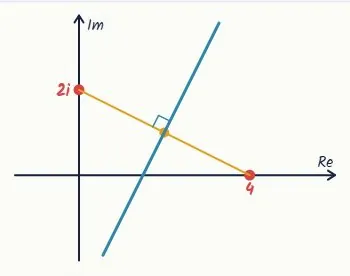
|z − 4| = |z − 2i|
- Equally far from 4 and from 2i.
- Join them and find the midpoint.
- The perpendicular bisector.
Square both sides
- x² and y² cancel
- Check with the midpoint
- |z − 4|² = |z − 2i|²square both sides
- (x − 4)² + y² = x² + (y − 2)²
- x² − 8x + 16 + y²expand
- = x² + y² − 4y + 4
- −8x + 16 = −4y + 4x² and y² cancel
- 4y = 8x − 12rearrange
- y = 2x − 3
- at (2, 1): 2(2) − 3 = 1midpoint lies on it
- gradients 2 × (−1/2) = −1perpendicular
Purely real, purely imaginary
- Complex numbers include the reals.
- Purely real: imaginary part 0.
- Purely imaginary: real part 0.
| Condition | |
|---|---|
| purely real | Im(w) = 0 |
| purely imaginary | Re(w) = 0 |
| arg w = π/4 | Re(w) = Im(w) > 0 |
w = (k + 2i)/(1 + i)
- Conjugate first
- Real: Im(w) = 0
- Imaginary: Re(w) = 0
- w = (k + 2i)/(1 + i)k real
- × (1 − i)/(1 − i)conjugate
- bottom: (1 + i)(1 − i) = 21 − i² = 2
- top: (k + 2i)(1 − i)
- = k − ki + 2i − 2i²expand
- = (k + 2) + (2 − k)ii² = −1, group
- w = ((k + 2) + (2 − k)i)/2
- Im = 0: 2 − k = 0, so k = 2real: w = 2
- Re = 0: k + 2 = 0, so k = −2imaginary: w = 2i
z + 4/z is purely real
- Write 4/z in x + iy form
- Take the imaginary part
- w = z + 4/z, z = x + iy
- 4/(x + iy) × (x − iy)/(x − iy)
- = 4(x − iy)/(x² + y²)bottom x² + y²
- w = x + iy + 4(x − iy)/(x² + y²)
- Im(w) = y − 4y/(x² + y²)imaginary parts
- y − 4y/(x² + y²) = 0purely real
Clear the fraction, factorise
- x² + y² is never 0 here
- Never divide by y
- y − 4y/(x² + y²) = 0
- y(x² + y²) − 4y = 0× (x² + y²)
- y(x² + y² − 4) = 0factorise
- y = 0 or x² + y² = 4
- y = 0, z ≠ 0the real axis
- x² + y² = 4, so |z| = 2circle, radius 2
What a proof needs: the 2025 error
- Prove: real roots for every real k.
- Trying some k is not a proof.
- It must work for any k.
| Proof? | |
|---|---|
| try k = 1, 2, 3 | examples only |
| find some k | not what was asked |
| any real k | a proof |
x² + kx + (k − 1) = 0
- Write the discriminant
- A square is never negative
- End with the conclusion
- a = 1, b = k, c = k − 1
- b² − 4ac = k² − 4(1)(k − 1)
- = k² − 4k + 4expand
- = (k − 2)²factorise
- (k − 2)² ≥ 0 for all real ka square is never < 0
- so b² − 4ac ≥ 0
- real roots for every real k
Prove: z is purely imaginary
- Substitute x + iy, square
- End with the sentence
- |z − 1| = |z + 1|, z = x + iy
- (x − 1)² + y² = (x + 1)² + y²
- x² − 2x + 1 + y²expand
- = x² + 2x + 1 + y²
- −2x = 2xx², y² and 1 cancel
- −4x = 0, so x = 0
- Re(z) = 0the real part
- so z is purely imaginary
Where the marks are
- Achieved: modulus, real and imaginary parts.
- Merit: purely real conditions, proofs.
- Excellence: quotients, harder proofs.
What to take away
- Substitute x + iy, set the right part to zero, and prove for every value.
| |z − a| = r | circle, centre a |
| Equal distances | perpendicular bisector |
| Purely real | Im = 0 |
| Purely imaginary | Re = 0 |
| Proof | general, with a reason |
| Finish | a concluding sentence |
Your turn: four questions
- Pause here and answer each one.
- Questions 1 and 2: substitute x + iy.
- Question 4: k is not zero.
| Given | Find | |
|---|---|---|
| 1 | |z − 3i| = 2 | Cartesian equation |
| 2 | |z + 2| = |z − 4| | Cartesian equation |
| 3 | (3 + i)(k + 2i), k real | k, if purely real |
| 4 | kx² + (k + 1)x + 1 = 0 | prove: real roots |
Show answer
1. x² + (y − 3)² = 4: circle, centre 3i, radius 2. 2. (x + 2)² + y² = (x − 4)² + y² gives 12x = 12, so x = 1. 3. (3k − 2) + (k + 6)i; imaginary part zero gives k = −6 (the number is −20). 4. Discriminant (k + 1)² − 4k = (k − 1)², a square, so never negative: real roots for every real k ≠ 0.
The answers: questions 1 and 2
- 1. z − 3i = x + (y − 3)isubstitute x + iy
- x² + (y − 3)² = 2² = 4centre 3i, radius 2
- 2. (x + 2)² + y² = (x − 4)² + y²square both sides
- x² + 4x + 4 = x² − 8x + 16y² cancels, expand
- 12x = 12x² cancels
- x = 1a vertical line
The answers: questions 3 and 4
- 3. (3 + i)(k + 2i)
- = 3k + 6i + ki + 2i²expand
- = (3k − 2) + (k + 6)ii² = −1, group
- k + 6 = 0, so k = −6purely real: Im = 0
- 3(−6) − 2 = −20the real number
- 4. b² − 4ac = (k + 1)² − 4(k)(1)
- = k² + 2k + 1 − 4kexpand
- = k² − 2k + 1 = (k − 1)²factorise
- (k − 1)² ≥ 0: real rootsa square is never < 0
Is your child on track?
Take the free placement test