 Vertex Learn
Contact and non-contact forces: ramps, magnets and gravity
What this lesson covers
- Heavier things need a bigger force to start, stop or change direction
- Ramps, slopes and wheels make moving heavy things easier
- Contact forces need touching; non-contact forces work across a gap
- Magnets have north and south poles that attract or repel
- Magnets attract iron, steel and nickel, but not every metal
- Gravity is a non-contact force that pulls things together
- Following a method fairly, and checking that it was followed
Forces and heavy things
- A force is a push or a pull.
- Forces can start, stop, speed up, slow down or turn things.
- Heavier things need a bigger force to get them moving, and a bigger force to stop them.
- An empty supermarket trolley is easy to push. A full one needs a bigger push, and it is harder to stop.
Ramps and wheels make it easier
- A ramp is a sloping surface, like a slope up to a door.
- Pushing a load up a ramp takes a smaller force than lifting it straight up. You just push it a longer way.
- Wheels roll instead of scraping along. That means less friction, the rubbing force between surfaces, so less force is needed.
- That is why trolleys, wheelbarrows and suitcases have wheels.
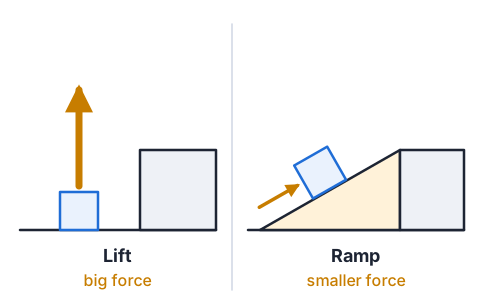
Example: ramp height and how far a car rolls
- Room 4 followed a method: let the toy car go from the top of the ramp, do not push it, and measure how far it rolls along the floor. They did each ramp height three times.
- What pattern do the results show, and is any result untrustworthy?
| Ramp height | Try 1 | Try 2 | Try 3 |
|---|---|---|---|
| 1 book | 80 cm | 85 cm | 82 cm |
| 2 books | 150 cm | 148 cm | 155 cm |
| 3 books | 220 cm | 290 cm | 225 cm |
- Higher ramp: the car rolls furtherabout 80, then 150, then 220 cm
- 3 books, try 2: 290 cm is far from 220 cm and 225 cm
- Their notes say the car was pushed on that try, so the method was not followed. Do that try again
- The higher the ramp, the further the car rolls
Contact and non-contact forces
- A contact force only works when two things touch. Kicking a ball, pushing a door and friction are contact forces.
- A non-contact force works across a gap, without touching.
- Magnetism and gravity are non-contact forces.
Try it: contact or non-contact?
Magnet poles
- A magnet has two ends called poles: north (N) and south (S).
- Attract means pull together. Repel means push apart.
- A north pole and a south pole attract each other.
- Two north poles repel each other, and so do two south poles.
- The force works across a gap, and even through paper or a thin table top.
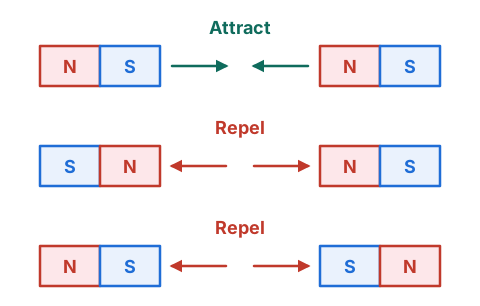
Try it: attract or repel?
Example: which metals does a magnet pick up?
- A class tested five metal things with a fridge magnet. What do the results show?
| Thing | Made of | Attracted? |
|---|---|---|
| Paper clip | Steel | Yes |
| Nail | Iron | Yes |
| Drink can | Aluminium | No |
| Piece of wire | Copper | No |
| Ring | Gold | No |
- Steel is mostly iron, so iron and steel are attracted
- Aluminium, copper and gold are metals but are not attracted
- Magnets attract some metals, like iron, steel and nickel, but not all metals
Try it: will a magnet pick it up?
Gravity
- Gravity is a pull between objects. Earth's gravity pulls everything towards the middle of the Earth.
- It is a non-contact force. An apple falls from a tree even though nothing touches it.
- Gravity is why balls fall, rivers flow downhill, and a car rolls down a ramp by itself.
How people use magnets
- Fridge magnets and the magnetic strips that keep fridge doors shut.
- Magnetic catches on cupboards, and clasps on bags.
- Recycling centres use big magnets to pull steel cans out from aluminium cans.
- Cranes in scrap yards use huge magnets to lift old steel cars.
Common mistakes
- All metals stick to magnets.Only some metals are attracted, mainly iron, steel and nickel; aluminium, copper and gold are not.
- Two north poles pull together.Matching poles repel; only a north pole and a south pole attract.
- A ramp makes the box lighter.The box weighs the same; a ramp lets you use a smaller push over a longer distance.
- Gravity only works on things that are falling.Gravity pulls on you all the time, even standing still; the floor pushes back up so you do not fall.
Magnet hunt
You need: a fridge magnet, a steel paper clip, a scrap of tinfoil, a steel spoon, a plastic lid, a wooden peg, some sheets of paper
- Predict which things the magnet will attract. Write your predictions down.
- Touch the magnet to each thing. Write down which ones it attracts.
- Put one sheet of paper between the magnet and the paper clip. Does the magnet still pull the clip?
- Add more sheets one at a time. Count how many sheets it can pull through.
- Look for this: only the steel things are attracted, and the magnet pulls through paper without touching, because magnetism is a non-contact force.
Safety: Small magnets and paper clips can be very dangerous if swallowed, so an adult keeps them away from younger children.
Your turn
Kicking a ball: is that a contact or a non-contact force?
The north pole of one magnet is near the south pole of another. Do they attract or repel?
Which one will a magnet attract: a steel nail, an aluminium can, or a copper pipe?
Why is a wheelie bin easier to move than a box of the same weight dragged on the ground?
An apple falls from a tree. Which force pulls it, and is it a contact force?
Why does a full trolley need a bigger push than an empty one?
Show answer
1. Contact, because the foot touches the ball. 2. Attract. 3. The steel nail. 4. Its wheels roll, so there is less friction than dragging. 5. Gravity, a non-contact force. 6. It is heavier, and heavier things need a bigger force to start moving.
Forces and Motion: Basics
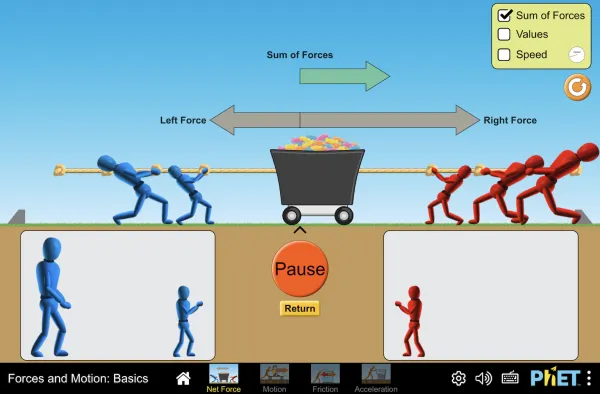
Full screen · PhET Interactive Simulations, University of Colorado Boulder, CC BY 4.0
Recap
- Heavier things need bigger forces to start, stop or turn.
- Ramps and wheels mean a smaller force can move a load.
- Contact forces need touching; magnetism and gravity work across a gap.
- North and south poles attract; matching poles repel.
- Magnets attract iron, steel and nickel, not all metals.
- Follow a method carefully, and repeat any result where it was not followed.
The maths behind it
Report a mistake
How is Year 4 maths going?
See the Year 4 maths guide