 Vertex Learn
Temperature: measuring how hot or cold
What this lesson covers
- Temperature tells us how hot or cold something is
- Thermometers measure temperature in degrees Celsius (°C)
- Reading a thermometer scale, including what each small mark is worth
- Predicting a temperature, then measuring it
- Why two readings can differ, and how to make readings more accurate
What temperature is
- Temperature is how hot or cold something is.
- Your skin is not a good judge. It compares with whatever it touched last.
- So we measure temperature with a thermometer.
- The unit is degrees Celsius, written °C.
How a thermometer works
- A liquid thermometer has a thin glass tube with coloured liquid inside and a bulb at the bottom.
- When the liquid warms up, it takes up more space and climbs the tube. When it cools, it shrinks back down.
- A digital thermometer shows the number on a screen.
- Some temperatures to know:
| Thing | About |
|---|---|
| Water with ice in it | 0 °C |
| A warm classroom | 20 °C |
| Your body | 37 °C |
| Pure water boiling at sea level | 100 °C |
Try it: match the temperature
Reading the scale
- Find the top of the liquid.
- Look at the numbered marks just above and just below it.
- Work out what each small mark is worth: count the gaps between two numbers and share the difference between them.
- Keep your eye level with the top of the liquid, not above or below it.
- Always write the unit, °C, after the number.
Example: what does it say?
- The thermometer has a number every 10 °C, with 5 small gaps between numbers.
- The liquid stops 2 marks above 20. What is the temperature?
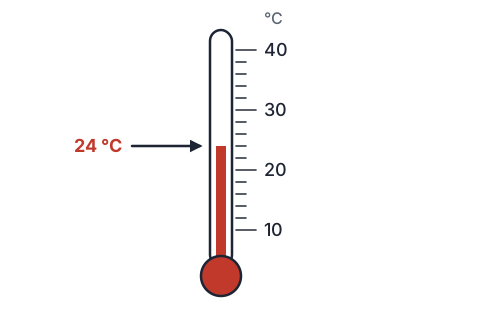
- 10 °C ÷ 5 gaps = 2 °C for each markwhat a mark is worth
- 2 marks × 2 °C = 4 °Chow far above 20
- 20 °C + 4 °C = 24 °C
Example: predict, then measure
- Room 9 predicted the temperature of four cups of water, then measured each one.
- Which prediction was furthest from the measurement?
| Cup | Prediction | Measured |
|---|---|---|
| Water with ice | 0 °C | 2 °C |
| Cold tap water | 10 °C | 14 °C |
| Left on the bench | 20 °C | 19 °C |
| Hot tap water | 60 °C | 48 °C |
- Ice: 2 − 0 = 2 °C out. Cold tap: 14 − 10 = 4 °C out. Bench: 20 − 19 = 1 °C out
- Hot tap: 60 − 48 = 12 °C out
- The hot tap water prediction was furthest out, by 12 °C
How accurate is it?
- Accurate means close to the true value.
- Two thermometers in the same cup can read a little differently.
- Readings go wrong if you read too soon, hold the bulb in your fingers, look from above or below, or lift the thermometer out of the water to read it.
- To check a result, measure more than once, or use two thermometers, and compare.
Example: spot the odd reading
- Four groups measured the same jug of water.
- Which reading is likely to be wrong, and what is the best value for the jug?
| Group | Reading |
|---|---|
| A | 21 °C |
| B | 22 °C |
| C | 21 °C |
| D | 30 °C |
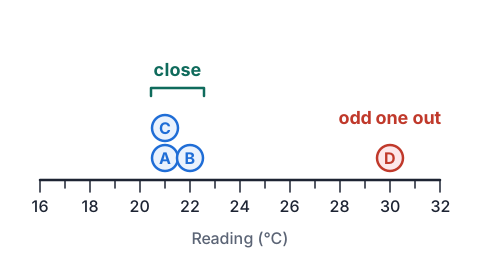
- A, B and C are within 1 °C of each other
- D is 8 °C higher than the others
- D's reading is likely wrong. Maybe the bulb was held in warm fingers. The jug is about 21 °C
Try it: spot the odd reading
Common mistakes
- Every small mark on a thermometer is 1 °C.Count the gaps between two numbers first; on many thermometers each mark is 2 °C or 5 °C.
- You can read the thermometer as soon as it goes in.Wait until the liquid stops moving, then read it while the bulb is still in the water.
- If the water feels warm to my hand, it is warm.Your hand compares with what it touched before; only a thermometer gives a number you can trust.
- The answer is 24.Always write the unit: 24 °C.
Can you trust your hands?
You need: 3 bowls, cold tap water, ice cubes, warm tap water, a towel, a kitchen thermometer, if you have one
- Fill the left bowl with cold tap water and ice. Fill the right bowl with warm tap water. Fill the middle bowl with a mix of the two.
- Put your left hand in the cold bowl and your right hand in the warm bowl. Count slowly to 30.
- Now put both hands into the middle bowl at the same time.
- Say how the water feels to each hand. If you have a thermometer, measure the middle bowl.
- Look for this: the middle bowl feels warm to one hand and cold to the other, even though it is one temperature. That is why we use a thermometer.
Safety: Use warm water that feels comfortable, never hot, and ask an adult to test it first so nobody gets scalded.
Your turn
What unit do we usually use for temperature?
A thermometer has a number every 10 °C and 10 small gaps between numbers. What is each mark worth?
Each mark is 2 °C. The liquid stops 3 marks above 30. What is the temperature?
You predicted 15 °C and measured 19 °C. How far out was your prediction?
Four readings of one cup are 18 °C, 19 °C, 18 °C and 26 °C. Which is likely to be wrong?
Why should the bulb stay in the water while you read the thermometer?
Show answer
1. Degrees Celsius, °C. 2. 1 °C, because 10 ÷ 10 = 1. 3. 36 °C, because 3 × 2 = 6 and 30 + 6 = 36. 4. 4 °C, because 19 − 15 = 4. 5. 26 °C, because it is far from the other three. 6. Out of the water the liquid starts to change straight away, so the reading would be wrong.
Recap
- Temperature is how hot or cold something is, measured in °C with a thermometer.
- Work out what each small mark is worth before you read the scale.
- Read at eye level, after the liquid stops moving, with the bulb still in.
- Predict first, then measure, and see how far out you were.
- Measure more than once and compare to check your results are accurate.
The maths behind it
Report a mistake
How is Year 4 maths going?
See the Year 4 maths guide