Variables: sorting, counting and measuring
What this lesson covers
- A variable is an attribute or measurement of the people or objects being studied: categorical variables classify objects or individuals into groups discrete numerical variables are counted continuous numerical variables are measured.
A variable is a question you ask everyone
- Go round the class: "what is your favourite fruit?"
- That question is the variable.
- The answers VARY from person to person. Hence the name.
| person | favourite fruit |
|---|---|
| Aria | apple |
| Tane | feijoa |
| Sam | apple |
| Mia | banana |
Sort, count, or measure?
- Favourite fruit: you sort people into groups.
- Number of pets: you count.
- How tall you are: you measure.
| the question | what you do | what it is called |
|---|---|---|
| what is your favourite fruit? | sort into groups | categorical |
| how many pets have you got? | count them | discrete |
| how tall are you? | measure it | continuous |
The proper names
- Sorting into groups: categorical.
- Counting: discrete. Measuring: continuous.
- But the action is what matters, not the word.
| if you... | the variable is |
|---|---|
| sort into groups | categorical |
| count whole things | discrete |
| measure with a tool | continuous |
Counting gives an exact answer
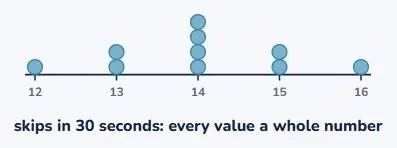
- You did 14 skips. Exactly 14.
- There is no such thing as 14 and a half skips.
- Counted things land on whole numbers.
Measuring never quite does
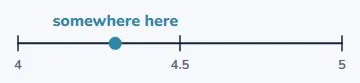
- How long did the 1000 m run take?
- It depends entirely on your stopwatch.
- A better one would give you more digits. Forever.
So a measurement gets rounded
- You have to stop somewhere and write a number down.
- Where you stop depends on what you are measuring.
- That choice is part of collecting the data properly.
| data | counted or measured? | how exact |
|---|---|---|
| 14 skips | counted | exactly 14, no halves |
| 3 pets | counted | exactly 3 |
| 132 cm tall | measured | to the nearest cm |
| 4 minutes 12 s | measured | to the nearest second |
Round to something sensible
- Heights to the nearest centimetre. Not millimetre.
- A run to the nearest second, not the nearest minute.
- Too rough loses information. Too fine is pretending.
| measuring | round to | but not |
|---|---|---|
| your height | the nearest cm | not the nearest mm |
| a 1000 m run | the nearest second | not tenths of a second |
| a walk to school | the nearest minute | not the nearest second |
Collecting it properly
- Ask everyone the same question, the same way.
- Use the same tool and the same rounding for everyone.
- Otherwise you are not comparing like with like.
| do this | not this |
|---|---|
| same question for everyone | changing the wording halfway |
| same tool every time | a ruler for some, a tape for others |
| same rounding | some to the cm, some to the mm |
Your turn: sort, count or measure?
- How many brothers and sisters have you got?
- What colour are your eyes?
- How heavy is your school bag?
| question | sort, count or measure? |
|---|---|
| how many brothers and sisters? | ? |
| what colour are your eyes? | ? |
| how heavy is your bag? | ? |
Show answer
Count: discrete, and always a whole number. Sort: categorical; there is no counting or measuring involved, just groups. Measure: continuous, so it needs rounding, sensibly to the nearest hundred grams rather than the nearest gram. Ask for the ACTION first; the technical word can follow.
Variables and data
- A variable is the question you ask everyone.
- Sort, count, or measure: that tells you the kind.
- Counting is exact. Measuring always needs rounding.
| idea | what to remember |
|---|---|
| a variable | the question you ask everybody |
| sorting | categorical (groups) |
| counting | discrete (exact whole numbers) |
| measuring | continuous (needs rounding) |
| how much rounding | whatever suits what you are measuring |
| fair data | same question, same tool, same rounding |
Is your child on track?
Take the free placement test