Column methods, and why they work
What this lesson covers
- Addition and subtraction can be carried out mentally, using known facts, place value and partitioning, or column methods.
- Standard written algorithms (e.g. column addition, column subtraction) rely on place value, regrouping, and renaming.
- Multiplication can be represented as repeated addition, scaling, or arrays, and larger numbers can be multiplied using an area model or column multiplication.
Written methods are not new tricks
- Column addition looks like a ritual you have to memorise.
- It is not. It is place value, written down.
- Everything in this lesson is partitioning in disguise.
| what it looks like | what it actually is |
|---|---|
| column addition | partitioning, arranged in columns |
| the carried 1 | ten ones that became one ten |
| the area model | partitioning, turned sideways |
First, do it in your head
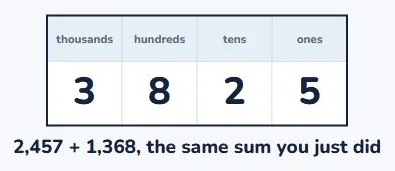
- 2,457 + 1,368. Break both into their columns.
- Add the thousands, then hundreds, then tens, then ones.
- 3,000 and 700 and 110 and 15. That is 3,825.
| column | add them |
|---|---|
| thousands | 2,000 + 1,000 = 3,000 |
| hundreds | 400 + 300 = 700 |
| tens | 50 + 60 = 110 |
| ones | 7 + 8 = 15 |
Now the same sum, in columns
- Exactly the same work. Same numbers, same order.
- The columns just hold the parts for you.
- Same answer: 3,825.
What the carried 1 actually is
- 7 ones and 8 ones make 15 ones.
- Ten of them become one ten, and move to the next column.
- 5 stays behind. That is the whole of carrying.
| you get | which is | so |
|---|---|---|
| 15 ones | 1 ten and 5 ones | write 5, carry the ten |
| 11 tens | 1 hundred and 1 ten | write 1, carry the hundred |
Subtraction borrows the same way, backwards
- If a column has too few, take one from its left.
- One hundred arrives as ten tens. Not as one ten.
- Same exchange rate, travelling the other way.
| you take | it arrives as |
|---|---|
| 1 ten | 10 ones |
| 1 hundred | 10 tens |
| 1 thousand | 10 hundreds |
Multiplying is rows of the same thing
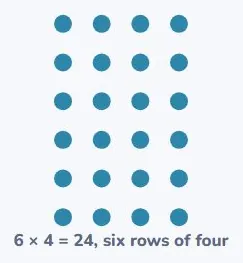
- 6 × 4 is six rows of four.
- You can count them, or add 4 six times.
- Or just know it. These are the facts worth memorising.
Bigger numbers: cut the rectangle
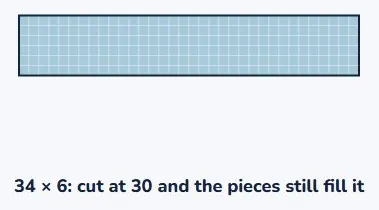
- 34 × 6 is a rectangle 34 long and 6 high.
- Cut it at 30. Now there are two easy rectangles.
- Nothing is lost in the cut, so the areas add up.
Two easy sums instead of one hard one
- 30 × 6 is 180.
- 4 × 6 is 24.
- Put them back together: 204.
| piece | sum | gives |
|---|---|---|
| the 30 part | 30 × 6 | 180 |
| the 4 part | 4 × 6 | 24 |
| put together | 180 + 24 | 204 |
Zero and one are not the same in both
- 6 × 0 is nothing. No groups at all.
- But 6 + 0 is still 6.
- Say "groups of" and the difference is obvious.
| sum | answer | say it out loud |
|---|---|---|
| 6 × 1 | 6 | one group of six |
| 6 × 0 | 0 | no groups at all |
| 6 + 0 | 6 | six, and nothing added |
| 6 ÷ 1 | 6 | shared between one person |
Dividing is sharing out the columns
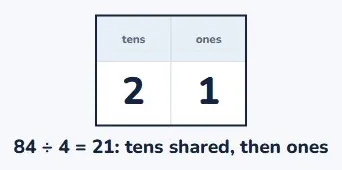
- 84 ÷ 4. Share the 8 tens first: 2 tens each.
- Then share the 4 ones: 1 each.
- 21. Place value again, one column at a time.
Your turn
- 2,608 + 1,495. Watch the carrying.
- 47 × 3, by cutting the rectangle at 40.
- 96 ÷ 3, sharing the tens first.
| try these | |
|---|---|
| 2,608 + 1,495 | two carries |
| 47 × 3 | cut at 40 |
| 96 ÷ 3 | tens first |
Show answer
4,103: the ones make 13 and the tens make 10, so there are two carries in a row, which is the point of choosing it. 141: 40 × 3 is 120, 7 × 3 is 21, and 120 + 21 = 141. 32: 9 tens shared 3 ways is 3 tens, 6 ones shared 3 ways is 2 ones. All three are the same move: split by place value, then reassemble.
Why the methods work
- Every written method is place value, written down.
- Carrying and borrowing are ten-for-one exchanges.
- Cutting a rectangle loses nothing, so the pieces add.
| method | what it really is |
|---|---|
| column addition | partition, add columns, reassemble |
| the carried 1 | 10 ones became 1 ten |
| subtraction | the same exchange, backwards |
| arrays | rows of the same thing |
| area model | cut it, do two easy sums, add |
| × 0 and × 1 | count the groups, not the objects |
| dividing | share the biggest columns first |
Is your child on track?
Take the free placement test