 Vertex Learn
Solids, liquids and gases, and how they change
What this lesson covers
- Solids keep their own shape and size; powders pour but are still solids
- Liquids keep the same amount but take the shape of their container
- Gases spread out to fill whatever they are in
- Melting, freezing, evaporating and condensing are physical changes
- Heating and cooling change matter from one state to another
- Pure water freezes at 0 °C and boils at 100 °C at sea level
Three states of matter
- Matter is anything that takes up space and has mass. Rocks, juice and air are all matter.
- Matter comes in three main states: solid, liquid and gas.
- Volume means how much space something takes up.
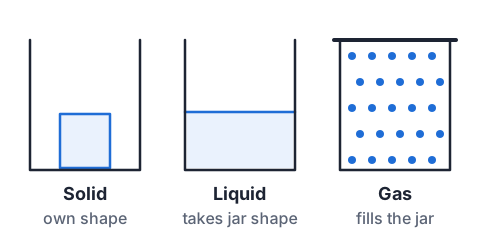
Solids
- A solid keeps its own shape and its own volume.
- A stone is the same shape in a cup or in a box.
- Sugar, flour and sand can be poured, a bit like a liquid.
- But each grain is a tiny solid that keeps its shape. So powders are solids.
Liquids
- A liquid keeps its volume, but it has no shape of its own.
- It flows, and it takes the shape of whatever it is poured into.
- 250 mL of milk in a tall glass or a wide bowl is still 250 mL.
Gases
- A gas has no shape of its own and no fixed volume.
- It flows easily and spreads out to fill whatever it is in.
- The air in a balloon fills all of it.
- A smell from the kitchen spreads through the whole house.
Example: solid, liquid or gas?
- Use two questions: does it keep its own shape, and does it keep its volume?
| Thing | Own shape? | Same volume? | State |
|---|---|---|---|
| Ice cube | Yes | Yes | Solid |
| Honey | No | Yes | Liquid |
| Air in a tyre | No | No, it fills the tyre | Gas |
| Salt | Each grain, yes | Yes | Solid |
- Salt pours, so it looks like a liquid
- But each grain keeps its own shapelook closely
- Salt is a solid, in the form of a powder
Try it: solid, liquid or gas?
Changing state
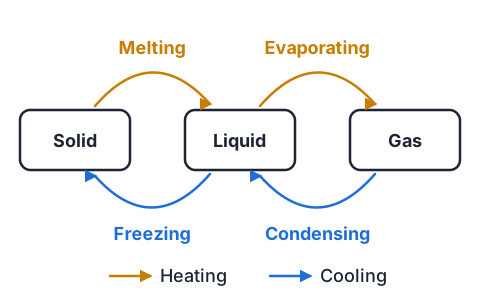
- Heating or cooling can change matter from one state to another.
- Melting: a solid turns into a liquid, like ice into water. Freezing is the opposite.
- Evaporating: a liquid turns into a gas, like a puddle drying up.
- Condensing: a gas turns into a liquid, like drips on a cold window.
- These are physical changes. The state changes, but no new substance is made. Melted chocolate is still chocolate.
Try it: name the change
Water's two special temperatures
- Temperature is measured in degrees Celsius, written °C.
- Pure water freezes at 0 °C.
- Pure water boils at 100 °C at sea level.
- High up a mountain, water boils at a lower temperature than that.
Try it: heat and cool water
Example: testing a prediction with chocolate
- Room 12 predicted: 'Chocolate melts faster in a warmer place.'
- They put the same size square of chocolate in four places and checked it every few minutes for 30 minutes.
- Was their prediction right?
| Place | Temperature | Result |
|---|---|---|
| Fridge | 4 °C | Still solid after 30 minutes |
| Classroom desk | 20 °C | Still solid after 30 minutes |
| Sunny window | 32 °C | Soft after 15 minutes |
| Plate over hot tap water | 45 °C | Melted after 4 minutes |
- 4 °C and 20 °C: too cool, the chocolate stayed solid
- 32 °C: warm enough, it went soft in 15 minutes
- 45 °C: much warmer, it melted in 4 minutes
- Yes. The warmer the place, the faster the chocolate melted
- Put back in the fridge, the melted chocolate set solid again: still chocolate
Common mistakes
- Sand can be poured, so it is a liquid.Each grain of sand keeps its own shape, so sand is a solid; powders just flow like liquids.
- When a puddle evaporates, the water disappears.The water turns into water vapour, a gas we cannot see; it is still water, now in the air.
- The white cloud above a boiling kettle is a gas.The white cloud is tiny drops of liquid water that have condensed; the gas itself is invisible.
- When ice melts it becomes a new substance.Melting is a physical change: it is still water, just in a different state.
The ice cube race
You need: 3 ice cubes the same size, 3 saucers, a clock, paper and a pencil, a kitchen thermometer, if you have one
- Write a prediction: which ice cube will melt first, in the fridge, on the kitchen bench, or on a sunny windowsill?
- Put one ice cube on each saucer, and put a saucer in each place at the same time.
- Check every 5 minutes. Write down what each ice cube looks like.
- Write down the time when each one has fully melted. If you have a thermometer, measure the temperature in each place.
- Look for this: the warmest place melts its ice first. The water in the saucer is the same water, just a liquid now.
Safety: Put the saucers where they will not be knocked over, and wipe up any water straight away so nobody slips.
Your turn
Flour can be poured. Is it a solid, a liquid or a gas?
You pour 300 mL of juice from a bottle into a wide jug. How much juice is in the jug?
Water vapour from a shower turns into drops on a cold mirror. What is this change called?
At what temperature does pure water freeze?
Butter melts in a hot pan. Is a new substance made?
Why does the air in a balloon fill the whole balloon?
Show answer
1. A solid, because each grain keeps its shape. 2. 300 mL, because a liquid keeps its volume. 3. Condensing. 4. 0 °C. 5. No. Melting is a physical change, and it is still butter. 6. Air is a gas, and a gas spreads out to fill its container.
States of Matter: Basics
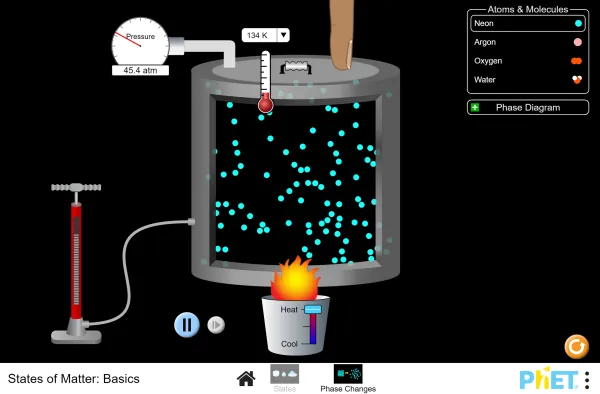
Full screen · PhET Interactive Simulations, University of Colorado Boulder, CC BY 4.0
Recap
- Solids keep their shape and volume; powders are solids that pour.
- Liquids keep their volume but take the shape of their container.
- Gases have no fixed shape or volume and spread to fill their container.
- Heating causes melting and evaporating; cooling causes condensing and freezing.
- Changes of state are physical changes: no new substance is made.
- Pure water freezes at 0 °C and boils at 100 °C at sea level.
The maths behind it
Report a mistake
How is Year 4 maths going?
See the Year 4 maths guide