 Vertex Learn
Blood, the heart and how food reaches every part of you
What this lesson covers
- How digested food and water get into the blood
- The heart pumps blood through blood vessels
- Arteries take blood away from the heart
- Veins bring blood back to the heart
- Capillaries swap substances with body cells
- What the body uses nutrients for
- What different models of the circulatory system show well, and what they miss
From your gut into your blood
- Digestion breaks food down into tiny pieces. The useful substances in food, such as sugars, fats and proteins, are called nutrients.
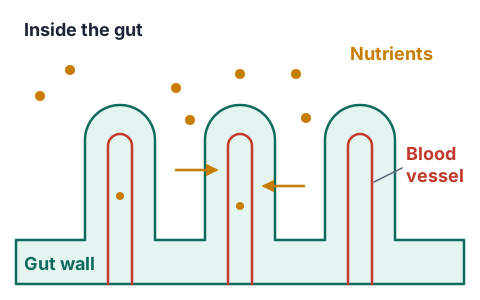
- The small intestine is a long, coiled tube below your stomach. Its inside is covered in tiny finger-like bumps, each packed with even tinier blood vessels.
- Digested nutrients and water pass through the thin walls of these bumps and into the blood.
- Most of the rest of the water is taken in further along, in the large intestine.
The heart and the circulatory system
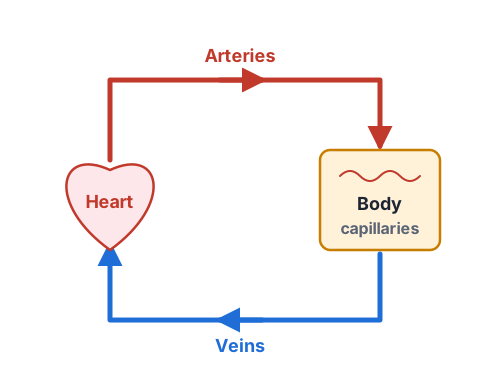
- The circulatory system is your heart, your blood vessels and the blood inside them.
- Blood vessels are the tubes that carry blood all through your body.
- The heart is a muscle about the size of your fist. Each time it squeezes, it pushes blood out into the blood vessels. This pumping keeps the blood moving round and round, all day and all night.
Try it: the heart and blood vessels
Arteries: away from the heart
- Arteries are the blood vessels that take blood away from the heart and out to the body.
- Each squeeze of the heart pushes blood into them hard, so arteries have thick, stretchy walls.
- Your pulse is that push, felt where an artery runs close to the skin, such as on the inside of your wrist or the side of your neck.
Veins: back to the heart
- Veins are the blood vessels that return blood from the body to the heart.
- Blood in veins flows more gently, so veins have thinner walls than arteries.
- The bluish lines you can see on the inside of your wrist are veins. The blood inside them is dark red, not blue; it only looks blue through your skin.
Capillaries: where the swapping happens
- Cells are the tiny building blocks that every part of your body is made of. A tissue is a group of similar cells working together, like muscle.
- Capillaries are tiny blood vessels, thinner than a hair, that run through every tissue. They join the arteries to the veins.
- Their walls are so thin that substances can pass through. Nutrients and oxygen move out of the blood into the body cells, and wastes such as carbon dioxide move from the cells into the blood.
Try it: artery, vein or capillary?
Following a bit of sugar from your lunch
- Trace a bit of sugar from the bread in your sandwich to a muscle in your leg.
- Stomach and small intestine: the bread is digested into sugardigestion
- Small intestine: the sugar passes into the capillaries in the gut wallabsorbed
- Veins carry the blood back to the heart, passing through the liver on the waytoward the heart
- The heart pumps it out along the arteries to the legaway from the heart
- Capillaries in the leg muscle: the sugar moves into the muscle cellsswapped
- Gut → capillaries → veins → heart → arteries → capillaries → muscle cells
What your body does with nutrients
- Once nutrients reach your cells, your body uses them in two main ways.
| Use | What it means | Example |
|---|---|---|
| Fuel | Releasing energy for moving and for staying warm | Sugar from kūmara or bread powering your muscles in a game of touch |
| Building blocks | Making new cells for growing and for repair | Protein from eggs, fish or beans used to heal a grazed knee |
| Keeping things working | Helping every other life process run | Calcium from milk keeping bones strong |
Comparing models of the circulatory system
- A model is a simpler version of something real that helps us understand it. Every model shows some things well and leaves other things out.
- Our loop diagram is a model. It makes the direction of flow clear, but it leaves out the lungs and shows only one of the thousands of capillary networks.
| Model | Shows well | Not so good at |
|---|---|---|
| Labelled drawing | Where every part is, all at once | Movement: nothing flows |
| Animation | Blood flowing and the heart pumping | Seeing every part at the same time |
| Squeeze bottle and tubes | How a pump pushes liquid round a loop | The real size, shape and number of vessels |
| Loop diagram | Which way blood goes in arteries and veins | The lungs, and how many vessels there are |
Measuring a pulse
- Mere counted her pulse for 15 seconds. Sitting still she counted 21 beats. After 1 minute of skipping she counted 33 beats. Work out her beats per minute each time, and explain the change.
- There are 4 lots of 15 seconds in 1 minutescale up
- Resting: 21 × 4 = 84 beats a minute
- After skipping: 33 × 4 = 132 beats a minute
- Her heart beat faster after skipping, 132 compared with 84, because her working muscles needed more fuel and oxygen delivered by the blood
Common mistakes
- Arteries carry blood to the heart and veins carry it away.It is the other way round: arteries take blood away from the heart, and veins bring it back.
- Blood in veins is blue.Blood is always red; veins only look blue because you see them through your skin.
- Nutrients go straight from the stomach to the muscles.Nutrients pass into the blood in the small intestine, travel through the heart, and leave the blood through capillaries.
- The heart makes the blood.The heart is a pump; it pushes blood round the body, but the blood is made elsewhere, inside your bones.
Measure your pulse at rest and after exercise
You need: a clock, timer or phone with seconds, paper and a pencil, a helper
- Sit still for 2 minutes. Find your pulse by pressing two fingers gently on the inside of your wrist, below your thumb.
- Have your helper time 15 seconds while you count the beats. Multiply by 4 and write down your beats per minute.
- Do star jumps for 1 minute, then count your pulse again for 15 seconds and multiply by 4.
- Sit and rest for 3 minutes and measure once more.
- Look for this: your pulse is highest just after exercise and drops back toward your resting rate as you rest.
Safety: Ask an adult first, and skip the star jumps if you have asthma or a heart condition; stop straight away if you feel dizzy, sick or short of breath.
Your turn
Which blood vessels carry blood away from the heart?
Where do digested nutrients get into the blood?
Why are capillary walls so thin?
Tama counts 18 beats in 15 seconds. What is his pulse in beats per minute?
An animation shows blood flowing. What is one thing it is not so good at showing?
Show answer
1. Arteries. 2. In the small intestine, through the walls of its finger-like bumps. 3. So nutrients, oxygen and wastes can pass between the blood and the body cells. 4. 18 × 4 = 72 beats per minute. 5. All the parts at the same time, so it is hard to see the whole system at once.
Recap
- Digested nutrients and water pass from the intestines into the blood.
- The heart pumps blood round the body through blood vessels.
- Arteries carry blood away from the heart; veins bring it back.
- In capillaries, nutrients and oxygen move into body cells and wastes move out.
- Nutrients are fuel for moving and warmth, and building blocks for growth and repair.
- Each model of the circulatory system shows some things well and hides others.
The maths behind it
Report a mistake
How is Year 6 maths going?
See the Year 6 maths guide