 Vertex Learn
Habitats: measuring their features and who lives where
What this lesson covers
- Te Taiao and what a habitat is
- Physical features of habitats you can observe and measure
- Why different habitats are home to different living things
- Why similar conditions in different places suit similar living things
- Recording a habitat along a transect line
- Predicting where an organism lives, and planning a garden
Te Taiao and habitats
- Te Taiao means the natural world. New Zealand's science curriculum describes it as the home that cares for, supports and links every living thing.
- An organism is any living thing: a plant, an animal, a fungus or a tiny microbe.
- A habitat is the place where an organism lives and finds what it needs to survive: food, water, shelter and space.
Physical features you can measure
- The physical features of a habitat are its non-living conditions, such as how much water there is, how much sun it gets, and how warm it is.
- You can observe some features and measure others with simple tools, so you can compare habitats fairly.
| Feature | How to observe or measure it |
|---|---|
| Temperature | A thermometer, in °C |
| Sun exposure | Rate it: full sun, part shade or full shade |
| Water | Squeeze a handful of soil: dry, damp or wet |
| Wind | A strip of ribbon: still, moving or flapping |
| Ground | Look: bare soil, sand, rock or leaf litter |
Different features, different living things
- Habitats with different features are home to different organisms, because each organism needs particular conditions.
- A native forest is shady, damp and sheltered. It suits tall trees, ferns, and birds such as tūī and kererū that feed on nectar and fruit.
- A rocky shore is salty and is covered and uncovered by the tide. It suits crabs, limpets and seaweeds.
- A sand dune is sunny, dry and windy. It suits tough plants with deep roots, such as pīngao, the golden sand sedge.
Similar conditions, similar living things
- Places with similar features tend to have similar kinds of organisms, even when they are far apart.
- Damp, shady spots, such as a bush gully, the shady side of a school building, or the ground under a rotting log, usually have mosses, fungi and lichens.
- Hot, dry, sunny spots, such as a rock wall facing north, often have skinks basking and plants with thick, waxy leaves that hold water.
- The same pattern happens across the whole world: deserts on different continents have similar kinds of plants.
Recording along a transect
- A transect is a straight line, usually a long tape measure, laid across a habitat so you can see how things change along it.
- You stop at regular distances, such as every 2 metres. At each stop you measure the same features and list the organisms, in the same way each time.
- Recording in the same way at every stop is called being systematic. It makes the results fair to compare.
Try it: sample along a line
Reading a transect
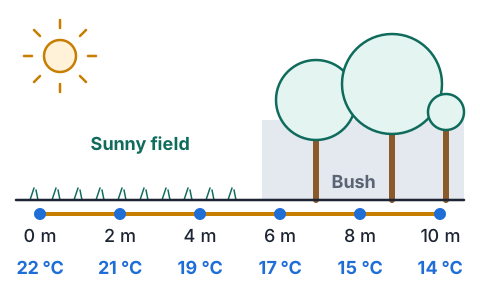
- Room 10 laid a 10 m tape from the middle of the school field into the bush at its edge. What changed along the line, and why?
| Distance (m) | Temperature (°C) | Sun | Soil | Organisms found |
|---|---|---|---|---|
| 0 | 22 | Full sun | Dry | Grass, clover |
| 2 | 21 | Full sun | Dry | Grass, daisies |
| 4 | 19 | Part shade | Damp | Grass, a few fern seedlings |
| 6 | 17 | Shade | Damp | Ferns, moss |
| 8 | 15 | Shade | Wet | Moss, fungi, slaters |
| 10 | 14 | Full shade | Wet | Ferns, moss, fungi, slaters |
- From 0 m to 10 m the temperature fell from 22 °C to 14 °Ccooler
- The sun went from full sun to full shade, and the soil from dry to wetshadier and damper
- Grass grew in the sunny, dry part; ferns, moss, fungi and slaters lived in the shady, wet partorganisms changed
- Moving into the bush, it got cooler, shadier and wetter, so the organisms changed from sun-loving grass to shade-loving ferns, moss and fungi
Try it: temperature along the transect
Predicting where an organism lives
- Slaters are small grey animals that dry out quickly in the sun and eat rotting leaves. Predict where in a garden you would find them.
- They dry out in the sun, so they need shade and dampneed: water
- They eat rotting leaves, so they need leaf litterneed: food
- Under logs, stones, pots or piles of damp leaves, in shady parts of the garden
Planning a garden that plants will thrive in
- Plants grow best where the features match their needs, so start by finding the sunny, shady, dry and damp parts of the garden.
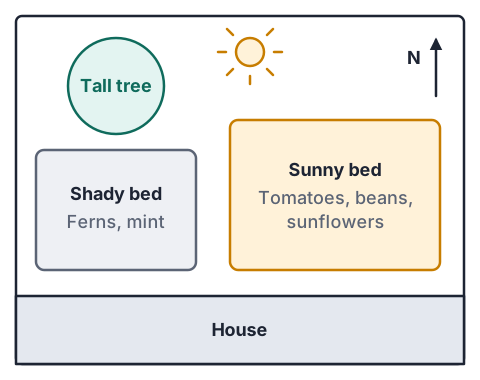
- In New Zealand the sun is in the northern part of the sky, so the north side of a garden gets the most sun, and a tall tree or fence throws shade on its south side.
- Tomatoes, beans and sunflowers need lots of sun and warmth, so they go in the sunny bed. Ferns and mint cope well with shade and damp soil, so they go under the tree.
Try it: sunny or shady spot?
Common mistakes
- A habitat is just the home an animal sleeps in, like a nest.A habitat is the whole place where an organism finds food, water, shelter and space.
- Measuring only one spot is enough to describe a habitat.Measure at many stops along a transect, the same way each time, to see how the features change.
- In New Zealand the sunniest side of a garden is the south side.We are in the southern half of the world, so the sun is in the northern sky and the north side gets the most sun.
Compare a sunny spot and a shady spot
You need: a measuring tape or a 1 metre piece of string, 4 sticks or pegs, gardening gloves, paper and a pencil, a thermometer, if you have one
- Choose a sunny patch and a shady patch of garden, such as open lawn and the ground under a tree or hedge.
- Mark out a 1 metre square in each with the sticks and string.
- In each square, rate the sun, squeeze the soil to test how damp it is, and take the temperature if you have a thermometer.
- Wearing gloves, gently lift leaves and small stones and count each kind of living thing you see, then put everything back as it was.
- Look for this: the shady square is usually cooler and damper, with more moss, slaters and worms; the sunny square has more grass and flowers.
Safety: Ask an adult to come with you, wear gloves, and never put your hand where you cannot see, because spiders and wasps can bite or sting; wash your hands afterwards.
Your turn
Name two physical features of a habitat you could measure.
A plant needs full sun and dry, sandy soil. Would it grow better on a sand dune or on a forest floor?
Where would you expect to find moss in a school playground?
In Room 10's transect, how much cooler was it at 10 m than at 0 m?
You want to grow lettuces, which like some shade on hot summer afternoons. Where in an NZ garden could you plant them?
Show answer
1. Any two of: temperature, sun exposure, how damp the soil is, wind, type of ground. 2. A sand dune, which is sunny with dry, sandy soil. 3. In a damp, shady place, such as the shady side of a building or under a tree. 4. 22 − 14 = 8 °C cooler. 5. Somewhere with sun in the morning but shade in the afternoon, such as the east side of a fence or tree.
Recap
- A habitat is where an organism finds food, water, shelter and space.
- Habitats differ in physical features such as water, sun and temperature, which you can observe and measure.
- Different features suit different organisms, and similar features suit similar organisms.
- A transect records the features and organisms at regular stops, the same way each time.
- Knowing what an organism needs lets you predict where it lives and plan a garden that suits each plant.
The maths behind it
Report a mistake
How is Year 6 maths going?
See the Year 6 maths guide