Order of operations and column methods
What this lesson covers
- In expressions that have more than one operation, the order of operations is important; operations are done as follows: operations grouped inside brackets exponents such as squaring multiplication and division, from left to right addition and subtraction, from left to right.
- Addition and subtraction can be carried out mentally, using known facts, place value and partitioning, or column methods.
What is 2 + 3 × 4?
- Work left to right and you get 20.
- Do the multiplying first and you get 14.
- Same marks on the page. Two different answers.
| Read it as | Answer |
|---|---|
| (2 + 3) × 4 | 20 |
| 2 + (3 × 4) | 14 |
Maths is not allowed two answers
- A written sum has to mean one thing to everybody.
- So mathematicians agreed an order and stuck to it.
- It is a convention, not a law of nature, but it is universal.
The agreed order
- Brackets first, always.
- Then squares and cubes.
- Then multiplying and dividing, left to right.
- Then adding and subtracting, left to right.
| Order | Do these |
|---|---|
| 1 | Brackets |
| 2 | Squares and cubes |
| 3 | × and ÷, left to right |
| 4 | + and −, left to right |
Brackets are an instruction
- Brackets say: this part is one lump, do it first.
- (2 + 3) × 4 makes the adding happen first.
- They are how you override the order on purpose.
| Expression | First step | Answer |
|---|---|---|
| (2 + 3) × 4 | 5 × 4 | 20 |
| 2 + 3 × 4 | 2 + 12 | 14 |
Squares come before multiplying
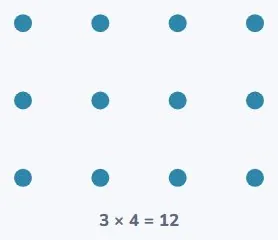
- In 2 × 3², deal with the 3² first.
- 3² is 9, so the sum becomes 2 × 9.
- That is 18, not 6² , which would be 36.
| Step | Expression |
|---|---|
| Start | 2 × 3² |
| Square first | 2 × 9 |
| Then multiply | 18 |
Multiplying and dividing share a stage
- They are not first and second. They are joint.
- When both appear, work left to right.
- Whichever you meet first is the one you do first.
| Order | Do these |
|---|---|
| 1 | Brackets |
| 2 | Squares and cubes |
| 3 | × and ÷, left to right |
| 4 | + and −, left to right |
So do adding and subtracting
- Same arrangement: joint, and left to right.
- 10 − 4 + 3 is 6 + 3, which is 9.
- Not 10 − 7. Left to right, every time.
| Step | Expression |
|---|---|
| Start | 10 − 4 + 3 |
| Leftmost first | 6 + 3 |
| Answer | 9 |
Back to 2 + 3 × 4
- No brackets. No squares.
- So the multiplying goes first: 3 × 4 is 12.
- Then the adding: 2 + 12.
- The answer is 14. Twenty was the wrong reading.
A longer one: 4 + 2 × 3²
- No brackets, so start with the square. 3² is 9.
- Now 4 + 2 × 9. Multiplying before adding.
- 2 × 9 is 18, so it becomes 4 + 18.
- The answer is 22.
| Step | Expression |
|---|---|
| Start | 4 + 2 × 3² |
| Square | 4 + 2 × 9 |
| Multiply | 4 + 18 |
| Add | 22 |
The trap: 12 ÷ 3 × 2
- The list says "multiplication and division", so × looks first.
- It is not. They are joint, and this is left to right.
- 12 ÷ 3 is 4, then 4 × 2 is 8.
- Do the × first and you get 2. That is the mistake.
| Reading | Working | Answer |
|---|---|---|
| Left to right | 4 × 2 | 8 |
| × first | 12 ÷ 6 | 2 |
Adding in your head by partitioning
- 347 + 285. Split both by place value.
- 300 + 200 is 500. 40 + 80 is 120. 7 + 5 is 12.
- Then 500 + 120 + 12 is 632.
- No paper needed: just place value and known facts.
| Part | Sum |
|---|---|
| Hundreds | 300 + 200 = 500 |
| Tens | 40 + 80 = 120 |
| Ones | 7 + 5 = 12 |
| Total | 632 |
The same sum in columns
- Line the numbers up by place value, not by their left edge.
- Ones under ones, tens under tens.
- Add each column, starting from the ones.
- 347 + 285 = 632, the same answer as before.
| H | T | O | |
|---|---|---|---|
| 3 | 4 | 7 | |
| + | 2 | 8 | 5 |
| = | 6 | 3 | 2 |
What the little carried 1 actually is
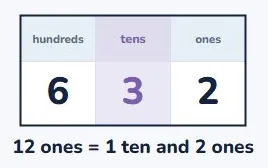
- 7 + 5 is 12, which will not fit in the ones column.
- So 10 of those ones become 1 ten and move across.
- The carried 1 is not a 1. It is ten ones, renamed.
- That is why the method works at all.
Subtracting across a zero
- 502 − 168. In the ones, 2 − 8 will not go.
- The tens column is a 0, so borrow from the hundreds first.
- 500 becomes 4 hundreds and 10 tens.
- Now the borrowing works, and the answer is 334.
| H | T | O | |
|---|---|---|---|
| 5 | 0 | 2 | |
| − | 1 | 6 | 8 |
| = | 3 | 3 | 4 |
Multiplying 542 × 12
- Split both numbers by place value.
- 542 becomes 500, 40 and 2. Twelve becomes 10 and 2.
- Every box is one easy multiplication.
- Six boxes, six answers, none of them hard.
| × | 500 | 40 | 2 |
|---|---|---|---|
| 10 | 5,000 | 400 | 20 |
| 2 | 1,000 | 80 | 4 |
Then add the boxes up
- 5,000 + 400 + 20 gives 5,420; that is 542 × 10.
- 1,000 + 80 + 4 gives 1,084; that is 542 × 2.
- Together, 5,420 + 1,084 = 6,504.
- So 542 × 12 = 6,504.
| Row | Adds to |
|---|---|
| 542 × 10 | 5,420 |
| 542 × 2 | 1,084 |
| Total | 6,504 |
Is 6,504 even sensible?
- Round first: 542 is about 500.
- 500 × 12 is 6,000.
- 6,504 is a bit more than 6,000, which is right.
- If you had got 650 or 65,000, the estimate would have caught it.
| Step | Value |
|---|---|
| Estimate | 500 × 12 = 6,000 |
| Actual | 6,504 |
Four to try
- 1. Work out 5 + 2 × 6.
- 2. Work out 20 ÷ 4 × 5.
- 3. Work out 604 − 247 in columns.
- 4. Work out 236 × 14 using a grid.
Show answer
Answers: 1. 17: multiply first; 42 means they went left to right. 2. 25, left to right; 1 means they did the × first, which is the trap beat again. 3. 357, and it needs borrowing across the zero in the tens. 4. 3,304 (200×10=2000, 30×10=300, 6×10=60, 200×4=800, 30×4=120, 6×4=24). Ask for the estimate on 4 before the answer: 236 is about 240, so roughly 240 × 14 = 3,360.
The order, and nothing else
- Four stages. Two of them are shared, and both go left to right.
- When in doubt, brackets make your meaning obvious.
| Order | Do these |
|---|---|
| 1 | Brackets |
| 2 | Squares and cubes |
| 3 | × and ÷, left to right |
| 4 | + and −, left to right |
Is your child on track?
Take the free placement test