 Vertex Learn
Earth's water: stores, clouds, vapour and the water we use
What this lesson covers
- The hydrosphere: the water lying on Earth's surface
- Water stores, and how water moves between them
- What clouds are made of
- Water vapour, the invisible gas in the air
- Why most of Earth's water is too salty to drink
- Reading water level data and working out household water use
The hydrosphere
- The hydrosphere is the name for every bit of water lying on our planet's surface: the oceans and seas, rivers, lakes, and ice.
- Water covers most of Earth's surface, which is why Earth looks blue from space.
- New Zealand is surrounded by the Pacific Ocean and the Tasman Sea, so most of the water near us is sea.
Water stores, and water on the move
- A water store is a place where water is kept for a while, such as the sea, a lake, a glacier, the ground, or the air.
- Water does not stay in one store. It moves by changing place, like a river flowing into the sea, or by changing state between solid ice, liquid water and gas.
- Evaporation is when liquid water turns into a gas and rises into the air. Condensation is when that gas cools and turns back into tiny drops of liquid.
- Precipitation is water falling from clouds as rain, hail or snow.
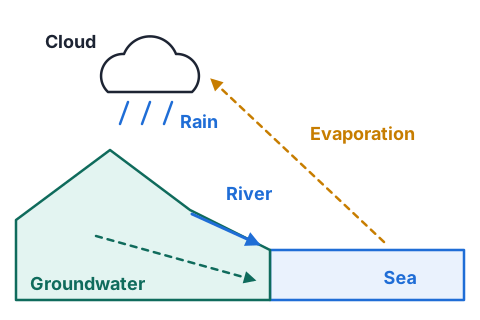
Try it: follow the water cycle
Clouds are a store too
- A cloud is a store of water in the sky.
- Clouds are made of tiny drops of liquid water, or tiny crystals of ice, or both. They are so small and light that air keeps them floating.
- High, wispy clouds are very cold, so they are made of ice crystals.
- When the drops or crystals join together and grow too heavy, they fall as rain, hail or snow.
Water vapour: the water you cannot see
- Water vapour is water as a gas. It is mixed into the air all around you, and it is invisible.
- The white cloud above a boiling jug is not vapour. It is tiny drops of liquid that formed when the vapour cooled.
- You can find the vapour by cooling it. On a humid Auckland day, a cold drink gets wet on the outside because vapour from the air condenses on the cold glass.
Try it: name the change
Most of Earth's water is salty
- Seawater holds a lot of dissolved salt. If you drink it, your body has to use even more water to get rid of the salt, so you end up thirstier.
- This table shows where Earth's water is kept. The oceans hold almost all of it.
- Groundwater is water stored underground, and you will learn more about it in part 2.
| Store | Share of all Earth's water (%) |
|---|---|
| Oceans, seas and bays | 96.54 |
| Ice caps, glaciers and permanent snow | 1.74 |
| Groundwater (fresh and salty) | 1.69 |
| Lakes | 0.013 |
| Air (vapour and clouds) | 0.001 |
Reading water level data
- Room 8 lives on a farming plain. With a farmer's help they measured the water in a bore each month, as metres below the ground, and recorded the rain from a school rain gauge. A bigger number means the water is deeper down. What happened, and why?
| Month | Rain (mm) | Water in the bore (m below ground) |
|---|---|---|
| January | 35 | 9.0 |
| February | 30 | 9.6 |
| March | 40 | 10.1 |
| April | 60 | 10.0 |
| May | 70 | 9.4 |
| June | 80 | 8.6 |
- January to March: little rain, and the water sank from 9.0 m to 10.1 m downfalling
- In summer, farms also pump groundwater out to water their cropspeople take water out
- April to June: more rain soaked in, and the water rose to 8.6 m downrising
- The groundwater fell in the dry summer, when people pumped it out, and rose again with the autumn and winter rain
How much water does a person use?
- Water from your tap is fresh water that has been collected, cleaned and piped to your home.
- Most of a home's water goes on showers, toilets and the washing machine.
- To find where to save water, list each use, work out the litres for each, and look for the biggest.
| What was measured | Result |
|---|---|
| Water a person in Auckland typically uses in a day | 140 to 170 litres |
Where could a family save water?
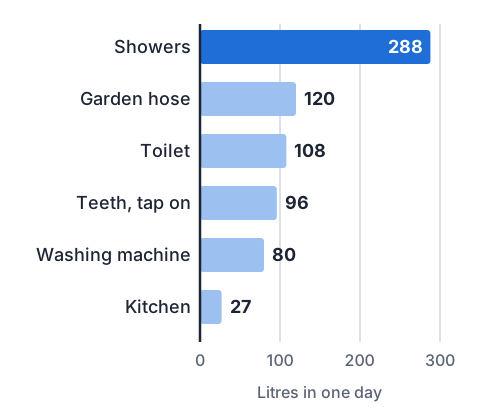
- Aroha in Room 8 kept a water diary for her family of four for one day. How much did each person use, and where could the family save the most?
| Use | How it adds up | Litres |
|---|---|---|
| Showers | 4 showers × 8 minutes × 9 litres a minute | 288 |
| Garden hose | 10 minutes × 12 litres a minute | 120 |
| Toilet | 18 flushes × 6 litres | 108 |
| Tap running while brushing teeth | 8 brushes × 2 minutes × 6 litres a minute | 96 |
| Washing machine | 1 load | 80 |
| Kitchen (cooking, drinking, dishes) | Measured with a jug | 27 |
- 288 + 120 + 108 + 96 + 80 + 27 = 719 litresadd every use
- 719 ÷ 4 ≈ 180 litres eachshare between 4 people
- That is a little more than the 140 to 170 litres Watercare says is typicalcompare
- Showers are the biggest use: 4-minute showers would save 144 litres a dayhalf of 288
- Shorter showers save the most; turning the tap off while brushing saves 96 litres more
Common mistakes
- The white cloud above a boiling jug is water vapour.Water vapour is invisible; the white cloud is tiny drops of liquid that formed when the vapour cooled.
- Clouds are made of water vapour.Clouds are tiny drops of liquid water or ice crystals; the vapour itself cannot be seen.
- Most of Earth's water is fresh, because rivers and lakes are everywhere.About 96.54% of Earth's water is in the oceans, which are too salty to drink.
- In the bore table, 10.1 m means more water than 9.0 m.The numbers are metres below the ground, so 10.1 m means the water is deeper down and the level has fallen.
Catch the invisible water vapour
You need: 2 cups of the same kind, metal or plastic, ice cubes, cold tap water, a tea towel, a clock or timer
- Fill one cup with ice cubes and cold water. Fill the other with tap water only.
- Dry the outside of both cups with the tea towel and stand them side by side.
- Leave them for 10 minutes, then run a finger down the outside of each cup.
- Look for this: the ice cup is wet on the outside and the other is dry. The water did not leak through; it is vapour from the air that turned back into liquid on the cold surface.
Safety: Ask an adult to help, and wipe up drips straight away, because water on a hard floor can make someone slip.
Your turn
A shower uses 9 litres a minute. How much water does a 6-minute shower use?
Someone cuts their shower from 10 minutes to 5 minutes. With 9 litres a minute, how much water do they save each day?
What are clouds made of?
A puddle on the playground is gone by lunchtime. Where did the water go?
Why can't a shipwrecked sailor drink seawater to stay alive?
Show answer
1. 6 × 9 = 54 litres. 2. 5 fewer minutes × 9 = 45 litres. 3. Tiny drops of liquid water or tiny ice crystals, floating in the air. 4. It evaporated: it turned into invisible water vapour in the air. 5. Seawater is too salty; the body uses even more water to get rid of the salt, so the sailor gets thirstier.
Recap
- The hydrosphere is every bit of water lying on Earth's surface.
- Water moves between stores by changing place or changing state.
- Clouds are tiny water drops or ice crystals; water vapour is an invisible gas.
- Almost all of Earth's water is in the oceans and is too salty to drink.
- Data on rain and water levels shows how stores rise and fall, and a water diary shows where a home can save the most.
The maths behind it
Report a mistake
How is Year 6 maths going?
See the Year 6 maths guide