 Vertex Learn
Earth's fresh water: ice, lakes, rivers and groundwater
What this lesson covers
- How small Earth's share of fresh water is
- Fresh water stored as ice, and in lakes and rivers
- Groundwater and aquifers
- Where our tap water comes from
- Showing amounts of water in grids, diagrams and graphs
Fresh water is rare
- Fresh water is water with very little salt in it. After cleaning, people, animals and plants can use it.
- The U.S. Geological Survey, a science agency that studies water, estimates that only 2.5% of Earth's water is fresh. All the rest is salty.
- That means for every 100 buckets of water on Earth, only about two and a half are fresh.
Where the fresh water is kept
- Most fresh water is frozen. A glacier is a huge, slow river of ice that creeps downhill, like the Franz Josef and Fox Glaciers in the Southern Alps. An ice cap is a thick sheet of ice covering land, like the one over Antarctica.
- The next biggest store is underground.
- Lakes and rivers, the fresh water we see most, hold only a tiny share. Lake Taupō is New Zealand's largest lake, and the Waikato River is its longest river.
| Fresh water store | Share of Earth's fresh water (%) |
|---|---|
| Ice caps, glaciers and permanent snow | 68.7 |
| Groundwater | 30.1 |
| Lakes | 0.26 |
| Air | 0.04 |
| Rivers | 0.006 |
Groundwater and aquifers
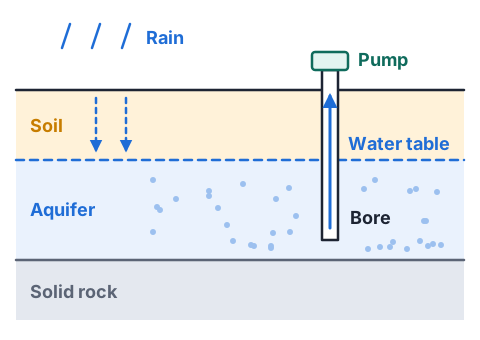
- Groundwater is fresh water stored underground, in the tiny gaps between grains of soil, sand and gravel, and in cracks in rock.
- An aquifer is a layer of rock or gravel that holds groundwater and lets it flow through, a bit like a giant sponge.
- Rain soaks down through the soil until it reaches ground that is already full of water. The top of this wet layer is called the water table.
- People reach groundwater by digging a well or drilling a narrow hole called a bore, then pumping the water up.
Where tap water comes from
- Rivers, lakes and groundwater supply nearly all the water people use. The ice is too far away and too hard to melt.
- Christchurch's tap water is pumped from aquifers deep under the Canterbury Plains.
- Auckland's comes mostly from dams in the Waitākere and Hūnua Ranges, which store rain and stream water in lakes, and from the Waikato River.
- Many farms and small towns have their own bores into the groundwater.
Try it: where is the fresh water?
Showing Earth's water in 100 squares
- Draw all of Earth's water as a grid of 100 squares, so each square stands for 1%. How many squares does each store get?
| Store | Share of all Earth's water (%) |
|---|---|
| Ice caps, glaciers and permanent snow | 1.74 |
| Fresh groundwater | 0.76 |
| Lakes, rivers and air together | less than 0.02 |
| Salty water | the rest |
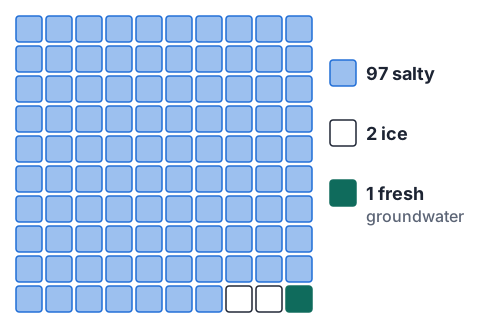
- Ice: 1.74 rounds to 2 squaresround to whole squares
- Fresh groundwater: 0.76 rounds to 1 squareround to whole squares
- Lakes, rivers and air: less than 0.02, so 0 squarestoo small to show
- Salty water: 100 − 2 − 1 = 97 squaresthe rest
- 97 salty squares, 2 ice squares and 1 groundwater square
- Rounding gives fresh water 3 squares, a little more than its real 2.5%
Try it: Earth's water in 100 squares
Other ways to show the amounts
- A bar graph puts each store on its own bar, so you can compare the sizes quickly.
- A pictogram uses a small picture, like a drop, for a set amount of water.
- A scaled model shrinks the real amounts. If all Earth's water fitted in a 1 litre jug, the fresh water would be just 25 mL, about 5 teaspoons.
- A map can show where the water is, such as which regions draw on groundwater.
Common mistakes
- Most fresh water is in lakes and rivers.Most fresh water is frozen as ice, and most of the rest is groundwater; lakes and rivers hold well under 1% of it.
- Groundwater is an underground lake or river.Most groundwater fills the tiny gaps between grains of soil and gravel and the cracks in rock, like water in a sponge.
- With 2.5% fresh water, people can use 2.5% of all Earth's water.Most of that 2.5% is locked in ice far away, so the fresh water people can easily reach is far smaller.
Earth's water in a jug
You need: a 1 litre measuring jug, water, a teaspoon, 2 small cups, a saucer, an ice cube tray, salt
- Fill the jug to 1 litre. This stands for all the water on Earth.
- Take out 5 teaspoons (25 mL) into a cup. This is all the fresh water. Then stir a teaspoon of salt into the jug to make the rest salty, like the sea.
- Put 3 and a half teaspoons of the fresh water into the ice cube tray and freeze it. That is the ice caps and glaciers. The last 1 and a half teaspoons in the cup is groundwater.
- Dip a finger in the groundwater and let 2 or 3 drops fall onto the saucer. That is roughly all the lakes, and all the rivers would be less than one drop.
- Look for this: a full jug of water, but only a few teaspoons of fresh water, and just a few drops in the places people find easiest to reach.
Safety: Ask an adult to help, and do not drink the salty water, because seawater makes you thirstier; wipe up spills so nobody slips.
Your turn
If all of Earth's water was 1000 mL, how much would be fresh water?
Which store holds the most fresh water?
What is an aquifer?
Where does Christchurch get its tap water from?
In a 100-square grid of Earth's fresh water only, about how many squares would groundwater get?
Show answer
1. 2.5% of 1000 mL is 25 mL. 2. Ice caps, glaciers and permanent snow, with 68.7% of it. 3. A layer of rock or gravel that holds groundwater and lets it flow through. 4. From aquifers deep under the Canterbury Plains. 5. Groundwater is 30.1% of fresh water, so about 30 squares.
Recap
- Only about 2.5% of Earth's water is fresh.
- Most fresh water is frozen in ice caps and glaciers; most of the rest is groundwater.
- Lakes and rivers hold only a tiny share, but they are the easiest to reach.
- Groundwater sits in gaps in soil and rock; an aquifer holds it and lets it flow.
- Rivers, lakes and groundwater supply nearly all the water people use.
- Grids, bar graphs, pictograms and scaled models make the amounts easy to compare.
The maths behind it
Report a mistake
How is Year 6 maths going?
See the Year 6 maths guide