 Vertex Learn
Cells: the building blocks of life
What this lesson covers
- How microscopes, and the work of Hooke and van Leeuwenhoek, revealed cells
- Cells are the basic units that all living things are made of
- The main organelles and what each one does
- How plant cells and animal cells compare
- Specialised cells shaped for jobs such as movement or storage
- How cells build tissues, organs and organ systems
- Microorganisms: single-celled life such as bacteria, yeast and some algae
Seeing cells for the first time
- Cells are far too small to see with your eyes alone, so nobody knew they existed until microscopes were invented.
- In 1665 the English scientist Robert Hooke published drawings of a thin slice of cork seen through his microscope. It was full of tiny empty boxes, which he named cells because they reminded him of small rooms.
- In the 1670s the Dutch lens-maker Antonie van Leeuwenhoek built simple microscopes with a single tiny lens that magnified over 200 times.
- He was the first to see living single-celled organisms, which he called animalcules, swimming in pond water and in scrapings from his own teeth, as well as blood cells.
- Later scientists, with better microscopes, showed that every living thing is made of cells and that new cells come only from existing cells.
Using a light microscope
- A school light microscope shines light up through a thin specimen on a glass slide.
- You look through the eyepiece lens, and an objective lens close to the slide makes the image bigger.
- Total magnification = eyepiece magnification × objective magnification.
- Always start with the lowest-power objective, focus with the coarse focus knob, then switch to a higher power and use only the fine focus knob.
Example: working out magnification
- A microscope has a 10× eyepiece and objective lenses of 4×, 10× and 40×. What is the highest total magnification?
- Highest objective = 40×pick the strongest lens
- 10 × 40 = 400eyepiece × objective
- 400×: the image is 400 times wider than the real thing
Try it: change the objective lens
Inside a cell
- A cell is the smallest unit that can carry out all the processes of life. It contains tiny structures called organelles, each with a job.
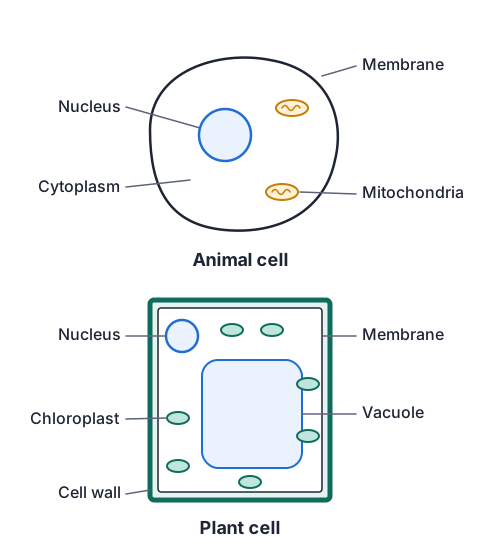
- Every animal and plant cell has a nucleus, cytoplasm, a cell membrane and mitochondria.
- Plant cells also have a cell wall, chloroplasts and usually a large vacuole.
| Part | Job | Animal cell | Plant cell |
|---|---|---|---|
| Nucleus | Holds the instructions (DNA) and controls the cell | Yes | Yes |
| Cytoplasm | Jelly where most chemical reactions happen | Yes | Yes |
| Cell membrane | Thin skin that controls what goes in and out | Yes | Yes |
| Mitochondria | Release energy from food (respiration) | Yes | Yes |
| Cell wall | Stiff outer layer that supports the cell | No | Yes |
| Chloroplasts | Use light to make food (photosynthesis) | No | Yes, in green parts |
| Large vacuole | Stores water and keeps the cell firm | No | Yes |
Example: plant or animal?
- A student draws two cells seen under a microscope. Cell A is a neat rectangle in a row of others, with a thick outline and a large clear space in the middle. Cell B is an irregular rounded shape with a thin outline and no clear space. Which is a plant cell?
- Regular box shape, thick outlinea cell wall gives a fixed shape
- Large clear spacea vacuole
- B: irregular, thin outlineonly a membrane, no wall
- A is a plant cell (like onion skin); B is an animal cell (like a cheek cell)
Try it: animal or plant cell
Specialised cells
- In a living thing made of many cells (a multicellular organism), cells divide the work between them.
- A specialised cell has a shape and set of parts that suit one job.
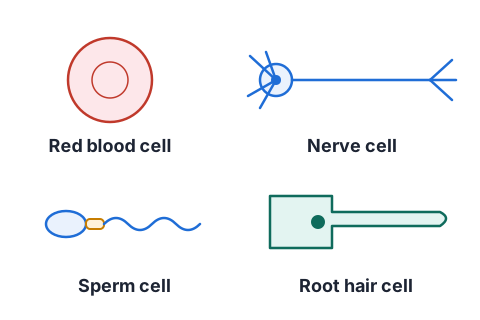
- Some cells are built for movement: a sperm cell swims with its tail, and muscle cells shorten to move bones.
- Some cells are built for storage: potato cells are packed with grains of starch, and fat cells store energy as oil.
- The shape of a cell is often the biggest clue to its job.
| Cell | Special feature | Job |
|---|---|---|
| Red blood cell | Disc shape, no nucleus | Carries oxygen around the body |
| Nerve cell | Very long, with branches | Carries messages quickly |
| Sperm cell | Long tail, lots of mitochondria | Swims to the egg (movement) |
| Root hair cell | Long thin extension | Takes in water from the soil |
| Potato cell | Filled with starch grains | Stores food (storage) |
From cells to systems
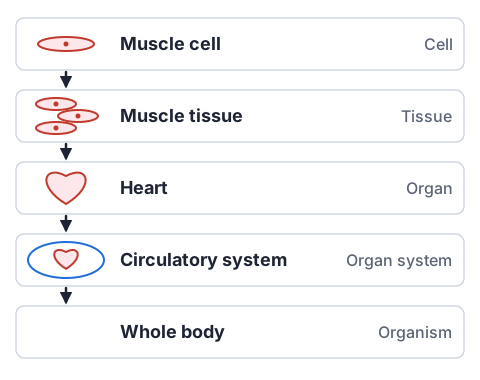
- Similar cells working together form a tissue, such as muscle tissue.
- Several tissues working together form an organ, such as the heart, which has muscle, nerve and lining tissues.
- Organs working together form an organ system, such as the circulatory system (heart, blood vessels and blood).
- Organ systems working together make up a whole organism.
- Plants are organised the same way: leaf cells, leaf tissues, the leaf as an organ, and the shoot system.
Example: putting levels in order
- Put these in order from smallest to largest: stomach, digestive system, stomach lining cell, stomach lining tissue, human.
- Cell: stomach lining cellthe smallest unit
- Tissue: stomach lining tissuemany similar cells
- Organ: stomachseveral tissues together
- Cell, tissue, stomach, digestive system, human
Try it: cell, tissue, organ or system?
Life in a single cell
- Microorganisms (microbes) are living things too small to see without a microscope. Many are made of just one cell, which does every job of life on its own.
- Bacteria are single cells with no nucleus. Some cause disease, but many are helpful, such as the bacteria that turn milk into yoghurt.
- Yeast is a single-celled fungus. Bakers use it to make bread rise, because it gives off carbon dioxide gas.
- Some algae are single cells, floating in ponds and the sea. The tiny algae in the ocean around New Zealand make food by photosynthesis and feed huge food webs.
- Not all fungi and algae are single-celled: a mushroom and a kelp forest are made of many cells.
Common mistakes
- Plant cells have a cell wall instead of a cell membrane.Plant cells have both: the membrane sits just inside the cell wall.
- Every plant cell has chloroplasts.Only cells in the green parts have chloroplasts; root cells, for example, have none.
- An organ is made of just one kind of cell.An organ is made of several tissues, such as the muscle, nerve and lining tissues in the heart.
- Magnification is eyepiece plus objective, so 10× and 40× gives 50×.Multiply the two: 10 × 40 = 400×.
Wake up some yeast
You need: 1 teaspoon of dried yeast, 2 teaspoons of sugar, warm tap water, a small plastic drink bottle, a balloon, a funnel or rolled-up paper
- Fill the bottle about a quarter full with warm (not hot) tap water.
- Use the funnel to add the sugar and the yeast, then swirl gently to mix.
- Stretch the balloon over the neck of the bottle and stand it somewhere warm.
- Check it every 10 minutes for half an hour and note any bubbles, froth and the size of the balloon.
- Look for the pattern: the mixture froths and the balloon slowly fills, because millions of single yeast cells are alive, feeding on the sugar and giving off carbon dioxide gas.
Safety: Use warm tap water only, ask an adult before using the kitchen, and do not drink the mixture; pour it down the sink when you finish.
Your turn
Which organelle controls the cell and holds its instructions?
Name two parts found in plant cells but not animal cells.
A microscope has a 10× eyepiece and a 10× objective. What is the total magnification?
Is the lung a cell, a tissue, an organ or an organ system?
A cell has a long tail and many mitochondria. What is it specialised for?
Show answer
1. The nucleus. 2. Any two of: cell wall, chloroplasts, large vacuole. 3. 10 × 10 = 100×. 4. An organ, because it is made of several tissues working together. 5. Movement: the tail swims and the mitochondria release the energy it needs, as in a sperm cell.
Recap
- Microscopes revealed cells: Hooke named them, and van Leeuwenhoek first saw living single-celled organisms.
- Cells are the basic units of life, with organelles that each do a job.
- Plant and animal cells share a nucleus, cytoplasm, membrane and mitochondria; plant cells also have a wall, chloroplasts and a large vacuole.
- Specialised cells have shapes that suit jobs such as movement or storage.
- Cells form tissues, tissues form organs, and organs form organ systems.
- Microorganisms such as bacteria, yeast and some algae are made of just one cell.
The maths behind it
Report a mistake
How is Year 7 maths going?
See the Year 7 maths guide