 Vertex Learn
Populations, communities and ecosystems
What this lesson covers
- A population: one kind of organism living in one place at one time
- A community: all the populations in a place, interacting with each other
- An ecosystem: the community together with the non-living parts of its environment
- Biotic (living) and abiotic (non-living) factors
- Producers, consumers and decomposers, and how food webs show who eats whom
- Patterns in how many organisms fill each role
- How species depend on one another, from pollinators to shelter
From one organism to an ecosystem
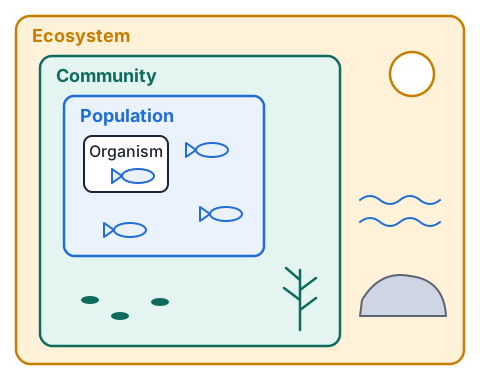
- An organism is a single living thing, such as one banded kōkopu (a native fish) in a stream.
- A population is all the members of one species found in one area during one period: all the banded kōkopu in that stream this year.
- A community is all the different populations living in that place and interacting: the kōkopu, mayfly larvae, koura (freshwater crayfish), ferns on the bank, algae on the rocks and many more.
- An ecosystem is the community plus the non-living parts of the environment it interacts with: the water, rocks, soil, air, sunlight and temperature.
Populations change
- A population always has a time and a place attached. The tūī in a city park this summer is one population; the tūī in another park is a different one.
- Populations grow when births and arrivals outnumber deaths and departures, and shrink the other way.
- Scientists track populations by counting or estimating them, for example in bird counts or by checking tracking tunnels for footprints.
Living and non-living parts
- Biotic factors are the living parts of an ecosystem, and the effects living things have on each other: food, predators, competitors, disease.
- Abiotic factors are the non-living parts: water, temperature, light, soil, rock, air and salt.
- Both kinds affect which organisms can live there. Kōkopu need cool, clear, well-oxygenated water, and shade from bank plants keeps the water cool.
| Bush stream | Examples |
|---|---|
| Biotic | Kōkopu, koura, mayfly larvae, algae, ferns, fungi, bacteria |
| Abiotic | Water flow, water temperature, sunlight, rocks, oxygen in the water |
Example: biotic or abiotic?
- Sort these parts of a rocky shore ecosystem: seaweed, waves, a sea star, sand, a fungus on driftwood, salt in the water, sunlight, a gull.
- Living, or made by something living now?the test to apply
- Biotic: seaweed, sea star, fungus, gullall living things
- Abiotic: waves, sand, salt, sunlightnone are alive
- Biotic: seaweed, sea star, fungus, gull; abiotic: waves, sand, salt, sunlight
Try it: biotic or abiotic?
Roles in an ecosystem
- Producers make their own food from sunlight by photosynthesis. Plants and algae are producers.
- Consumers eat other organisms. Herbivores eat producers; carnivores eat other animals; omnivores eat both.
- A top predator is a carnivore that nothing else in the web normally eats.
- Decomposers, such as fungi, bacteria and many worms, break down dead organisms and waste and return nutrients to the soil or water for producers to use again.
Try it: what role does it play?
Reading a food web
- A food chain shows one line of feeding. A food web joins many food chains together.
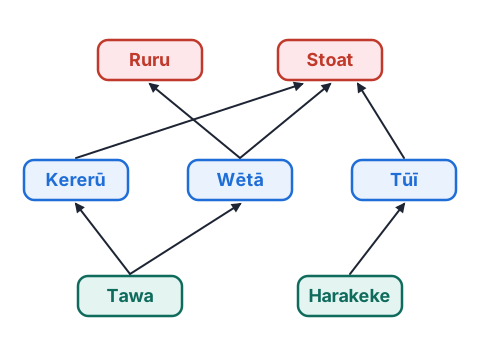
- Each arrow points from the food to the organism that eats it, so arrows show the direction energy moves.
- In this bush food web, tawa and harakeke are producers. Kererū eat tawa fruit, wētā eat leaves, and tūī drink harakeke nectar.
- Ruru (moreporks) eat wētā. Stoats, a pest brought to New Zealand, eat wētā, birds and eggs.
- Decomposers are not usually drawn, but they feed on every organism in the web once it dies.
Try it: a forest food web
Example: counting the roles
- A Year 7 class in Tauranga counted the organisms in four 1 m² squares of their school garden and sorted them by role.
- What pattern do the totals show, and why might it happen?
| Role | Organisms found | Total |
|---|---|---|
| Producers | Grass plants, clover, dandelions | 184 |
| Herbivores | Aphids, snails, slugs, caterpillars | 63 |
| Carnivores | Spiders, ladybirds, centipedes | 11 |
- 184 > 63 > 11compare the totals
- 63 ÷ 184 ≈ 0.34; 11 ÷ 63 ≈ 0.17each level is a fraction of the one below
- Each animal eats many organisms below it, and energy is used up at every stepa likely reason
- Numbers fall at each step up: most producers, fewer herbivores, fewest carnivores
- Food webs from other places show the same pattern: few top predators, many producers
Species depend on each other
- Interdependence means species in an ecosystem rely on each other, so a change to one affects others.
- Food: every consumer depends on what it eats, and in the end on producers.
- Pollination: many native flowers, including harakeke and kōwhai, are pollinated by nectar-feeding birds such as tūī and korimako (bellbirds), which carry pollen from flower to flower.
- Seed dispersal: kererū swallow large fruit and drop the seeds far away, helping trees such as tawa and taraire spread.
- Shelter: tree wētā hide in holes in tree trunks by day, and many insects live in leaf litter under the trees.
Example: when a species disappears
- Use the bush food web. Suppose trapping removes all the stoats from a reserve. Predict what happens to the wētā, the tūī and the harakeke.
- Stoats eat wētā, tūī and kererūfrom the arrows
- No stoats: more wētā, tūī and kererū surviveless predation
- More tūī: more harakeke flowers pollinatedtūī carry pollen
- Wētā, tūī and kererū increase, and harakeke may set more seed
- More wētā could also mean more food for ruru, so ruru may increase too
Common mistakes
- In a food web, the arrow points from the eater to its food.The arrow points from the food to the eater, showing the way energy flows.
- A population is all the animals living in an area.A population is just one species; all the species together make a community.
- An ecosystem is only the living things in a place.An ecosystem includes the non-living parts too, such as water, soil, light and temperature.
- Removing a predator only affects the animals it eats.The change spreads through the web, reaching plants, other predators and the species that depend on them.
Survey a square of garden
You need: 4 sticks or pegs, string about 4 m long, a ruler or tape measure, a magnifying glass if you have one, a notebook and pencil
- Mark out a 1 m by 1 m square on a lawn or garden bed with the pegs and string.
- Count or estimate the plants in your square, and write down any animals you find, gently lifting leaves and looking under stones.
- Sort what you found into producers, herbivores, carnivores and decomposers (such as fungi or worms).
- Note the abiotic factors too: is the soil wet or dry, is the square sunny or shady, and how warm is it?
- Look for the pattern: you will almost always find far more producers than herbivores, and fewest carnivores.
Safety: Ask an adult where you may survey, wash your hands afterwards, and do not pick up spiders, bees or wasps; put any stones back where they were.
Your turn
All the pōhutukawa trees on one headland this year form a what?
Is the temperature of a rock pool a biotic or an abiotic factor?
In the bush food web, name one producer and one top predator.
Which way does an arrow point in a food web: from the food or from the eater?
Fungi on a fallen log break it down. What role do the fungi have, and why does the ecosystem need them?
Show answer
1. A population, because it is one species in one place at one time. 2. Abiotic, because temperature is not living. 3. Producer: tawa or harakeke; top predator: the stoat or the ruru, since nothing in the web eats them. 4. From the food to the eater. 5. They are decomposers; they return nutrients from dead material to the soil so producers can use them again.
Recap
- A population is one species in one place at one time; a community is all the populations there, interacting.
- An ecosystem is a community together with the non-living parts of its environment.
- Biotic factors are living; abiotic factors are non-living, such as water, light and temperature.
- Producers, consumers and decomposers each have a role, and food web arrows point from food to eater.
- Surveys and food webs show a pattern: many producers, fewer herbivores, and fewest predators.
- Species depend on each other for food, pollination, seed dispersal and shelter.
The maths behind it
Report a mistake
How is Year 7 maths going?
See the Year 7 maths guide