 Vertex Learn
Survival adaptations: how living things fit their environment
What this lesson covers
- An adaptation is a feature that helps a living thing survive and reproduce where it lives
- Structural, behavioural and physiological adaptations
- Adaptations for getting food and water, avoiding danger, and reproducing
- Matching adaptations to environments, with their advantages and limits
- Individuals in a species vary, and some variations suit the environment better
- Adaptations improve the odds of survival but never guarantee it
- Lamarck's idea that acquired features are inherited, and why it was rejected
What an adaptation is
- An adaptation is a feature of a living thing that helps it survive and reproduce in its environment.
- Every organism needs to get resources (food, water, light, shelter), avoid hazards (predators, cold, drought) and reproduce.
- Adaptations are inherited: they are passed from parents to young, not learned or grown during one lifetime.
- An organism's adaptations suit the place it lives. A feature that is useful in one habitat may be useless, or even a problem, in another.
Three kinds of adaptation
- Structural adaptations are physical features of the body: its shape, size, colour or covering.
- Behavioural adaptations are things an organism does: the way it acts.
- Physiological adaptations are processes inside the body: chemistry you cannot see from the outside.
| Type | Example | How it helps |
|---|---|---|
| Structural | Kiwi's long beak with nostrils at the tip | Smells and probes for worms underground |
| Structural | Tūī's brush-tipped tongue | Mops up nectar from flowers |
| Behavioural | Kororā (little penguins) come ashore after dark | Fewer predators see them |
| Behavioural | Emperor penguins huddle in winter | Share warmth and lose less heat |
| Physiological | Mountain stone wētā survive being frozen | Live through alpine winters |
Try it: what kind of adaptation?
Getting resources, avoiding danger, reproducing
- Getting resources: plant roots spread wide or deep to reach water, and leaves turn towards light.
- Avoiding hazards: stick insects look like twigs (camouflage), ongaonga (tree nettle) is covered in stinging hairs, and many animals freeze or flee when a predator is near.
- Reproducing: male kākāpō make deep booming calls to attract females, kererū swallow large fruit and spread the seeds of trees such as taraire and tawa, and a kiwi father sits on the egg until it hatches.
Example: reading beak shapes
- A beak is a tool, and its shape fits the bird's food. Match each beak to a way of feeding: probing soil, sipping nectar, or digging and tearing.
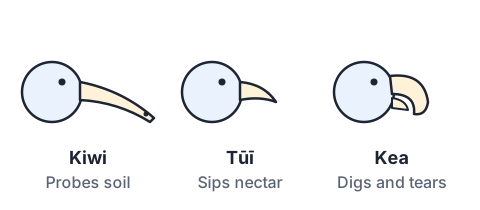
- Kiwi: long, thin, nostrils at the tipreaches deep into soil and smells prey
- Tūī: short, curved, with a brush tonguefits into flowers such as harakeke
- Kea: thick and hookedstrong enough to dig roots and rip food apart
- Kiwi probes soil, tūī sips nectar, kea digs and tears
Suited to a place
- Ducks such as pāteke (brown teal) have webbed feet that push against water like paddles, so they swim well. On land they waddle.
- Kiwi lost the ability to fly while living in forests with no ground-hunting mammals. Running, burrowing and a strong sense of smell suited that world.
- When people brought stoats, cats and dogs to New Zealand, that same ground-living life became a weakness, and kiwi numbers fell sharply.
- So an adaptation is only good or bad compared with a particular environment.
Example: advantages and limits
- For each adaptation, say when it helps and when it becomes a problem.
| Adaptation | Helps when | Problem when |
|---|---|---|
| Thick fur and blubber of kekeno (fur seals) | Swimming in cold sea | Lying on hot rocks in summer: risk of overheating |
| Webbed feet of ducks | Swimming and paddling | Walking or running fast on land |
| Flightlessness of kiwi | Saves energy where no predators hunt on the ground | Stoats and dogs arrive |
- Each feature suits one set of conditionscompare the columns
- Change the conditions and the same feature can hurtthe right-hand column
- Every adaptation has advantages and limits, depending on the environment
No two individuals are the same
- Members of the same species are not identical. They differ in size, colour, speed, thickness of fur and many other traits. This is called variation.
- Much of this variation is inherited from parents.
- In a particular environment, some variations work better than others. A slightly darker snail may be harder for a bird to spot on dark soil.
- Individuals with better-suited traits tend to survive longer and have more young, and those young can inherit the useful trait.
Camouflage depends on the background
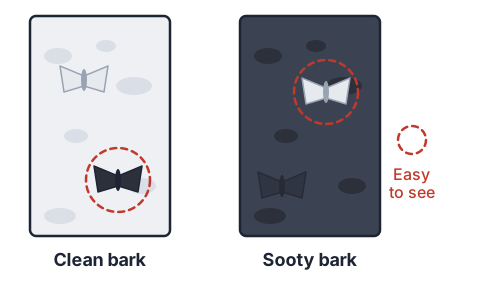
- Peppered moths in England come in pale and dark forms. They rest on tree trunks by day, where birds hunt them.
- On pale, lichen-covered bark the pale moths were hard to see, and the dark moths were eaten more often.
- In the 1800s, factory soot blackened the trees around industrial cities. There, the dark moths were hidden and became common, while the pale ones were picked off.
- When the air was cleaned up, the bark lightened again and the pale form became common once more. The same colour helped in one place and harmed in another.
Example: a camouflage hunt
- A Year 7 class scattered 20 green and 20 red toothpicks over a patch of school lawn. Students playing birds had 2 minutes to pick up as many as they could.
- Use the results to work out what percentage of each colour survived, and explain the difference.
| Colour | Scattered | Found by birds | Survived |
|---|---|---|---|
| Green | 20 | 4 | 16 |
| Red | 20 | 17 | 3 |
- Green: 16 ÷ 20 × 100 = 80% survivedsurvivors out of the total
- Red: 3 ÷ 20 × 100 = 15% survivedsame method
- Green blends into grass; red stands outthe background matters
- 80% of green survived but only 15% of red, because green is camouflaged on a lawn
- On a red brick path the result would likely reverse, so repeat on a second background to test this
Try it: toothpicks left on the lawn
Better odds, not a guarantee
- An adaptation raises the chance that an individual survives and reproduces. It cannot make survival certain.
- Even well-camouflaged moths were sometimes eaten, and some badly hidden ones lived; the difference showed up across many moths.
- A storm, a disease or a new predator can kill well-adapted individuals too.
- What matters over generations is that, on average, better-suited individuals leave more young.
Lamarck's idea, and why it failed
- In the early 1800s the French naturalist Jean-Baptiste Lamarck suggested that features an animal gains during its life are passed to its young.
- His famous example: giraffes stretched their necks to reach high leaves, their necks grew a little longer, and their calves were born with longer necks.
- Evidence did not support this. A weightlifter's big muscles are not passed to their children, and in the 1880s August Weismann cut the tails off mice for several generations, yet every new generation was born with normal tails.
- Scientists now explain adaptation by variation and inheritance instead: giraffes that happened to be born with longer necks reached more food, survived better and passed on that trait.
Common mistakes
- An animal grows an adaptation because it needs it.Adaptations are inherited traits; individuals that already have a useful trait survive and pass it on.
- An adaptation means the animal will always survive.An adaptation only improves the chances of surviving and reproducing; it is never a guarantee.
- Penguins huddling is a structural adaptation.Huddling is something penguins do, so it is behavioural; structural means a body feature.
- A good adaptation works in any environment.How well an adaptation works depends on the conditions, as camouflage shows on different backgrounds.
Hunt for camouflaged prey
You need: 20 small squares of green paper, 20 small squares of brightly coloured paper, scissors, a patch of lawn or garden, a timer or phone, a helper
- Cut 40 small squares about 2 cm wide, 20 green and 20 of a bright colour such as red or yellow.
- While the hunter looks away, scatter all 40 squares over a patch of lawn about 2 m by 2 m.
- The hunter has 30 seconds to pick up as many squares as they can, one at a time.
- Count how many of each colour were found and how many survived, then swap roles and repeat.
- Look for the pattern: more green squares should survive on grass, because they are camouflaged against it.
Safety: Ask an adult to help with the scissors, check the lawn first for anything sharp or for bees on flowers, and pick up every paper square afterwards.
Your turn
Is a kiwi's long beak a structural, behavioural or physiological adaptation?
Hedgehogs roll into a ball of spines when threatened. Is this adaptation for getting resources, avoiding hazards or reproducing?
A white rabbit lives on a snowy hillside. The snow melts and leaves brown grass and rock. What happens to its chances of survival, and why?
In a camouflage hunt, 10 of 25 brown beads survived on a lawn. What percentage survived?
A student says that because a bodybuilder lifts weights, their baby will be born strong. Whose idea is this, and why is it wrong?
Show answer
1. Structural, because it is a body feature. 2. Avoiding hazards. 3. Its chances fall, because it now stands out against the brown background and predators spot it more easily. 4. 10 ÷ 25 × 100 = 40%. 5. Lamarck's idea that acquired traits are inherited; muscles built during a lifetime are not passed on to children.
Natural Selection
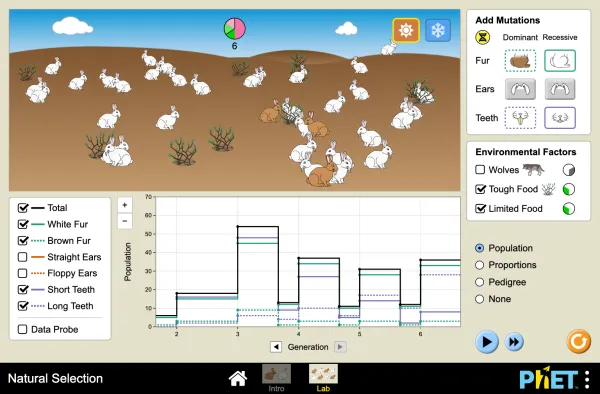
Full screen · PhET Interactive Simulations, University of Colorado Boulder, CC BY 4.0
Recap
- Adaptations are inherited features that help organisms get resources, avoid hazards and reproduce.
- They can be structural (body features), behavioural (actions) or physiological (body processes).
- Each adaptation suits particular conditions and has limits in others.
- Individuals in a species vary, and better-suited individuals tend to survive and breed more.
- Adaptations raise the odds of survival but never guarantee it.
- Lamarck thought acquired traits were inherited; evidence showed they are not.
The maths behind it
Report a mistake
How is Year 7 maths going?
See the Year 7 maths guide