Multiplying and dividing bigger numbers
What this lesson covers
- Division may result in a whole number quotient or a quotient with a remainder, represented as a whole number.
- Division can be represented as grouping, sharing, or an area model and larger numbers can be divided using a standard written algorithm, where appropriate.
- Standard written algorithms for multiplication and division rely on place value, regrouping, and renaming.
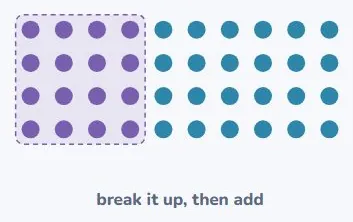
Every big one is small ones added up
- 243 × 4 looks like a new kind of problem.
- It is three small multiplications, then an addition.
- That is the whole idea, and it works for division too.
The tables are the toolkit
- Everything here assumes the tables from 2 to 12.
- A video cannot make you memorise them. Practice can.
- Every minute spent on them is repaid in every lesson after.
| worth knowing cold | why |
|---|---|
| 2s, 5s, 10s | they appear in everything |
| 3s, 4s, 6s | they carry most word problems |
| 7s, 8s, 12s | the ones people skip |
One fact gives you many
- You know 6 × 4 = 24. That reaches further than it looks.
- 6 × 40 is ten times bigger, so 240.
- And 24 ÷ 6 = 4 is the same fact read backwards.
| from | you get | how |
|---|---|---|
| 6 × 4 = 24 | 6 × 40 = 240 | ten times bigger |
| 6 × 4 = 24 | 6 × 8 = 48 | double it |
| 6 × 4 = 24 | 24 ÷ 6 = 4 | the same fact backwards |
Factor pairs make hard ones easy
- 15 × 12 is awkward straight off.
- 12 is 4 × 3, so multiply by 4, then by 3.
- 15 × 4 = 60, and 60 × 3 = 180.
| step | running total |
|---|---|
| start | 15 |
| × 4 | 60 |
| × 3 | 180 |
Three digits by one digit
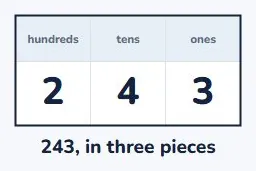
- 243 × 4. Split 243 by place value.
- 200, then 40, then 3.
- Multiply each by 4 and add the three answers.
Work it and add it
- 200 × 4 = 800. 40 × 4 = 160. 3 × 4 = 12.
- 800 + 160 + 12 = 972.
- Every step used a fact you already knew.
| part | value |
|---|---|
| 200 × 4 | 800 |
| 40 × 4 | 160 |
| 3 × 4 | 12 |
| add them | 972 |
Two digits by two digits
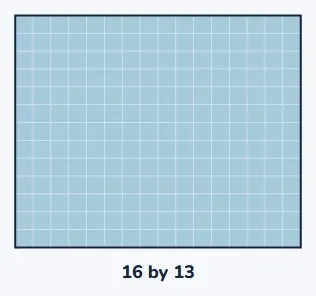
- 16 × 13. Now both numbers split.
- Draw it as a rectangle 16 wide and 13 tall.
- Cut it into four smaller rectangles.
Four pieces, then add
- 10 × 10 = 100. 10 × 3 = 30.
- 6 × 10 = 60. 6 × 3 = 18.
- 100 + 30 + 60 + 18 = 208.
| piece | value |
|---|---|
| 10 × 10 | 100 |
| 10 × 3 | 30 |
| 6 × 10 | 60 |
| 6 × 3 | 18 |
| add them | 208 |
Division is sharing or grouping
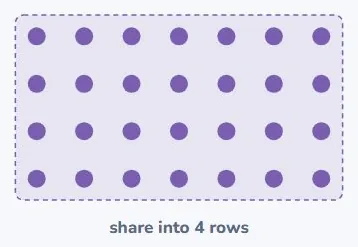
- 278 ÷ 4 can be read two ways.
- Share 278 between 4, or make groups of 4 from 278.
- Both give the same answer, and both may leave something over.
Work down the places
- 2 hundreds shared by 4 will not give a whole hundred.
- So carry them: 27 tens shared by 4 is 6 tens, 3 tens over.
- 38 ones shared by 4 is 9, with 2 left. So 69 remainder 2.
| place | share by 4 | carry |
|---|---|---|
| 2 hundreds | 0 | 2 hundreds |
| 27 tens | 6 tens | 3 tens |
| 38 ones | 9 ones | 2 left |
The remainder is a whole number
- The 2 left over is written as a whole number, not a fraction.
- Sometimes it matters: 278 people, 4 to a van, needs 70 vans.
- The maths says 69 and a bit. The situation says round up.
| question | answer |
|---|---|
| 278 ÷ 4 | 69 remainder 2 |
| vans needed | 70 |
| full vans | 69 |
Multiply back to check
- 69 × 4 = 276, and 276 + 2 = 278.
- Quotient times divisor, plus remainder, gives you back the start.
- If it does not, something slipped a place.
| check | result |
|---|---|
| 69 × 4 | 276 |
| + remainder 2 | 278 |
| matches? | yes |
Your turn
- 1. Use 8 × 3 = 24 to work out 8 × 30 and 8 × 6.
- 2. 316 × 5, by splitting 316 into places.
- 3. 32 × 14, using four pieces.
- 4. 195 ÷ 6, and check it by multiplying back.
Show answer
1. 240 and 48. 2. 1,500 + 50 + 30 = 1,580. 3. 300 + 120 + 20 + 8 = 448. 4. 32 remainder 3, and 32 × 6 = 192, plus 3 is 195.
What to take away
- Split by place value, multiply the pieces, add them up.
- A division may leave a remainder, written as a whole number.
- Multiply back, add the remainder, and you should be home.
| problem | answer |
|---|---|
| 243 × 4 | 972 |
| 16 × 13 | 208 |
| 278 ÷ 4 | 69 r 2 |
Is your child on track?
Take the free placement test