Fractions, decimals and percentages
What this lesson covers
- A fraction can describe a proportional relationship between two amounts.
- Every fraction can be represented by an infinite set of equivalent fractions that occupy the same point on the number line.
- Fractions can be converted to decimals using division, and the result can be a terminating decimal or a recurring decimal.
A half plus a third is not two fifths
- Adding the tops and the bottoms feels right.
- But two fifths is less than a half.
- We just added something to a half. It cannot shrink.
What a fraction is
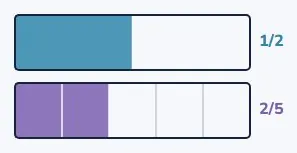
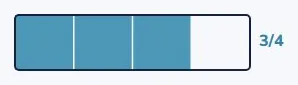
- Three quarters means three out of every four.
- It compares two amounts, not one.
- So it works on 4, on 40, on anything.
Same amount, different cuts
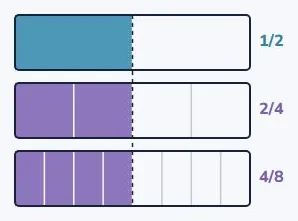
- One half. Two quarters. Four eighths.
- Cut it finer and take more pieces.
- The shaded width never changes.
They are the same number
- Not just the same amount: the same point.
- One place on the line, several names.
- 0.5 and 50% are two more names for it.
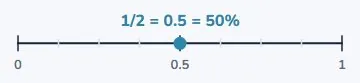
Four names, one number
- A fraction. An equivalent fraction. A decimal.
- A percentage. All the same value.
- You pick whichever suits the question.
| Form | Written |
|---|---|
| Fraction | 1/2 |
| Equivalent | 2/4, 5/10, 50/100 |
| Decimal | 0.5 |
| Percentage | 50% |
Making an equivalent fraction
- Multiply the top and the bottom by the same number.
- Both, or the value changes.
- There are infinitely many of them.
| From | Do this | Get |
|---|---|---|
| 1/2 | × 2 top and bottom | 2/4 |
| 1/2 | × 5 top and bottom | 5/10 |
| 1/2 | × 50 top and bottom | 50/100 |
Simplest form: 18/24
- Go the other way: divide instead.
- The HCF of 18 and 24 is 6.
- 18 ÷ 6 = 3 and 24 ÷ 6 = 4, so it is 3/4.
| Step | Working | Result |
|---|---|---|
| 18/24 | HCF of 18 and 24 is 6 | |
| ÷ 6 | 18 ÷ 6 = 3, 24 ÷ 6 = 4 | 3/4 |
| Check | 3 and 4 share nothing | done |
Fraction to decimal: just divide
- The line in a fraction means divide.
- 5/16 means 5 ÷ 16.
- Which is 0.3125, and it stops there.
| Fraction | Divide | Decimal |
|---|---|---|
| 5/16 | 5 ÷ 16 | 0.3125 (stops) |
| 7/8 | 7 ÷ 8 | 0.875 (stops) |
Sometimes it does not stop
- 1 ÷ 3 gives 0.333 and it keeps going.
- 2 ÷ 11 gives 0.1818, repeating forever.
- That is normal. The division still worked.
| Fraction | Divide | Decimal |
|---|---|---|
| 5/16 | 5 ÷ 16 | 0.3125 (stops) |
| 7/8 | 7 ÷ 8 | 0.875 (stops) |
| 1/3 | 1 ÷ 3 | 0.333... (never stops) |
| 2/11 | 2 ÷ 11 | 0.1818... (repeats) |
Percent means out of a hundred
- 50% is 50 hundredths, which is 0.5.
- The % sign is shorthand for "out of 100".
- So a percentage is just a decimal in disguise.
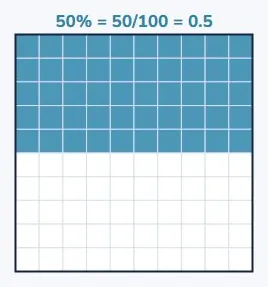
The ones worth knowing cold
- These five come up constantly.
- Knowing them saves working every time.
- And a third is the only messy one.
| Fraction | Decimal | Percentage |
|---|---|---|
| 1/2 | 0.5 | 50% |
| 1/4 | 0.25 | 25% |
| 3/4 | 0.75 | 75% |
| 1/5 | 0.2 | 20% |
| 1/3 | 0.333... | 33.3% |
Which is bigger: 3/5 or 0.62?
- You cannot compare different forms directly.
- Turn them all into decimals first.
- 3 ÷ 5 = 0.6, so 0.62 is bigger.
| Value | Working | As a decimal |
|---|---|---|
| 3/5 | 3 ÷ 5 | 0.6 |
| 0.62 | already a decimal | 0.62 |
| Bigger | 0.62 | so 0.62 wins |
Why you cannot just add the tops
- Halves and thirds are different sized pieces.
- You cannot count them together.
- Cut them both into the same size first.
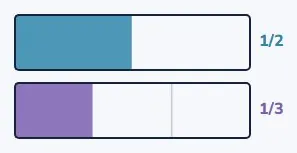
1/2 + 1/3 in sixths
- Sixths work for both: 2 and 3 both go into 6.
- A half is 3 sixths. A third is 2 sixths.
- 3 + 2 = 5 sixths.
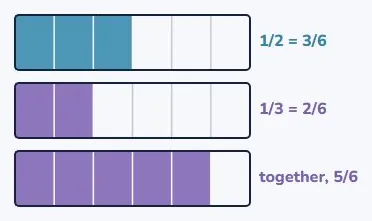
The same thing written down
- Find a denominator both go into.
- Rewrite each fraction with it.
- Add the tops. Leave the bottom alone.
| Fraction | Step | Becomes |
|---|---|---|
| 1/2 | becomes | 3/6 |
| 1/3 | becomes | 2/6 |
| Add the pieces | 3 + 2 = 5 | 5/6 |
Mixed numbers: 2 1/4 + 1 5/6
- Turn both into improper fractions first.
- Twelfths: 27/12 + 22/12 = 49/12.
- 49 ÷ 12 is 4 remainder 1, so 4 and 1/12.
| Step | Working | Result |
|---|---|---|
| 2 1/4 | as an improper fraction | 9/4 |
| 1 5/6 | as an improper fraction | 11/6 |
| Twelfths | 27/12 + 22/12 | 49/12 |
| Back to mixed | 49 ÷ 12 = 4 r 1 | 4 1/12 |
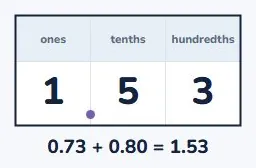
Adding decimals
- Much easier: the pieces already match.
- Line up the decimal points, not the last digits.
- 0.73 + 0.80 = 1.53.
Your turn: four questions
- Pause here and try all four.
- For question 3, find a denominator both go into.
- For question 4, turn the fraction into a decimal.
| Question | |
|---|---|
| 1 | Write 18/24 in its simplest form. |
| 2 | Convert 7/8 to a decimal. |
| 3 | Work out 2/3 + 1/4. |
| 4 | Which is bigger: 5/8 or 0.6? |
Show answer
1. 3/4. The HCF of 18 and 24 is 6, so divide both by 6. 2. 0.875, from 7 ÷ 8. 3. 11/12. Twelfths: 8/12 + 3/12. It is already in simplest form. 4. 5/8, because 5 ÷ 8 = 0.625, which is more than 0.6.
The answers
- 18/24 simplifies to 3/4. And 7 ÷ 8 = 0.875.
- 2/3 + 1/4 in twelfths is 8/12 + 3/12 = 11/12.
- 5/8 is 0.625, so it beats 0.6.
| Answer | |
|---|---|
| 1 | 3/4 |
| 2 | 0.875 |
| 3 | 11/12 |
| 4 | 5/8, since it is 0.625 |
What to take away
- Equivalent fractions are one point on the line.
- To add, cut both into the same size pieces first.
- Never add the tops and the bottoms.
| Remember | |
|---|---|
| Equivalent fractions | the same point on the line |
| To simplify | divide top and bottom by their HCF |
| To decimalise | divide the top by the bottom |
| To add | cut both into the same size pieces first |
| Never | add the tops and add the bottoms |
Is your child on track?
Take the free placement test